Ancient America

Reclaiming Native History

“As with all historical events, it is a fool’s errand to judge it by contemporary standards.” – Michael Walsh

Far too often, historians, or those who pretend to be historians, try to understand history through modern eyes. Sometimes this is unintentional, but often in our era, it is purposeful revisionism driven by narratives and personal beliefs rather than a desire to understand the past.

One of the most interesting trends in history has been the changes in studies of Native American history. It is one of many historical subjects that have been battered by changing narratives and people with little regard for truth. This, though, is changing.

For many years, academia tended to paint Native Americans as helpless victims, wiped out by ruthless Europeans. Kathleen DuVal, in Native Nations, writes, “More recent U.S. history textbooks provide more coverage and rightly condemn the violence…but tend to emphasize victimization and decline.” Duval shows how influential writings on native history by Howard Zinn, Dee Brown, Jared Diamond, and Charles Mann enforced this idea that “Europeans dominated North America virtually from the moment they arrived here” and the natives were “helpless victims.” Even now, education still often portrays American Indians as peoples from the past, as if they no longer exist, and “overemphasize the periods of catastrophe” like the Cherokee Trail of Tears or the Wounded Knee Massacre.

This narrative has begun to crumble, a change often driven from natives themselves. They weren’t wiped out, and scholars trying to do native history justice, often have done the opposite with unsupported death, disease, and population numbers. Now, historians are recognizing, as Pekka Hämäläinen writes in Indigenous Continent, this was “a four-centuries-long war” and “Indians won as often as not.” While there “were colonists who utterly despised Indians and wanted to eradicate them” there were many who “sought to embrace them.”

Natives prospered from trade and contact, and sought out such activities. They suffered as well in this classic clash of different civilizations, not unlike what had played out thousands of times in history. However, they weren’t clueless, innocent hippies wandering through the woods, hugging trees. They weren’t much different from the Europeans, both good and bad. War, slavery, and torture were not uncommon.

There is a lot of overlap in DuVal and Hämäläinen’s books, and they are excellent histories of native history after contact. There are times where both authors seem to have trouble letting go of the very inaccurate histories they are trying to correct. DuVal likes to often remind readers the Europeans were white, not understanding ideas of racism weren’t the same as modern ones. For example, racist beliefs directed from one white European group to another were common well into the 20th Century. Nor did all Europeans base their perceptions of the natives based solely on skin color. Both authors talk about colonialism like it was a new invention in the Americas, as if this wasn’t a driving force in civilization’s expansion and growth since mankind began. These and some other points are artifacts of interjecting modernity into the past.

This why I think Jeff Fynn-Paul’s book, Not Stolen, adds good balance to these other studies. Fynn-Paul doesn’t obscure the bad events on the continent between natives and the newcomers, but he shows there was often more to the story. For example, the tragic Cherokee Trail of Tears was not something that went unnoticed at the time, nor was it widely supported. Quite the opposite, it was very controversial with the public, and the president was acting against a ruling of the Supreme Court. The point being, there wasn’t a widespread conspiracy to wipe out the natives. While DuVal and Hämäläinen sometimes throw around the word genocide, the individuals who were for such things didn’t have broad support for the total destruction of native nations.

Admittedly, trying to formulate a balanced history of such a complex era of the past, involving so many people, is no easy task. No one person can survey and collate every available source. We should all strive to examine a broad variety of sources on every subject we study, and do so with an open mind. As Fynn-Paul writes:

An ideal historian will look dispassionately at the evidence, the sources, and the probable facts of a case, and write a narrative interpretation based on reason, logic, and a well-honed sense of judgment. Personnel preference – including political opinions – is supposed to be relegated to secondary status.

Categories: Ancient America, History, Native Americans | Tags: , , , , , , , | 1 Comment

History of a Cursed Island

Fan of the show The Curse of Oak Island? Randall Sullivan has released the definitive history of the island spanning from the original discovery of the “Money Pit,” to the latest efforts on the television show. Even if you watch the show, you know only a fraction of the island’s history. Sullivan explores the decades of digs, and the endless theories of who visited the island, including many fanciful tales whipped up in fertile imaginations. However, the island sits at a crossroads of the old seafarers, and many unexplained artifacts have been found. Who would go to such effort, and why, to hide something presumably a great value? Would gold warrant elaborate traps and tunnels? Was it already found or perhaps never there?

Maybe it will remain an unsolved mystery, or perhaps someday history will be changed.

oakis

Categories: Ancient America, Ancient Sites, artifacts, History | Tags: , , , | Leave a comment

Who Came to Ancient America?

Unlike many “reality” shows, the History Channel series, The Curse of Oak Island, has a real dose of history behind its premise. If you can bear with the typical reality show style editing and pacing, you will be rewarded with clues to the island’s history. However, as they say, there is much more to the story.

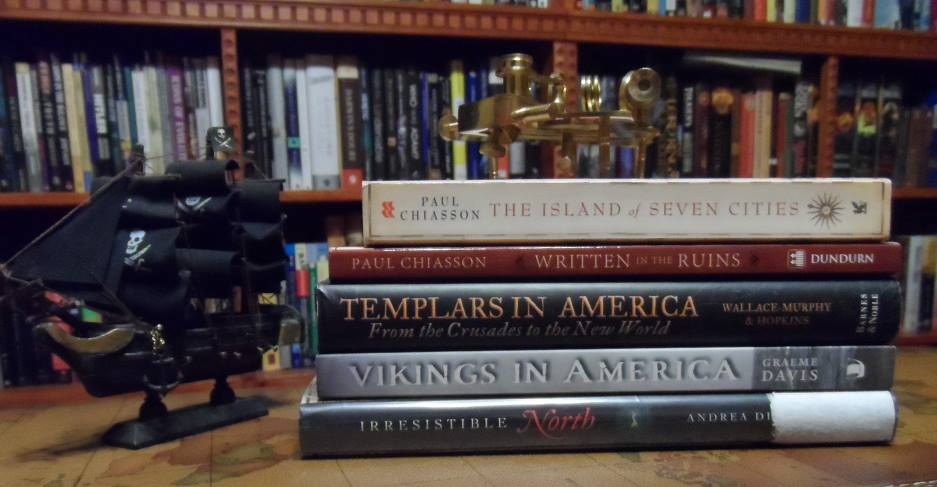
This region of the North Atlantic seems to hold many more secrets beyond what Oak Island may hold. Paul Chiasson writes in The Island of Seven Cities and Written in Ruins of evidence pointing to Chinese visitors to Cape Brenton Island. Mysterious ruins and Chinese words in native languages are among the clues.

Graeme Davis’ Vikings in America attempts to unravel the scope of Viking excursions into the Americas. No one questions they were here, only the extent and impact of their travels.

In Irresistible North, Andrea Di Robilant tracks down the legendary Zeno brothers of Venice. Did they make it to the New World?

And finally, no ancient mysteries would be complete without throwing the Knights Templars into the mix. In Templars in America, Tim Wallace-Murphy and Marilyn Hopkins trace a globe trotting mystery that may have crossed paths with the Zeno brothers and followed the trail first blazed by the Vikings.

So, are you ready for some exploring?

curse

Categories: Ancient America, Ancient Sites, Forgotten Places, History, Legend, Mysteries | Tags: , , , , , , , , , , | Leave a comment

Is Humanity Doomed?

If you have ever read about our ancestors, you were probably taught that, at the end of the last Ice Age, the citizens of North America hunted the many species of megafauna (giant mammals) to extinction. After all, why not assume terrible humans are responsible for all that death?

As it turns out, evidence has been growing of a planet-altering catastrophe as the cause. Most likely an impact event centered over North America (which endured most of the extinctions), with indications of impact craters littered across the East Coast.

Why is this so fascinating? Because it reminded me of the tendency of some people to immediately blame humans for every terrible event to befall the planet. These are the same people, with their dour and glum outlook, whom have been predicting for decades, that we only have a decade or two before we destroy the planet, run out of energy, and starve to death.

Then the decades pass, and the apocalyptic scenarios do not. Continue reading

Categories: Ancient America, History, Native Americans, Prehistory | Tags: , , , , , , , , , | 1 Comment

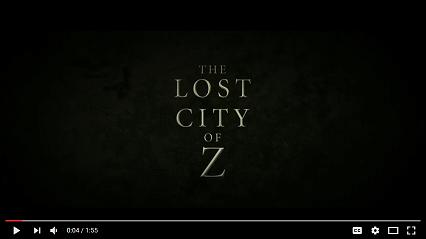
Lost City of Z

David Grann‘s book The Lost City of Z reintroduced readers to the true story of Percy Fawcett‘s epic search for the legendary Lost City of Z in the Amazon. Now, it is being told on the big screen this spring and may be a welcome respite to the same old, action films. Check out the trailer here:

Categories: Ancient America, Forgotten Places, History, Mysteries, Native Americans | Tags: , , , | Leave a comment

Lost Cities & Deadly Jungles

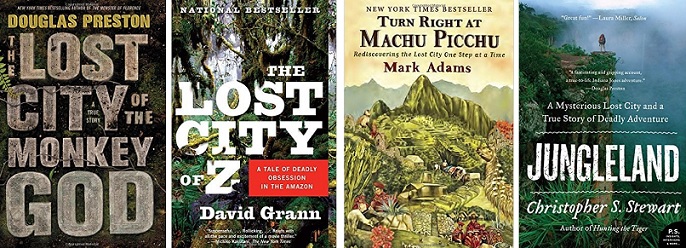
The search for lost cities is what movies are made of — and many of the films were inspired by real life. A number of authors have set out following the trails and clues left by others in search of what may still be lost. The latest is thriller writer Douglas Preston‘s book  The Lost City of the Monkey God.

Rumors of the White City hidden in the impenetrable jungles of Honduras have persisted for centuries. Preston joined a team of explorers and archaeologists, using a combination new technology and old-fashioned fight-your-way-through-the-jungle, to search for lost ruins.

Indeed, they find a lost city and indications of others. This a true story of adventure into a land of deadly animals and diseases, cartels and fixers, and forgotten histories that may still hold messages for modern man.

As Preston and the authors below have shown us, there is still much of our past to be uncovered. And there are still adventures to be had.

Categories: Ancient America, Ancient Sites, Forgotten Places, History, Native Americans | Tags: , , , , , , | Leave a comment

Turn Right, and Meet Me in the Lost World

In my review of travel adventure books, we have searched for Sheba and explorers of the New World. We have also disappeared into the jungles of Latin America on the trail of lost cities. Now we will return to uncovering the ancient world.

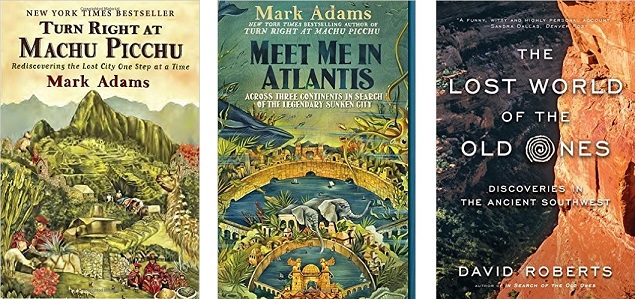
Mark Adams set a benchmark for travel adventure lit with his Turn Right at Machu Picchu. This fish-out-of-water follows the trail of legendary explorer Hiram Bingham who brought Machu Picchu, the hidden Inca mountain refuge, to the world’s attention. A perfect combination of Adams’ travails and history — every bit a page turner as a novel.

Adams followed this adventure up with Meet Me in Atlantis. Here he tries to hunt down the true experts of the legendary lost city, among a field known for, how should I put it, fringe thinkers. His hunt leads to many possibilities, and even though not as much adventuring as his first book, it is a refreshing change to the libraries full of bizarre Atlantis speculations.

Now we turn to David RobertsThe Lost World of the Old Ones where he continues his many years of hiking off-trail into the Southwest. Readers will be amazed at how much lies undiscovered and unknown about the civilizations that once populated these states. Roberts chronicles the politics, history and conflicting visions that have attempted to preserve the past — not always successfully. A fascinating and entertaining account that will remind people that United States has its own lost civilization still waiting for discovery

mcpic

Categories: Ancient America, Ancient Sites, artifacts, History, Native Americans, Prehistory | Tags: , , , , , , , , , , | Leave a comment

From Arabia to the New World

Most people love some sort of fiction whether it film, television or books. Yet, there are adventures to be had in the real world amidst all of its chaos and strife. We already took a look at some fantastic travels into Latin America where the ancient world still hides. Here are some more tales of authors who went on their own adventures to explore lost histories of our past:

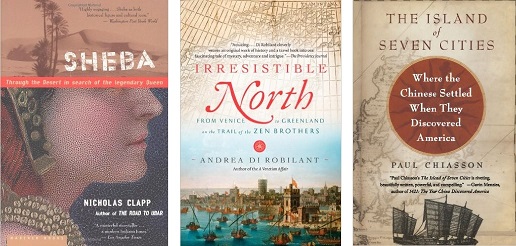
Few love stories can claim to have endured centuries, but that of Solomon and Sheba has done just that. Nicholas Clapp set out in Sheba: Through the Desert in Search of the Legendary Queen to uncover the truth to what is only briefly mentioned in biblical chronicles and some other sources. Traveling through unstable Yemen in Arabia, to ancient sites in Ethiopia and to the Jerusalem, the city of Solomon, he uncovers clues to the lost empire of Sheba that tantalize us with potentially much more hidden in the sands.

Legend has it that Venetian brother Antonio and Nicolo Zeno arrive in North America a hundred years before Columbus. Is it only a legend? Andrea di Robilant tracks them across Europe and to the fringes of the New World to uncover the truth in Irresistable North. Given a recent, new discovery of vikings, should we not take a little closer look at the Zenos?

The Zenos may not be the only ones to beat Columbus as Paul Chiasson writes in The Island of Seven Cities. Ruins on Cape Brenton in northeast Canada, not all that far from Viking sites, could be the remains of a Chinese outpost. If this wasn’t interesting enough, the Zeno brothers had mentioned encountering some sort of non-native settlement in the region. Vikings or Chinese or one of these intermixed with natives?

I’m thinking real life adventures like these beat television any day. So where do you want to go?

Categories: Ancient America, Ancient Documents, Ancient Sites, Bible, History | Tags: , , , , , , , , | 1 Comment

What the Vikings Can Teach Us

We’re all taught that Columbus “discovered” the New World in 1492, with the caveat that the Vikings arrived centuries earlier circa 1000 A.D. This is always added as a bit of a footnote, as if it’s not all that important. Sure, it didn’t have the impact of the Spanish-backed Columbus voyages, but the Viking voyages have always been begrudgingly admitted to existing. Even before ruins were found in the 1960s, the Viking Sagas and other accounts were largely written off as myth. Even after the finds, the story went like this, “Yes, they came here, probably over a couple centuries, but these infamous explorers never did much of anything.” Doesn’t really make much sense, does it? Why the reluctance to give the Vikings their due? In light of the discovery of a new Viking site in Canada, perhaps our prejudices in studying our own history need re-examined. Continue reading

Categories: Ancient America, Ancient Sites, Critical Thinking, Native Americans | Tags: , , , | 2 Comments

Choose Your Adventure

The busyness of the Christmas season has become nearly a tradition itself. Many are bogged down in the Retail Apocalypse right to the last hours of Christmas Eve. Stores will do anything to get in you in the door and our leaders will smile at the minor economic bump and run and hide when it’s erased with post-holiday debt. Nevertheless, perhaps you’re like me and try to carve some time out of these weeks to tone it down a bit. Perhaps you’d like to go on an adventure? Disappear into the jungles searching for lost cities like Indiana Jones?

No, seriously, you can for only a few dollars.

In The Lost City of Z, you can follow the trail of legendary explorer Percy Fawcett. In 1925, he disappeared into the Amazon looking for the fabled city. When you’re done, head to Honduras in Jungleland and search for Ciudad Blanca — perhaps the fabled El Dorado. Then head back down south and follow the footsteps of Hiram Bingham and explore Machu Picchu in Cradle of Gold.

So take a breath, turn the lights down, and vanish into another world.

Categories: Ancient America, Ancient Sites, artifacts, Books, Forgotten Places, History, Mysteries, Native Americans | Tags: , , , , , , | Leave a comment

Create a free website or blog at WordPress.com.