Ancient Documents

Sorry, Christmas and Christmas Trees Still Not Pagan

Every Christmas we hear people proclaiming Christmas and its traditions were once pagan or still are pagan (“pagan” in this context meaning a non-Christian religion). My first instinct is to laugh at those who think they discovered some long-lost, secret knowledge. My second thought is to turn to history for the truth.

Christianity has a long history of subverting — or appropriating — items, thoughts, days, and locations from other cultures if they agree with Christian teachings. Sometimes these things are given new meanings if they don’t agree Christian beliefs. This method of opening the door to Christianity for people was initiated by the Apostle Paul.

In the Areopagus Sermon, recorded in Acts 17:22–34, Paul argues to the Greeks at their high court on the reality of God by using the words of their own thinkers such as Epimenides, Aratus, and Cleanthes. He starts by pointing to one of their monuments: “I even found an altar with this inscription: TO AN UNKNOWN GOD. So you are ignorant of the very thing you worship — and this is what I am going to proclaim to you.” Paul is subverting parts of their own beliefs that can, or do, point to God, to open their mind to the discussion by highlighting what is already in agreement.

If we go further back, we find more examples of subversion. The Ark of the Covenant is very similar to Egyptian ark designs, and Israel’s temple also has likenesses to Egyptian temples. Why would God give the Israelites instructions to build these using Egyptian archetypes? Probably due their familiarity after living among the Egyptians for so long. However, the Israelites also let other things they had learned corrupt them. The Golden Calf could have been inspired by the Egyptian veneration of the Apis Bull. These are among many Egyptian details recorded in Exodus — including the name Moses which was borrowed from the Egyptian language — which lend credibility to the accounts. Skeptics who doubt the events in Exodus have to explain away all the subtle, and not so subtle, Egyptian references.

There are other examples, but here we have seen God, Paul, and later Christians appropriate objects and writings from other religions and give them new meaning. People who claim these things are bad because they once were pagan, are committing the genetic fallacy. In other words, as I like to say, Who cares what they once meant, what do they mean now? Sure, not everything can be easily appropriated. Some things not at all.

A popular rebranding method was when Christian denominations would take pagan festival dates and rename them and given them new meaning. Does Christmas Day and some of its associated traditions fall under this category as we are often told?

Actually, they do not.

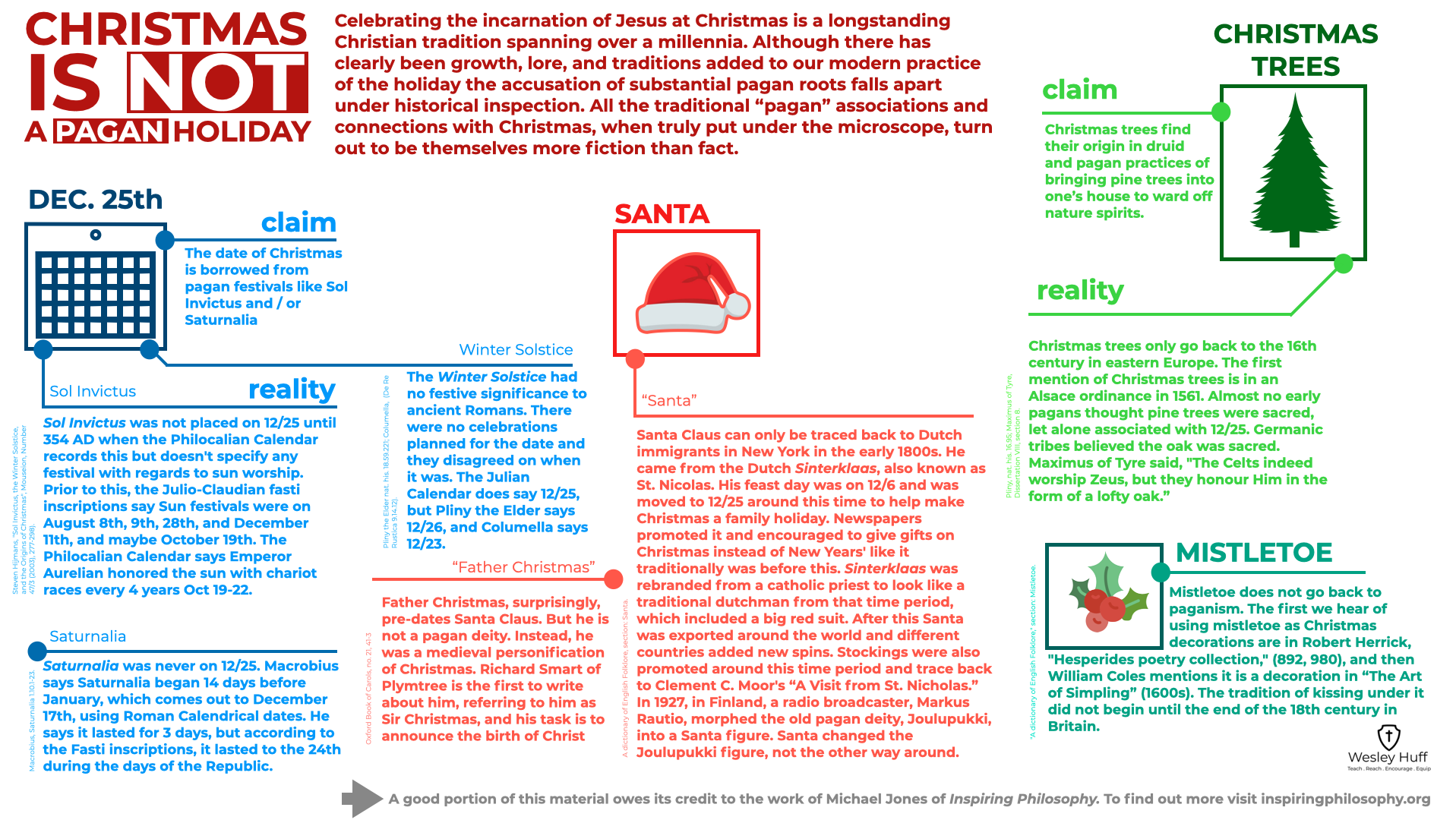
Biblical and ancient documents scholar Wes Huff explains in this video why “All the traditional ‘pagan’ associations and connections with Christmas, when truly put under the microscope, turn out to be themselves more fiction than fact.”

Historian William Tighe concluded after his research, “The ‘pagan origins of Christmas’ is a myth without historical substance.” Wes also provides these two infographics summarizing his research: Christmas is not a Pagan Holiday and So Where does Dec 25 Come from if it’s Not Pagan?

Check out those links for all the research. Most people don’t bother to test what they hear, especially if it fits a preconceived bias of one sort or another. Ultimately, the methodology of opening the door to discussing Christianity by finding points of agreement is a logical and sensical approach.

We can’t really say the same about all the drive-by scholars and their yearly attempts to rewrite history.

Categories: Ancient Documents, Bible, Critical Thinking, History, Traditions | Tags: , , , , , , , | Leave a comment

Biblical Times: The Original Proper Human Diet

A couple of weeks ago I wrote these three maxims as keys to good health:

Eat what your body is designed to use.

We are not designed to be couch potatoes.

Eat and move like our ancestors.

For people who struggle with health, that last one is key. We are only a few generations removed from a time when chronic diseases were rare. Why? They ate very differently than we do. Simpler, more natural, whole foods. It’s a simple message from our healthy ancestors. We like to believe we are smarter, but we are the sicker ones. Eat what your body is designed to use. That’s exactly what they did.

Keeping this in mind, I was intrigued to check out Jordan Rubin and Dr. Josh Axe‘s new book, The Biblio Diet. Any time a book proposes a new “diet,” or claims to divine new knowledge from the Bible, I proceed with caution. I am pleased to report that Rubin and Axe have provided another great resource outlining the Proper Human Diet.

They simply ask, “What were people in the Bible eating thousands of years ago?” And, why not? There’s no indication of any prevalence of chronic diseases or any of the other health issues plaguing our modern society. No surprisingly, it boils down to eating whole, natural foods, and not living sedentary lives. They also reference a lot of the science explaining why this is true. It’s a shame we have to spend millions in research to re-learn what was once innately understood. Nonetheless, if we are to halt this downward spiral of health, we must continue to educate people on the Proper Human Diet.

Rubin and Axe have written an accessible and concise book, which combines the knowledge of our ancestors with our best science. An easy and important read to improve and preserve your health and longevity. Take control of your health by listening to your ancestors (also, check out this interview with Jordan Rubin).

Categories: Ancient Documents, Bible, health | Tags: , , , , , , , , | Leave a comment

Myths & Monsters

Why do myths from centuries and even millennia in the past still fascinate us? Why does the quest of the Hero find its way into so many stories? Can these legendary tales still help us find our purpose? The new 6-part documentary series, Myths & Monsters explores these questions and the myths that have endured for countless generations. Check the trailer out here:

Categories: Ancient Documents, Legend | Tags: , , , , | Leave a comment

From Arabia to the New World

Most people love some sort of fiction whether it film, television or books. Yet, there are adventures to be had in the real world amidst all of its chaos and strife. We already took a look at some fantastic travels into Latin America where the ancient world still hides. Here are some more tales of authors who went on their own adventures to explore lost histories of our past:

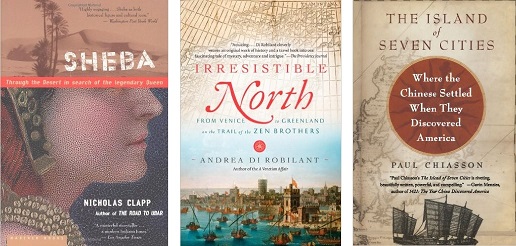
Few love stories can claim to have endured centuries, but that of Solomon and Sheba has done just that. Nicholas Clapp set out in Sheba: Through the Desert in Search of the Legendary Queen to uncover the truth to what is only briefly mentioned in biblical chronicles and some other sources. Traveling through unstable Yemen in Arabia, to ancient sites in Ethiopia and to the Jerusalem, the city of Solomon, he uncovers clues to the lost empire of Sheba that tantalize us with potentially much more hidden in the sands.

Legend has it that Venetian brother Antonio and Nicolo Zeno arrive in North America a hundred years before Columbus. Is it only a legend? Andrea di Robilant tracks them across Europe and to the fringes of the New World to uncover the truth in Irresistable North. Given a recent, new discovery of vikings, should we not take a little closer look at the Zenos?

The Zenos may not be the only ones to beat Columbus as Paul Chiasson writes in The Island of Seven Cities. Ruins on Cape Brenton in northeast Canada, not all that far from Viking sites, could be the remains of a Chinese outpost. If this wasn’t interesting enough, the Zeno brothers had mentioned encountering some sort of non-native settlement in the region. Vikings or Chinese or one of these intermixed with natives?

I’m thinking real life adventures like these beat television any day. So where do you want to go?

Categories: Ancient America, Ancient Documents, Ancient Sites, Bible, History | Tags: , , , , , , , , | 1 Comment

Jesus, Real and Imagined

There’s seems to be a wave of folks of redefining Jesus: Some wandering hippie, a good guy, hobo, this-or-that-retinterpreted-through-modern-cause or just someone that someone else made up. No, I’m not getting into a religious discussion here, but a historical one. This is also a case study in rooting out bias and agenda. In today’s 24/7 Internet, there’s a demand for a constant flow of articles. We should keep our baloney detector on, no matter what the topic we are reading (whether we like the author’s overall position or not).

Take the article by Chris Sosa, journalist, entitled “Historical Jesus, Not so Fast.” It starts out as if he is going to do what journalists do: A careful examination of an important subject. Very quickly, however, it becomes apparent we have nothing of the sort. Rather it is a repeating of common skeptical claims, not really new to anyone versed in such studies. An agenda emerges quickly.

Especially to anyone who spends 5 minutes looking up the author’s claims.

Claim 1: The Quirinius census (Luke 2:2) was too late to coincide with Herod the Great’s reign (Mathew 2:1) (thus Jesus birth story all out of whack). A couple things Sosa leaves out: Some serious; scholars believe Quirinius was twice governor as implied in Lapis Tiburtinus; inscription.  Others have suggested the translation should be, “this census was before the census which Quirinius, governor of Syria, made.” Not all issues have clear cut answers, but nor is there lack of answers, as implied by the article.

Claim 2: Sosa claims the Gospel of Mark “does not say that Jesus resurrected” stating this was “added at a later date.” Actually, as the translation he references clearly marks, the disputed portion starts at Mark 16:9. The resurrection is mentioned before this in Mark 16:6. The author hasn’t followed his own advice of, “Grab a bible and read along.”

Claim 3: Then there this old stand-by, “…not a single [gospel] agrees with the others on who actually saw [the resurrection].” A cursory review of the gospels reveals that none claim who first saw the empty tomb. That’s an important point (or omission on Sosa’s part). All of the gospels choose different details to focus on of the same events, which is clearly not the same as disagreeing.

Claim 4: Okay, he doesn’t claim anything, only defaults to quoting Bart Ehrman, (infamous) New Testament scholar. Ehrman is a fave among Jesus-debunkers and their go-to guy. Problem is that those who actually test his claims find that he isn’t all that scholarly. In fact, his arguments fail quite spectacularly. That all is beyond the scope of this essay, but finding someone who affirms your view and not testing their claims is not the same as actually proving it. (And Ehrman, scholar he may be, likes to sell his books under tabloidish titled books like Forged).

Claim 5: Sosa then discounts extrabiblical mentions of Jesus, which, obviously, “disintegrate under close examination” when consulting only scholars that agree with predetermined view. Interestingly, though, he doesn’t list all the known references, only ones some people debate.

I’m sure Sosa can “go on for hundreds of pages about the contradictions and historical problems of the Jesus narrative” just as Ehrman has by ignoring thousands of pages — and years — of contrary scholarship. Among other things, they neglect the eyewitness issues and rapid spread of Christianity in face of persecution. Or, very importantly, few Jews ever denied Christ’s existence. By history’s standards, there is far more documentation for Christ than most others we accept as real in the ancient world.

Note here that I didn’t resort to “faith” or talking points or emotion, only history and looking at the documents. Sure, I haven’t gone into a lengthy scholarly dissertation here either, but that wasn’t the point. The point is that we shouldn’t get mad reading an article, or automatically agree with it, without basic verification. Tone can indicate an agenda. A brief article claiming to unseat two millennia of scholarship needs some scrutiny, to say the least.

Regardless of what you think of the New Testament, it is arguably one of the most important documents to come down from antiquity. We have more ancient copies of it than any other document from the ancient world. Even the most revisionist of skeptics and Jesus-debunkers see no reason to claim Jesus was a “myth.”

Earth is flat. Jesus wasn’t real. Aliens traveling light-years in little saucers to abduct humans and make circles in corn fields.

Sometimes we just need to think. Just a little.

jbk

Categories: Ancient Documents, Bible, Critical Thinking | Tags: , , , , | Leave a comment

Missing Letters from Antiquity

Unknown thousands of writings from mankind’s past have been lost through the centuries, so it’s always impressive when finds are made, as with these Dead Sea Scrolls this month.

One has to wonder, what else is out there?

We know of some missing works, such as at least four letters that the Apostle Paul wrote (referenced in his other letters) that have no known remnants. He also wrote of a journey to Arabia and the intention to go to Spain (no one is sure if he made it). Did the prolific missionary-writer leave no records of these?

Finding these writings would be most interesting — or should I say historic?. Most consider the Bible closed — and any contrary suggestion unthinkable — but wouldn’t these letters be canonical? After all, the epistles state they exist. It would be quite the event, or circus, if such a discovery was made. Not a great disappointment like pseudo-gospels like the Gospel of Judas much ballyhooed a few years ago until scholars took a close look at it. Not that those types of documents don’t have any value, just not the religion-changing headlines often claimed.

Scholar and novelist Paul L. Maier explored the idea of the discovery of a missing part of the Bible in his novel The Constantine Codex. Another example of how it can take fiction to explore ideas some may not like.

And that is why fiction will never die.

Categories: Ancient Documents, Bible, Books | Tags: , , , | Leave a comment

Noah’s Ark Lands in Hollywood

Expensive biblical epics haven’t been a staple of Hollywood for decades, but this week saw the release of the first trailer of Noah which will hit theaters in early 2014.

Enter controversy.

Some like J.W. Wartick have written on concerns over possible “divergence from the Biblical story.” Fair enough, but I don’t have a problem with divergence, if it is in the sense Brian Godawa describes:

…there is nothing wrong with engaging in creative license, whether it is magical seeds or six-armed Watchers, or even Noah as a warrior. I don’t even think there is a problem in using non-biblical sources like the Book of Enoch or the Sumerian version of the Flood story, where unlike in the Bible, Noah receives dreams about the coming Deluge. The question is, does it support the spirit or meaning of the original story, or the original author’s intent. Bible believing Christians do not necessarily own this category of Biblical interpretation. The Bible doesn’t say what vocation Noah had before the Flood, only what he was afterward (a tiller of the soil). So if a Christian attacks the notion of Noah as a warrior shaman, he may really be illustrating his own cultural prejudice of the notion of a white bearded old farmer which is not in the Bible either…[bold mine]

However, Godawa does discuss quite a few concerns he had with an earlier draft of the script. Having only seen a brief clip of the movie, and not knowing how the script evolved or was edited, I’m not going to add or subtract from his analysis other than this: I do like how the film trailer does not depict Noah as a pastoral old man leading cute, Narnia-like animals into an ark. This Sunday School-fantasy version ignores the terror — and ultimately the point — of the account: Horrible evil is occurring in the world and mankind will be wiped out because of it. The actual story — an adult one — has been co-opted by preschoolers. Perhaps the film will spark debate on how shallow our take on Noah has become.

Hopefully, the filmmakers chose not to put modern agendas into an iconic account from the ancient world. There’s enough historical contextual sources to draw from, as Godawa does in his own novel on Noah. In a film of this budget, studios try not to be too offensive to anyone. It is a business after all. Then again, many big budget films failed in 2013.

Time will tell if Noah emerges under a rainbow or washes out.

Update [3/2/14, 3/17/14]: After continuing controversy over a film not released, Jerry A. Johnson, president of the National Religious Broadcasters (NRB), discusses Five Positive Facts and Five Negative Facts about the film. Johnson and the NRB were behind the recent press release from Paramount Pictures which states, “the feature film is a dramatization of the major scriptural themes and not a line-by-line retelling of the Bible story.”

Apparently the NRB thinks the Christian world is not intelligent enough to figure that out on their own. On the other hand, the “Sunday School-fantasy version” of Noah I discussed above that many envision in their minds is not “a line-by-line retelling of the Bible story” either.

And here, Dr. Hugh Ross looks at the biblical Noah account here and here. Or check out his new book that explores this and other issues of Genesis.

Update [4/3/14]: Here’s an interesting debate: Is Noah a Gnostic interpretation or not.

Categories: Ancient Documents, Bible, Prehistory | Tags: , , , , , , , , , , , , , , , , , , , | Leave a comment

The Jesus “Myth” Myth

Recently, I ran across someone claiming Jesus was a myth. This, at first, made me laugh. Not from a religious perspective (though these claims seem to crop up during Easter like clockwork), but from the perspective of ancient history. I also shook my head on the realization that more and more people don’t test such claims. People are way too trusting. That’s another story altogether, but what does history tell us about this “Jesus didn’t exist” theory? Why has the evidence from history has compelled most scholars, regardless of their religious beliefs, to believe Jesus was real? First, this:

There are more ancient documents attesting to Jesus than any other individual from antiquity.

“So what?” says the skeptic. “Most were written by Christians.”

True, but since the writers were Christians (or what we would now consider such), does that automatically mean we should suspect deception? By that logic (or lack of), we should also be suspect of any non-christian writing about Christianity.

More importantly, the Gospels were all written relatively close to the time of Jesus. So people who had seen, known or encountered Jesus were still alive to verify the writings or serve as sources. Verses in Paul’s epistles have been recognized as coming from early creeds that date within a few years (the first two), if not months, from the death of Jesus. In 1 Corinthians 15:3-8 there are various clues that indicate Paul is repeating an early creed, both in the language and style he uses and the underlying Aramaic. This is also why some of Paul’s writings predate the writing of the Gospels.

Also note that other sources do not deny Jesus existed. Jewish writers, who had more reason than anyone else to show Jesus didn’t exist, did not do so. Instead, they argued he wasn’t the Messiah. This brings us to the next important point:

The New Testament is not the only collection of ancient documents writing about Jesus.

Many Christians don’t even know this. Some examples: Roman historian Cornelius Tacitus in Annals; Suetonius, chief secretary of Emperor Hadrian; Flavius Josephus, Jewish historian in Antiquities; Julius Africanus in Extant Writings refers to the lost works of Thallus who describes the darkness and earthquake at the time of Christ’s death; in Pliny the Younger’s Letters; in letters from Emperors Trajan and Hadrian; Jewish documents the Talmud and the Toledoth Jesu; writings by Lucian, second century Greek satirist.

Understand that most of these writers were not “pro-Jesus” by any stretch. Even if some of the Josephus references were added later, as some claim, we are still left with a large body of undisputed writings. Nor have we mentioned the large body of apocryphal books that appeared in those ancient times.

And for those who claim the New Testament is unreliable, I’ll briefly state this: Pseudoscholars claim there are hundreds of thousands of variants between New Testament manuscripts. In reality, most of these variants are spelling variations, using different synonyms or language-to-language translation issues. What you are left with are a few verses like John 7:53-8:11 that are not in early manuscripts and Bibles denote them as such. These verses, and none of the variants, impact the orthodox beliefs of Christianity.

Claiming Jesus is a “myth” is nothing more than a futile attempt to rewrite history.

Categories: Ancient Documents, Bible, Critical Thinking | Tags: , , , , , , | Leave a comment

What was the Star of Bethlehem?

Planets, stars, novas or even UFOs, all have been presented as the source of the account in the Gospel of Matthew. He was the only gospel writer who felt it necessary to include the star, which make many wonder if it really happened. Like many of these topics, one can choose to be quickly dismissive or delve deeper.

The latter is what Michael R. Molnar does in his book The Star of Bethlehem. It’s one of the most complete studies of the topic I have run across and draws out many overlooked details in the biblical account and from history. Some additional studies from a science-faith think tank can be found here, but Molnar’s book would be a great study for this Christmas season.

If you want more Christmas lore, try Revelation of the Magi by Brent Landau. This is a translation of a once popular, now largely forgotten, apocryphal Christian story. It’s a fascinating account for students of early Christian history and Christmas traditions. Does it add any truth to the gospel account? Maybe, maybe not. It has the style of fiction rather than historical reporting.

Now Landau’s speculations about the story and the biblical account are, at times, poor theology. He thinks the infancy accounts have no value and supposedly the “majority” of scholars agree. It didn’t take me long to find many who disagree with that. He also seems to be promoting some sort of pluralistic variety of Christianity by somehow concluding this Magi text points to all religious beliefs coming from Christ. It’s sad that some “scholars” seem to ignore scholars who don’t agree with them and try to dumb down Christianity (I’m not saying other religions don’t have any truths in them, but pluralists like to pretend everyone is the same). So don’t buy Landau’s book for the theology. If ancient texts interest you, his translation of the Magi text is a good read.

Instead of non-stop rushing around this month, take some time, sit by the Christmas tree, and learn about the history and traditions that surround us this time of year.

Categories: Ancient Documents, Bible, Mysteries, Traditions | Tags: , , , , , | 2 Comments

The Media’s Jesus-Wife Myth

Recent years have seen fiction writers and pretend scholars make claims about Jesus having a wife. People who have bothered to examine such claims a little deeper have found that they don’t hold up very well. If you think the media is going to do the fact-checking for you, think again. Check out this post which compares a poor, sensationalist media report compared to the actual academic study. Is it any wonder why many people trust the media less and less?

Categories: Ancient Documents, artifacts, Bible, Critical Thinking | Tags: , | Leave a comment

Create a free website or blog at WordPress.com.