Native Americans

Reclaiming Native History

“As with all historical events, it is a fool’s errand to judge it by contemporary standards.” – Michael Walsh

Far too often, historians, or those who pretend to be historians, try to understand history through modern eyes. Sometimes this is unintentional, but often in our era, it is purposeful revisionism driven by narratives and personal beliefs rather than a desire to understand the past.

One of the most interesting trends in history has been the changes in studies of Native American history. It is one of many historical subjects that have been battered by changing narratives and people with little regard for truth. This, though, is changing.

For many years, academia tended to paint Native Americans as helpless victims, wiped out by ruthless Europeans. Kathleen DuVal, in Native Nations, writes, “More recent U.S. history textbooks provide more coverage and rightly condemn the violence…but tend to emphasize victimization and decline.” Duval shows how influential writings on native history by Howard Zinn, Dee Brown, Jared Diamond, and Charles Mann enforced this idea that “Europeans dominated North America virtually from the moment they arrived here” and the natives were “helpless victims.” Even now, education still often portrays American Indians as peoples from the past, as if they no longer exist, and “overemphasize the periods of catastrophe” like the Cherokee Trail of Tears or the Wounded Knee Massacre.

This narrative has begun to crumble, a change often driven from natives themselves. They weren’t wiped out, and scholars trying to do native history justice, often have done the opposite with unsupported death, disease, and population numbers. Now, historians are recognizing, as Pekka Hämäläinen writes in Indigenous Continent, this was “a four-centuries-long war” and “Indians won as often as not.” While there “were colonists who utterly despised Indians and wanted to eradicate them” there were many who “sought to embrace them.”

Natives prospered from trade and contact, and sought out such activities. They suffered as well in this classic clash of different civilizations, not unlike what had played out thousands of times in history. However, they weren’t clueless, innocent hippies wandering through the woods, hugging trees. They weren’t much different from the Europeans, both good and bad. War, slavery, and torture were not uncommon.

There is a lot of overlap in DuVal and Hämäläinen’s books, and they are excellent histories of native history after contact. There are times where both authors seem to have trouble letting go of the very inaccurate histories they are trying to correct. DuVal likes to often remind readers the Europeans were white, not understanding ideas of racism weren’t the same as modern ones. For example, racist beliefs directed from one white European group to another were common well into the 20th Century. Nor did all Europeans base their perceptions of the natives based solely on skin color. Both authors talk about colonialism like it was a new invention in the Americas, as if this wasn’t a driving force in civilization’s expansion and growth since mankind began. These and some other points are artifacts of interjecting modernity into the past.

This why I think Jeff Fynn-Paul’s book, Not Stolen, adds good balance to these other studies. Fynn-Paul doesn’t obscure the bad events on the continent between natives and the newcomers, but he shows there was often more to the story. For example, the tragic Cherokee Trail of Tears was not something that went unnoticed at the time, nor was it widely supported. Quite the opposite, it was very controversial with the public, and the president was acting against a ruling of the Supreme Court. The point being, there wasn’t a widespread conspiracy to wipe out the natives. While DuVal and Hämäläinen sometimes throw around the word genocide, the individuals who were for such things didn’t have broad support for the total destruction of native nations.

Admittedly, trying to formulate a balanced history of such a complex era of the past, involving so many people, is no easy task. No one person can survey and collate every available source. We should all strive to examine a broad variety of sources on every subject we study, and do so with an open mind. As Fynn-Paul writes:

An ideal historian will look dispassionately at the evidence, the sources, and the probable facts of a case, and write a narrative interpretation based on reason, logic, and a well-honed sense of judgment. Personnel preference – including political opinions – is supposed to be relegated to secondary status.
Categories: Ancient America, History, Native Americans | Tags: , , , , , , , | 1 Comment

Erasing History

When Land-O-Lakes began to remove the Native American woman from its products, they talked around why, only saying it was to better represent their farmers and customers. Most people suspect it was also in response to activists claiming the image was racist, and perhaps the American Psychological Association’s Fake Science claiming such images have “a negative impact on the self-esteem of American Indian children.”

Turns out the artist, Patrick DesJarlait was a Native American himself. He painted the iconic woman, named Mia, to represent a real native. His son, who has protested other images and icons that he felt weren’t a positive reflection of natives, also confirms Mia is not racist or a stereotype.

He also noted,

Mia’s vanishing has prompted a social media meme: ‘They Got Rid of The Indian and Kept the Land.’ That isn’t too far from the truth. Mia, the stereotype that wasn’t, leaves behind a landscape voided of identity and history. For those of us who are American Indian, it’s a history that is all too familiar.

#SaveMia


The madness continues (6/20/19)…

Quaker Foods is removing the image of the woman from its Aunt Jemima brands, stating, “We recognize Aunt Jemima’s origins are based on a racial stereotype.”

However, the original Aunt Jemima on the products was freed slave Nancy Green. Green has been called a “trailblazing corporate model,” a “talented entrepreneur” and “transitional symbol.” Green also “transformed Aunt Jemima from a strictly racist, commercial cipher into a symbol of friendliness and hospitality.”

Just as with Land ‘O Lakes erasing the Native American woman from their products — even though she was drawn by a Native American to honor his ancestors — more companies are choosing to give in to false claims of racism. “Aunt Jemima” began as a racial stereotype, but symbols can change, and Green changed it.

Mia, the native woman, wasn’t a real person, but Nancy Green was. Both, however, have had their stories whitewashed from society.

Isn’t that ironic?

Categories: Native Americans | Tags: , , , , , , , | Leave a comment

The Enigma of Columbus

“Columbus has been alternately venerated and vilified…he became a lightning rod for controversy…[some] saw him as the visionary that led the way [to the Americas]. Others, preferring to believe that Columbus’s discoveries begat genocide against the New Worlds peaceful indigenous people, uniformly vilify him — as if he had orchestrated the atrocities himself or as if the indigenous tribes hadn’t already been waging war on one another…Still others invest themselves in the pointless argument that Columbus was not the New World’s discoverer…Columbus’s claim to fame isn’t that he got there first, it’s that he stayed.

“…History does not know what to make of the Admiral of the Ocean Sea without passions of one kind or another intruding. The explorer will always remain something of an enigma…He was a man of great charisma whose passion sometimes turned others against him…His advocates marveled at his daring and tenaciousness…His detractors thought him brutal and weak. The only certainty about Columbus is that, for better or worse, he chose to live a bold life rather than settle for mediocrity.” – Martin Dugard writing in The Last Voyage of Columbus.

Every Columbus Day people come out of the woodwork to correct what we were taught about Columbus. Then people correct them, and others correct them. It’s clear few of them have bothered to study the history of they day in any depth. So the quote above is meant to impart that actual history is far too complex to be learned from drive-by memes, or history lessons given by people with agendas.

If you want to speak about a person from our past, you should actually step into his world and follow him around. That’s why the study of history is like time travel. Step on in and give it a try.

Categories: History, Native Americans | Tags: , , | Leave a comment

Is Humanity Doomed?

If you have ever read about our ancestors, you were probably taught that, at the end of the last Ice Age, the citizens of North America hunted the many species of megafauna (giant mammals) to extinction. After all, why not assume terrible humans are responsible for all that death?

As it turns out, evidence has been growing of a planet-altering catastrophe as the cause. Most likely an impact event centered over North America (which endured most of the extinctions), with indications of impact craters littered across the East Coast.

Why is this so fascinating? Because it reminded me of the tendency of some people to immediately blame humans for every terrible event to befall the planet. These are the same people, with their dour and glum outlook, whom have been predicting for decades, that we only have a decade or two before we destroy the planet, run out of energy, and starve to death.

Then the decades pass, and the apocalyptic scenarios do not. Continue reading

Categories: Ancient America, History, Native Americans, Prehistory | Tags: , , , , , , , , , | 1 Comment

Lost City of Z

David Grann‘s book The Lost City of Z reintroduced readers to the true story of Percy Fawcett‘s epic search for the legendary Lost City of Z in the Amazon. Now, it is being told on the big screen this spring and may be a welcome respite to the same old, action films. Check out the trailer here:

Categories: Ancient America, Forgotten Places, History, Mysteries, Native Americans | Tags: , , , | Leave a comment

The West that Was

Like many topics, the expansion into the West and the wars with the Indians (Native Americans) gets some short blurbs in history class before moving onto the next era. The Oregon Trail, ’49 Gold Rush, Pony Express, famous cowboy outlaws, Transcontinental Railroad, wagon trails and Custer’s Last Stand are among the familiar touchstones.

Yet he details of this history are far more vivid, fascinating and, sometimes, disturbing.

These three books, by different authors, serve as a trilogy to the western expansion and the “Indian Wars” of the 1800s: The Heart of Everything That Is: The Untold Story of Red Cloud, An American Legend, Empire of the Summer Moon: Quanah Parker and the Rise and Fall of the Comanches, the Most Powerful Indian Tribe in American History and The Last Stand: Custer, Sitting Bull, and the Battle of the Little Bighorn.

Most now understand that pushing out the natives was often driven by greed and viewing them as primitives. Custer is no longer a hero. Few, though, know how brutal those wars were, or the hardships of settlers caught in the middle. Nor were many of the Indian nations peaceful peoples. Even fighting among themselves, their warfare was barbaric. That doesn’t justify their extermination; nor does their defense justify all of their own actions. Sometimes, in real history, it’s hard to pick out the villains and heroes. Other times, they aren’t who you thought they were.

For better or for worse, this was a defining era in U.S. history. It is a reminder, that in the not so distant past, people could be convinced to take terrible actions. A much greater nation managed to emerge from the blood and dust, so we should be thankful for that. Now we must respect the past so the wrongs don’t become our future, and those who should have lived are finally remembered.

Categories: History, Native Americans | Tags: , , , , , , , , , , | 1 Comment

Lost Cities & Deadly Jungles

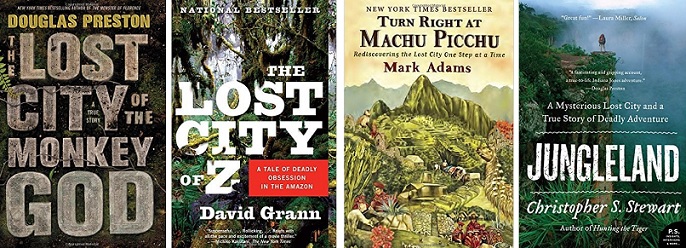
The search for lost cities is what movies are made of — and many of the films were inspired by real life. A number of authors have set out following the trails and clues left by others in search of what may still be lost. The latest is thriller writer Douglas Preston‘s book  The Lost City of the Monkey God.

Rumors of the White City hidden in the impenetrable jungles of Honduras have persisted for centuries. Preston joined a team of explorers and archaeologists, using a combination new technology and old-fashioned fight-your-way-through-the-jungle, to search for lost ruins.

Indeed, they find a lost city and indications of others. This a true story of adventure into a land of deadly animals and diseases, cartels and fixers, and forgotten histories that may still hold messages for modern man.

As Preston and the authors below have shown us, there is still much of our past to be uncovered. And there are still adventures to be had.

Categories: Ancient America, Ancient Sites, Forgotten Places, History, Native Americans | Tags: , , , , , , | Leave a comment

1492

In 1492, Columbus sailed the ocean blue…

That little rhyme was once taught to all kids. Now, the name Columbus isn’t uttered much, and people just know the mail isn’t delivered today, the banks are closed, and they might have they day off.

However, for a historical perspective on the man who rediscovered America, check out my post from last year.

And, perhaps, we can look forward to the day that mankind rediscovers its spirit of exploration.

Categories: History, Native Americans, Uncategorized | Tags: , , , , | Leave a comment

Turn Right, and Meet Me in the Lost World

In my review of travel adventure books, we have searched for Sheba and explorers of the New World. We have also disappeared into the jungles of Latin America on the trail of lost cities. Now we will return to uncovering the ancient world.

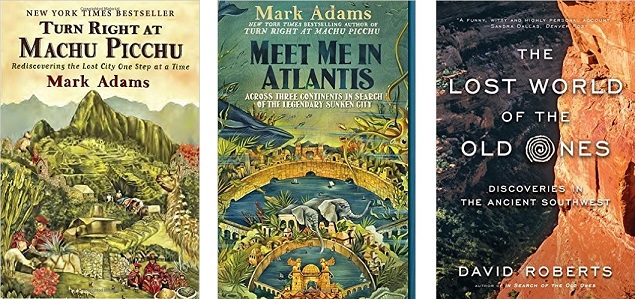
Mark Adams set a benchmark for travel adventure lit with his Turn Right at Machu Picchu. This fish-out-of-water follows the trail of legendary explorer Hiram Bingham who brought Machu Picchu, the hidden Inca mountain refuge, to the world’s attention. A perfect combination of Adams’ travails and history — every bit a page turner as a novel.

Adams followed this adventure up with Meet Me in Atlantis. Here he tries to hunt down the true experts of the legendary lost city, among a field known for, how should I put it, fringe thinkers. His hunt leads to many possibilities, and even though not as much adventuring as his first book, it is a refreshing change to the libraries full of bizarre Atlantis speculations.

Now we turn to David RobertsThe Lost World of the Old Ones where he continues his many years of hiking off-trail into the Southwest. Readers will be amazed at how much lies undiscovered and unknown about the civilizations that once populated these states. Roberts chronicles the politics, history and conflicting visions that have attempted to preserve the past — not always successfully. A fascinating and entertaining account that will remind people that United States has its own lost civilization still waiting for discovery

mcpic

Categories: Ancient America, Ancient Sites, artifacts, History, Native Americans, Prehistory | Tags: , , , , , , , , , , | Leave a comment

What the Vikings Can Teach Us

We’re all taught that Columbus “discovered” the New World in 1492, with the caveat that the Vikings arrived centuries earlier circa 1000 A.D. This is always added as a bit of a footnote, as if it’s not all that important. Sure, it didn’t have the impact of the Spanish-backed Columbus voyages, but the Viking voyages have always been begrudgingly admitted to existing. Even before ruins were found in the 1960s, the Viking Sagas and other accounts were largely written off as myth. Even after the finds, the story went like this, “Yes, they came here, probably over a couple centuries, but these infamous explorers never did much of anything.” Doesn’t really make much sense, does it? Why the reluctance to give the Vikings their due? In light of the discovery of a new Viking site in Canada, perhaps our prejudices in studying our own history need re-examined. Continue reading

Categories: Ancient America, Ancient Sites, Critical Thinking, Native Americans | Tags: , , , | 2 Comments

Blog at WordPress.com.