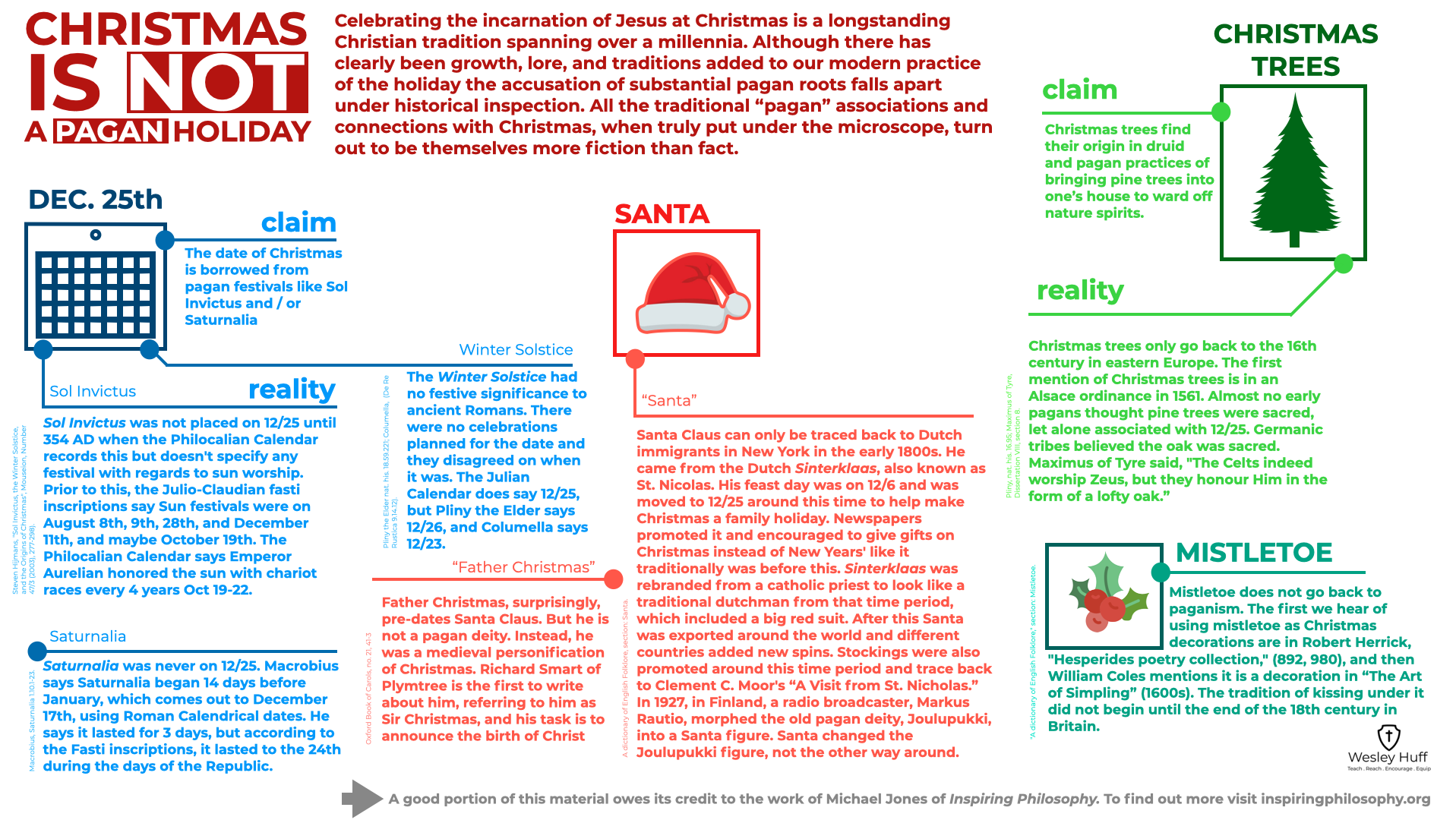
Every Christmas we hear people proclaiming Christmas and its traditions were once pagan or still are pagan (“pagan” in this context meaning a non-Christian religion). My first instinct is to laugh at those who think they discovered some long-lost, secret knowledge. My second thought is to turn to history for the truth.
Christianity has a long history of subverting — or appropriating — items, thoughts, days, and locations from other cultures if they agree with Christian teachings. Sometimes these things are given new meanings if they don’t agree Christian beliefs. This method of opening the door to Christianity for people was initiated by the Apostle Paul.
In the Areopagus Sermon, recorded in Acts 17:22–34, Paul argues to the Greeks at their high court on the reality of God by using the words of their own thinkers such as Epimenides, Aratus, and Cleanthes. He starts by pointing to one of their monuments: “I even found an altar with this inscription: TO AN UNKNOWN GOD. So you are ignorant of the very thing you worship — and this is what I am going to proclaim to you.” Paul is subverting parts of their own beliefs that can, or do, point to God, to open their mind to the discussion by highlighting what is already in agreement.
If we go further back, we find more examples of subversion. The Ark of the Covenant is very similar to Egyptian ark designs, and Israel’s temple also has likenesses to Egyptian temples. Why would God give the Israelites instructions to build these using Egyptian archetypes? Probably due their familiarity after living among the Egyptians for so long. However, the Israelites also let other things they had learned corrupt them. The Golden Calf could have been inspired by the Egyptian veneration of the Apis Bull. These are among many Egyptian details recorded in Exodus — including the name Moses which was borrowed from the Egyptian language — which lend credibility to the accounts. Skeptics who doubt the events in Exodus have to explain away all the subtle, and not so subtle, Egyptian references.
There are other examples, but here we have seen God, Paul, and later Christians appropriate objects and writings from other religions and give them new meaning. People who claim these things are bad because they once were pagan, are committing the genetic fallacy. In other words, as I like to say, Who cares what they once meant, what do they mean now? Sure, not everything can be easily appropriated. Some things not at all.
A popular rebranding method was when Christian denominations would take pagan festival dates and rename them and given them new meaning. Does Christmas Day and some of its associated traditions fall under this category as we are often told?
Actually, they do not.
Biblical and ancient documents scholar Wes Huff explains in this video why “All the traditional ‘pagan’ associations and connections with Christmas, when truly put under the microscope, turn out to be themselves more fiction than fact.”
Historian William Tighe concluded after his research, “The ‘pagan origins of Christmas’ is a myth without historical substance.” Wes also provides these two infographics summarizing his research: Christmas is not a Pagan Holiday and So Where does Dec 25 Come from if it’s Not Pagan?
Check out those links for all the research. Most people don’t bother to test what they hear, especially if it fits a preconceived bias of one sort or another. Ultimately, the methodology of opening the door to discussing Christianity by finding points of agreement is a logical and sensical approach.
We can’t really say the same about all the drive-by scholars and their yearly attempts to rewrite history.



 Darrick Dean