Posts Tagged With: Indians

Reclaiming Native History

“As with all historical events, it is a fool’s errand to judge it by contemporary standards.” – Michael Walsh

Far too often, historians, or those who pretend to be historians, try to understand history through modern eyes. Sometimes this is unintentional, but often in our era, it is purposeful revisionism driven by narratives and personal beliefs rather than a desire to understand the past.

One of the most interesting trends in history has been the changes in studies of Native American history. It is one of many historical subjects that have been battered by changing narratives and people with little regard for truth. This, though, is changing.

For many years, academia tended to paint Native Americans as helpless victims, wiped out by ruthless Europeans. Kathleen DuVal, in Native Nations, writes, “More recent U.S. history textbooks provide more coverage and rightly condemn the violence…but tend to emphasize victimization and decline.” Duval shows how influential writings on native history by Howard Zinn, Dee Brown, Jared Diamond, and Charles Mann enforced this idea that “Europeans dominated North America virtually from the moment they arrived here” and the natives were “helpless victims.” Even now, education still often portrays American Indians as peoples from the past, as if they no longer exist, and “overemphasize the periods of catastrophe” like the Cherokee Trail of Tears or the Wounded Knee Massacre.

This narrative has begun to crumble, a change often driven from natives themselves. They weren’t wiped out, and scholars trying to do native history justice, often have done the opposite with unsupported death, disease, and population numbers. Now, historians are recognizing, as Pekka Hämäläinen writes in Indigenous Continent, this was “a four-centuries-long war” and “Indians won as often as not.” While there “were colonists who utterly despised Indians and wanted to eradicate them” there were many who “sought to embrace them.”

Natives prospered from trade and contact, and sought out such activities. They suffered as well in this classic clash of different civilizations, not unlike what had played out thousands of times in history. However, they weren’t clueless, innocent hippies wandering through the woods, hugging trees. They weren’t much different from the Europeans, both good and bad. War, slavery, and torture were not uncommon.

There is a lot of overlap in DuVal and Hämäläinen’s books, and they are excellent histories of native history after contact. There are times where both authors seem to have trouble letting go of the very inaccurate histories they are trying to correct. DuVal likes to often remind readers the Europeans were white, not understanding ideas of racism weren’t the same as modern ones. For example, racist beliefs directed from one white European group to another were common well into the 20th Century. Nor did all Europeans base their perceptions of the natives based solely on skin color. Both authors talk about colonialism like it was a new invention in the Americas, as if this wasn’t a driving force in civilization’s expansion and growth since mankind began. These and some other points are artifacts of interjecting modernity into the past.

This why I think Jeff Fynn-Paul’s book, Not Stolen, adds good balance to these other studies. Fynn-Paul doesn’t obscure the bad events on the continent between natives and the newcomers, but he shows there was often more to the story. For example, the tragic Cherokee Trail of Tears was not something that went unnoticed at the time, nor was it widely supported. Quite the opposite, it was very controversial with the public, and the president was acting against a ruling of the Supreme Court. The point being, there wasn’t a widespread conspiracy to wipe out the natives. While DuVal and Hämäläinen sometimes throw around the word genocide, the individuals who were for such things didn’t have broad support for the total destruction of native nations.

Admittedly, trying to formulate a balanced history of such a complex era of the past, involving so many people, is no easy task. No one person can survey and collate every available source. We should all strive to examine a broad variety of sources on every subject we study, and do so with an open mind. As Fynn-Paul writes:

An ideal historian will look dispassionately at the evidence, the sources, and the probable facts of a case, and write a narrative interpretation based on reason, logic, and a well-honed sense of judgment. Personnel preference – including political opinions – is supposed to be relegated to secondary status.

Categories: Ancient America, History, Native Americans | Tags: , , , , , , , | 1 Comment

The West that Was

Like many topics, the expansion into the West and the wars with the Indians (Native Americans) gets some short blurbs in history class before moving onto the next era. The Oregon Trail, ’49 Gold Rush, Pony Express, famous cowboy outlaws, Transcontinental Railroad, wagon trails and Custer’s Last Stand are among the familiar touchstones.

Yet he details of this history are far more vivid, fascinating and, sometimes, disturbing.

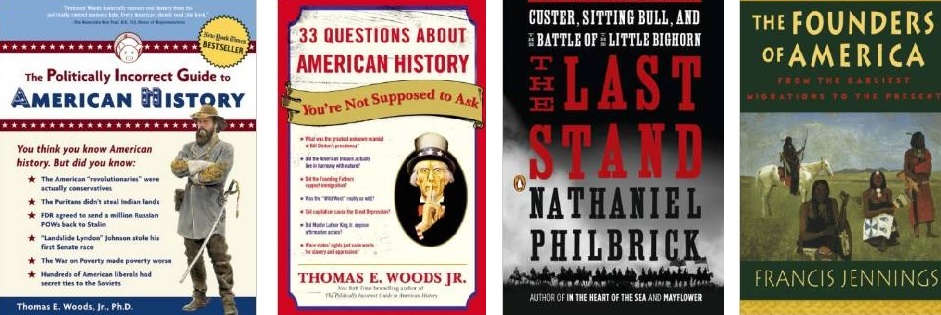
These three books, by different authors, serve as a trilogy to the western expansion and the “Indian Wars” of the 1800s: The Heart of Everything That Is: The Untold Story of Red Cloud, An American Legend, Empire of the Summer Moon: Quanah Parker and the Rise and Fall of the Comanches, the Most Powerful Indian Tribe in American History and The Last Stand: Custer, Sitting Bull, and the Battle of the Little Bighorn.

Most now understand that pushing out the natives was often driven by greed and viewing them as primitives. Custer is no longer a hero. Few, though, know how brutal those wars were, or the hardships of settlers caught in the middle. Nor were many of the Indian nations peaceful peoples. Even fighting among themselves, their warfare was barbaric. That doesn’t justify their extermination; nor does their defense justify all of their own actions. Sometimes, in real history, it’s hard to pick out the villains and heroes. Other times, they aren’t who you thought they were.

For better or for worse, this was a defining era in U.S. history. It is a reminder, that in the not so distant past, people could be convinced to take terrible actions. A much greater nation managed to emerge from the blood and dust, so we should be thankful for that. Now we must respect the past so the wrongs don’t become our future, and those who should have lived are finally remembered.

Categories: History, Native Americans | Tags: , , , , , , , , , , | 1 Comment

Rescuing History

The truth is that the white men and savage Indians could never live in peace in the same land. The Indians wanted the land for hunting grounds; the white people wanted it for farms and ranches. The white men, being stronger, were able to win.

So it was written in the elementary school history text, The Growth of the American People and Nation, published in 1937. Boy, times have changed. A perfect example of history being revised, perhaps unintentional or based on the intentional agendas of others. Some more:

The government at last decided it was cheaper to feed the Indians than to keep on fighting them…moved [them] to…Indian reservation[s]…Government Indian schools were opened…The Indian problem was no longer one of our chief problems.

History has since, for the most part, corrected its recording of what transpired to the natives in the Americas. They didn’t just want the land for hunting, it was their home where they had lived for generations. Nor were they particularly more “savage” then any other humans. The text even notes that, “…the Indians had no food supply [buffaloes killed], [their] lands were taken from them…[they] were put on reservations.” Sobering to those who think such things cannot happen in a democracy. Historian Francis Jennings wrote in The Founders of America:

From 1812 until the end of the century, official policy, no matter what euphemistic terms expressed, was simple conquest. Its purpose was to reduce Indian persons to dependence and to seize tribal lands. It is common scandal that the United Sates has violated every single one of its treaties with Indians.

We cannot engage in revisionism of history, the good or bad, what we like or dislike, or else we cannot learn from it. One wonders, though, how many genocides and oppressions we must witness, or allow happen, before we get it. Unfortunately, historical revisionism is alive and well and is a favorite of those with political and other agendas.

There seems to have been a craze of trying to dig up dirt on the Founding Fathers in order to justify support for our less than stellar elected class. No one ever claimed the founders were perfect, unblemished humans. Comparative to many of our own, they did have a higher respect for their office. In the zealous attempts to dethrone them, facts have often been flushed away. For instance, take the cottage industry of attacking Thomas Jefferson.

One of those attacks is the claim that DNA proved he was fathering children with slave Sally Hemings. The problem with this is that the DNA didn’t have Jefferson’s name on it, only that someone in his family was implicated. Turns out that his brother could have been the father of the children. There is nothing that can be used to state that Thomas Jefferson absolutely was fathering these children, as so often has been implied or stated.

Often the old history books do get it right and can be used to ferret out agendas in our own. It is always a fun exercise to compare the two. The points to remember are these: Dig a little deeper, don’t think everything you are told or read is without error. Look for bias and agendas, especially when attached to politicians and those that fund them. Ask why some detail of history has changed and where’s the evidence. Yes, it can take time and may seem unnecessary to some people. Ultimately, however, we have a responsibility to pass on accurate and truthful history.

We must start thinking about those who will follow us instead of just tomorrow and the next day. We do this in the hope that our ancestors won’t repeat our tragedies and mistakes and will remember our triumphs.

hsbks

Categories: History | Tags: , , , , , , | Leave a comment

American Natives: Not so Primitive

There is a common misconception that the Native Americans were primitive or only a step or two removed from barbarians. In reality they built sophisticated societies across the Western Hemisphere. The cities of the Aztecs, Mayans and Incas are a testament contrary to the myth. So are the sophisticated irrigation works and brick towns of the Southwest. In the Ohio and Mississippi Valleys natives built thousands of mounds across the region. Many were complex shapes, effigies of animals or were part of sprawling earthworks. Mounds often hid burials, some with underground tombs. Places like Cahokia in East St. Louis, Illinois, were the centers of massive populations. This city centered around an earthen flat-topped mound that resembled the pyramids in Mesoamerica in shape and Egypt’s in size. It was no small feat for pre-industrial peoples to build such structures that seem only mounds of dirt to us.

Sadly, the vast majority were destroyed as settlers moved into these areas. Where they stood out in the relatively flat lands of Ohio, town-builders and farmers were quick to level them. In hillier lands, what mounds existed often blended into the terrain. Farmers, who had to farm the rolling land as it was, were more apt to leave mounds alone. At times they farmed around and over the mounds. I suspect that some have survived to this very day hiding in plain sight.

The Mound Builder cultures (Adena, Hopewell and Mississippian) were gone by the time the colonials arrived. The Indians then living in the lands knew little about those who had lived here before. The colonials couldn’t believe that the natives were sophisticated enough to build such things which gave rise to the fantastic tales of Josiah Priest, and some say the books of Joseph Smith, founder of the Mormon Church. What archaeology has uncovered, and some native legends confirm, is that after centuries of civilization the Mound Builders succumbed to war, assimilation and other factors.

There are those, however, who have uncovered evidence that they believe points to outside influence on these Mound Builder cultures. It’s not proof of the spinners of fables (whose stories bare scant resemblance to known history), but, in particular, the suggestion is of pre-Columbus explorers and settlers from across the oceans. Controversial to say the least, but not in the way one may think. These visitors assimilated into existing cultures and added to them from their own. Sounds innocent enough, but this diffusionism is not so simple. More on this later…

(Adapted from here. See book for references.)

Categories: Ancient America, Native Americans | Tags: , | Leave a comment

1491

There’s a pervasive belief that the Indians were primitive or only a few steps above the cave man. Neither were true. From the metropolis at Cahokia (modern-day St. Louis), to the irrigation systems of the southwest to the teeming civilizations of Mesoamerica, the cave man was no where to be found. Had Columbus arrived a few decades later, or diseases not wiped out as much or more than 90% of the population, history in the Western Hemisphere may have unfolded a bit differently. One of the best books on the subject is 1491: New Revelations of the Americas Before Columbus. A must read on a lost world far different, and far more advanced, than many realize.

Categories: Ancient America, Books, Native Americans | Tags: , , | Leave a comment

Create a free website or blog at WordPress.com.