Monthly Archives: December 2015

A Time to Speak

Even though some of my favorite books are old-school dystopian — A Brave New World, 1984, Fahrenheit 451 — I haven’t picked up many of the new wave of books in this genre. One exception has been Nadine BrandesOut of Time series. I reviewed book one, A Time to Die here. Book two, A Time to Speak continues chronicling the life of Parvin Blackwater.

Parvin lives in a future where the world was devastated by disaster. All she knows of civilization is walled in from the rest of the world and run by an oppressive government. The rulers control the population through Clocks. Each person knows when their life will end as their Clock counts down. Parvin was only months away from the end and her life hasn’t amounted to much. In book one, we saw how she began to change that, facing perils she never could have imagined. The true nature of the world she lived in also began to reveal itself.

I don’t want to give too much about this book and reveal the ending of the first for those who haven’t read it. I will say, Parvin has not quit on changing the fate of her people even though events have become much worse. With the Council packing people up and shipping them off to an unknown fate — which reminded me of 1930s Germany — Parvin struggles with being anyone’s leader. People are also dying before their Clocks expire. Her journey will take her to distant parts of the globe and force her to decide if she will lead, and speak, regardless of the risk to herself.

Brandes continues a well-realized, character-centric story with Parvin. Not that the other characters aren’t important or without depth, but Parvin drives this tale. You want to see what happens to her next, her choices and her changes. While her dystopian world will be familiar to genre fans, and Parvin follows that reluctant hero path, it’s her journey that sets her apart from the others. Stories like this are one reason why people write and read:

To remind us to evaluate our own journey on this world.

ndtts

Categories: Books, Fiction | Tags: , , , , | Leave a comment

Edit Without Mercy

Miss Benison gives some great advice for the editing stage of writing your book. Editing can be a long, drawn out process.  It’s where you learn to shape and reshape words, sentences, plots, and characters. As Benison writes, this is where you need to:

Be ruthless and objective. Don’t think of the book as your own. Think that it belongs to a complete strangers. Don’t be afraid of the words “Cut” and “Delete”, in editing, they could be your best friends.

The idea of deleting may be unthinkable to some writers.  We all know what things aren’t working.  They probably never did. If they can’t be fixed or moved, deleting words, sentences, or whole paragraphs will often make a writer think, “Wow, that’s so much better.” Force yourself to evaluate your writing as someone else would. Don’t let yourself rationalize away parts of your story you know aren’t right.

Benison also writes about focusing on different aspects during each edit. Focus on grammar one time, details (too much or too little) during another.

At some point you may consider finding beta readers, because no matter how many times your review your manuscript, you’ll miss something. Then you’ll decide on whether or not you want an editor (other than you) to edit your work.  Separating yourself from your work can be hard.  Sometimes someone else can do it better.

Editing isn’t easy and it’s time-consuming. One of the best pieces of advice I read somewhere went something like, “Find part of your story that just pops: You know, every word is perfect and clicks with each other. It’s the example of what you want your voice to be. This is the standard the rest of the story should rise to meet.”

That’s a high standard, and no book is perfect to the author or all readers. If you set your standard as high as possible, however, you’ll end up with one amazing story.

Categories: Books, Writing | Tags: | 2 Comments

“Heavy Handed Message Fic” Doomed?

Virtually every book ever written has some sort of message or messages. Even the escapist pulp variety once so popular — and now making a comeback — has some insights for us. What about books that go to the other extreme — authors who wish to overwhelm us with their commentary (and authors who think that’s what books should be)? Are these losing favor? Author Mike Duran seems to be leaning in that direction:

The more I grow as an author and a reader, the less I am interested in “heavy-handed message fic.” Of course, stories have messages. And writing stories for the “betterment of the world” seems like quite a noble endeavor. Nevertheless, when such an intention becomes the over-arching agenda and leads to “heavy handed message fic,” I’m checking out. I read to be entertained, inspired, disturbed, and moved. Nit-picking over an author’s race or gender, the number of ethnicities represented in their books, or the sociological or environmental issues they manage to tackle, seems like a wrong-headed approach to story-telling. Give me good, old-fashioned pulp over pretentious preaching any day.

Entertaining books. What a concept!

Categories: Books, Writing | Tags: , , , | 2 Comments

Eris Miller Was Having a Bad Day

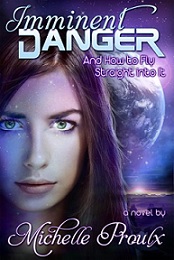
I have followed Michelle Proulx for awhile (her site that is), but never checked out her sci-fi book Imminent Danger.

I’ve long been a sci-fi fan, but I think the “YA/Romance” label threw me off. Not really into either of those genres, well, not at all. And was this one of those “cute girl gets abducted by aliens” stories?

Then I found myself considering the book while reading one of Ms. Proulx’s posts the other day. Maybe it was the cover — the woman on the cover resembled the person on my book cover. Parallel universe, perhaps? Or maybe it was the intriguing blurb. Plus, I need to get my money’s worth out of the Kindle and the book is only $2.99, so I might as well give it a try.

I’m happy I did.

The story of Eris Miller being abducted and her subsequent perils across the galaxy is a fast-paced adventure that will keep you turning the pages. The Hitchhiker’s Guide to Galaxy vibe makes Eris’ bad-day-that-just-got-a-lot-worse an entertaining departure from all the super-serious books out there. It was like I was back in my Space Quest days (gamer fans, you know what I’m talking about).

Even though the author has labeled this YA, I think it will appeal to all sci-fi fans. As for the “romance,” I don’t think there is any more in here than in many sci-fi or other adventures (I’m not counting that creepy Luke-hitting-on-Leia-before-he-knew-she-was-his-sister stuff). That’s a common enough thread in many books not strictly in the romance genre. So don’t worry (if that worries you).

So hold your breath and prepare for hyperspace. Eris is about to make the galaxy wish E.T. never snatched her.

Categories: Books, Fiction | Tags: , , | 1 Comment

How the Father of Fantasy Told His Story

The influence of 19th Century novelist George MacDonald can still be seen in the fantasy genre today. C.S. Lewis referred to MacDonald as his “master.” Tolkien called his fairy tales “stories of power and beauty.” MacDonald encouraged his friend C. L. Dodgson to publish his children stories — later known to the world as Alice in Wonderland under the pen name Lewis Carroll. MacDonald unintentionally became the father of modern fantasy.

Biographer Michael R. Phillips writes he was “deeply challenged with the magnitude and complexity” of telling MacDonald’s life:

…[MacDonald had a] tremendous variety of…literary genres — he was [also] a theologian, a spiritual mystic, a poet, a novelist, a preacher, a scientist, an essayist, a highly successful lecturer, a teacher, an actor, an editor and a fantasy writer — his ideas defy categorization and pigeon-hole analysis.

That MacDonald was a writer can be seen in his comments on potential biographies on himself. He maintained “that no biography should be written, stating that his books contained all he had to say to the world…” Phillips continues:

But it is my hope to convey George MacDonald’s thoughts and emotions…[which are] most strongly reflected through his literary works…his fictional characters were a means of communicating his own ideas and view of the world…The words he wrote…illuminate what he thought about, how he approached his quandaries, what kinds of questions he asked, and what answers he found…His books are the fullest means we have to get under the surface of his thought-skin to discover what really made him tick.

Therein lies a truth for all writers. Their fiction is art, entertainment and conveyor of ideas and messages. Ultimately, though, no matter how they try not to (if they try not to), parts of their story is also in the tales they tell.

I have written often here that everyone has a story to tell. That doesn’t just mean in the sense of sci-fi, fantasy, thriller or romance. It means the stories that reveal who you are, regardless of what background you tell it against.

Categories: Writing | Tags: , , , , , | 2 Comments

Return to Mars

Ever wish there were new adventures of your favorite books? One more trek across Middle Earth? Just a few more stories from Bradbury? Another voyage to Barsoom? Once an author has passed away, all such chances fade away, with rare exception. Tolkien’s son did complete his fathers The Children of Hurin. When Robert Jordan knew his health was failing, he made sure someone was going to finish his Wheel of Time series. There also has been a number of attempts to bring back Edgar Rice Burroughs quintessential space hero, John Carter, back to life through the world of comics.

First, I’ve never been into comics. I think I owned one at some point long ago. Now even the word “comics” is archaic and they have been replaced with graphic novels (graphic in the sense of lavishly illustrated). I may have to make an exception here, if it means more epic adventures across the Red Planet.

Back in the late 1970s, Marvel created the John Carter: Warlord of Mars series of new tales that took place within the first book, The Princess of Mars. A few years ago, all of the issues were collected into one volume (it’s surprising how vivid the artwork is when printed on high-quality paper as opposed to the old comic newsprint).

In recent years, Dynamite has brought Carter back in its graphic novels. One of the spin-offs of the series features the princess of Mars, Dejah Thoris, in her own adventures before she ever met earthling John Carter. Because of the highly visual nature of this iteration, these stories are usually labeled for “mature” readers.

Burroughs’ books weren’t explicit in nature, but what happens when the violence is visualized – and those barely clothed Martians are depicted? Whereas the books leave much to the imagination, these graphic novels — not so much. Ironically, Burroughs’ blink-and-you-miss-it description of Dejah Thoris in the first book would inspire decades of sci-fi and fantasy art.

So if you long to return to high adventure on the distant Red Planet, John Carter and Dejah Thoris are still out there generations after we first read of their meeting.

The ultimate action couple.

Categories: Fiction | Tags: , , , , , , , , , , | 1 Comment

Writing and That Other Job

Author Mike Duran gives some tips on how to manage your writing while holding your “day job.”

Categories: Writing | Tags: | Leave a comment

Tainted

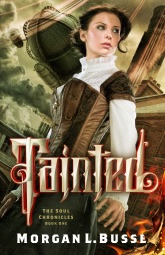
I’ve posted a number of times on Morgan L. Busse‘s incredible Follower of the Word fantasy series. Now she has given us a first look at the part one, Tainted, of her new steampunk series coming next spring:

Hopefully, some more sneak peaks into the series are coming soon.

Categories: Books, Fiction | Tags: , , , | Leave a comment

13 Hours

Michael Bay gets criticized for his flashy Transformers movies, but say what you will, he does have a tremendous visual style. Now he returns to ground tread in his film Pearl Harbor in 13 Hours:

fflm

As much as I like alien robots, stories about American heroes trump them any day.

Categories: Modern History | Tags: , , , | Leave a comment

Lord of the Apes

I have posted numerous times on the books of Edgar Rice Burroughs. His knack for fantastic adventures set the stage for books and film for decades right up to this day. Funny, though, I have never read his best known series.

Tarzan.

Twenty-six books in the series were penned by Burroughs. Some 200 films have the name Tarzan in the title, but most stray considerably from the source material. First written in 1912, Tarzan finally gets the big budget Hollywood treatment it deserves:

fflm

Disney failed to launch Burroughs’ epic Barsoom tales into a franchise (though take a look at how much Burroughs’ Mars books inspired Star Wars), but maybe Warner Brothers can bring Tarzan into the 21st Century.

And quite frankly, we need a hero who isn’t a mutant or alien.

Categories: Books, Fiction | Tags: , , , , | Leave a comment

Create a free website or blog at WordPress.com.