Soon the veil will thin and not all beyond is meant to be found…
Tentative sequence and titles of the Watchers of the Light series announced here. More previews coming soon.

Soon the veil will thin and not all beyond is meant to be found…
Tentative sequence and titles of the Watchers of the Light series announced here. More previews coming soon.
There’s been much debate among Christian writers on what writing “Christian Fiction” means. The artificial rules of Corporate Christian Publishing would eliminate many of the well-known writers who were Christians. These would include J.R.R. Tolkien and C.S. Lewis, as Donovan M. Neal writes. Many Christian writers – like writers of all beliefs – just want to write their story. A story informed by their beliefs (again, like all writers), but where their beliefs come through organically – not forced or contrived by some sort of formula. I’ve read books from all sorts of authors who want to lecture or preach to their readers. Really, it’s the difference between good and bad writing.
That’s not to say there isn’t anything good on the Christian Fiction shelf. There’s good and bad in all fiction markets and genres. Part of the debate also concerns the pros and cons of having your fiction labeled by your religion. If you are writing for a specific audience, then I suppose it’s fine, though religion is still bit of an unique way to classify fiction. Yes, there are other examples of targeting this or that demographic.
In the end, regardless of a writer’s beliefs, they shouldn’t spend their time figuring out how to be successful in getting certain people to read their books. They should write their story.
Readers should demand it.
Sure, your favorite on-line or brick and mortar bookstore have thousands of books to choose from. What about the thousands that came before? Used bookstores, flea markets and especially on-line sellers have given new life to forgotten books. It’s like a treasure hunt: Buy a bag or a “lot” of books and hope to find a couple gems. Maybe a new author, who isn’t so new, that you want to read more from. Or something out of the thousands of reads from the heyday of sci-fi and pulp fiction may grab your interest.
Perhaps an over-the-top adventure with the Swordmen of Vistar, a homage to the works of Edgar Rice Burroughs (unfortunately, the author never continued the series). Travel among the stars to save Earth in Cosmic Engineers or The Way Station from sci-fi master Clifford D. Simak. Live an amazing life throughout the universe in Stardrift. Survive on your own, on the run, in the all too real Rogue Male.
Don’t pass up those books with the yellowed pages and worn covers that are like unearthed scrolls.
A treasure may lay inside.

Anastasia writes on Reading and Snobbism.
Ever know someone who can’t just let themselves enjoy a book or movie? “That movie is just completely implausible and unrealistic,” they say. “But it’s about alien robots!” you respond. Not everything has to be dead serious. Can you write purely for entertainment?
We have examined how a writer can be entertaining and thoughtful, about writing with your own voice and readers misunderstanding your book. These are all important considerations to a writer, but can he or she write more for pure entertainment? Sure they can.
Ultimately, an author’s beliefs or views come out somewhere in a book, but they don’t even have to be the central theme – or a theme at all. Think of all the barely plausible thrillers, and the movies that come from them such as 007, and how entertaining they are. Edgar Rice Burroughs nearly invented the swashbuckling “man finds himself in alien world/culture and must survive one peril after another to get the (native) girl in the end” scenario. He used the archetype in nearly every book he wrote, but through changing the details and characters he made each an original, breathless read.
Sure, his books weren’t without comments on society and such, but for the immersive reader they are the perfect escape. An immersive reader disappears into a book and doesn’t analyze or critique or try to figure it out. They want to be pulled in and, if the writer is good, the reader will catch whatever themes and messages work their way into the story. There’s nothing wrong with starting with a message, so long as it is organically delivered. However, most authors are seeking to tell a story first and foremost. Some may be doing so for pure escapism. Robert Adams writes at the start of his Horseclans series:
The following tale is a fantasy, pure and simple. It is a flight of sheer imagination. It contains no hidden meanings and none should be read into it…rather, [this is] intended for the enjoyment of any man or woman who has ever felt a twinge of that atavistic urge to draw a yard of sharp, flashing steel and with a wild war cry recklessly spur a vicious stallion against impossible odds.
It’s your story. Have a little fun.
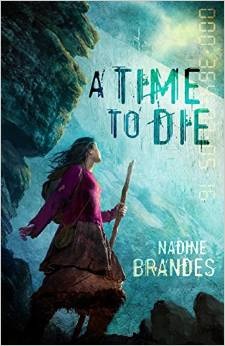
“People are allowing themselves to place time above life.” Parvin Blackwater should know, her Clock is counting down to her last day. She’s always known when the end would be, but she won’t let it define her. “I want…to be remembered.” This is the core of Nadine Brandes‘ novel A Time to Die, a refreshingly original entry into the crowded dystopian genre.
The world has been shattered by a global disaster and the nation is divided. A wall divides the East and the West. There are cities outside the wall, but desolate areas where people have regressed to primitive cultures. Parvin and her family are at the bottom of society inside the Wall. The elites who rule the society that rose from the ashes control the population through Clocks. Each person knows when the end will be as their Clock counts down (somewhat reminiscent of the film In Time). Eighteen-year-old Parvin is only months away from the end and her life hasn’t amounted to much. She is determined to change that in what time she has left.
We have a typical dystopian background, but instead of that overwhelming the story, Nadine Brandes focuses in on Parvin’s journey. It’s not an easy one, with some moments that will take you aback. There’s more depth in this character’s pilgrimage than in similar books. Not the simple “rise against the oppressors” story, Parvin must learn who she is and what she believes if she is to learn her place in the world. Told perfectly in the first person, we get to see her struggle with belief, with God, doubt and with what she encounters outside the Wall. Yes, like the female protagonists in those other books, Parvin is challenged beyond anything a normal person would face. Here, though, it isn’t all that obvious where this will lead. Maybe she will challenge the oppressors, indirectly or directly, but she’s certainly not taken the well-worn route of her contemporaries (in other novels, that is).
By approaching the dystopian tale from a different path, and themes of time, finding one’s place in the Story and of belief, Brandes has begun a captivating epic.
We do not go to the green woods and crystal waters to rough it, we go to smooth it. We get it rough enough at home; in towns and cities; in shops, offices, stores, banks – anywhere that we may be placed – with the necessity always present of being on time and up to our work; of providing for the dependent ones; of keeping up, catching up, or getting left.
So wrote George W. Sears – better known as Nessmuk – in his 1884 book Woodcraft. It has been in print ever since.
His words apply today just as they did over hundred years ago. We like to think we are better off than our ancestors in all ways, but clearly we are not. We still immerse ourselves in busyness and then complain we are exhausted and have no time. Nessmuk’s book was directed to such average folks – not the “man of millions” – in hopes they would find “at least once a year…a season of rest and relaxation” that they “well deserve.” He mentions those who succumbed to the “temptation to buy this or that bit of indispensable camp-kit.” If only he could see the outdoor industry now. He recommended we “go light; the lighter the better, so that the simplest material for health, comfort and enjoyment.” That’s something, I suppose, we can all consider in all parts of our lives.
The wild still calls to people as it has for generations. We’re almost aliens on this world, yet are uniquely designed to enjoy what John Eldredge calls the “extravagant beauty” that is all around us. We can’t raise nature to be a god and put it over the lives of humankind, but it is certainly there for those who wish to find it. Nessmuk ends his book with these words:
Wherefore, let us be thankful that there are still thousands of cool, green nooks besides crystal springs, where the weary soul may hide for a time, away from debts, duns and deviltries…
Free yourself from being busy. Eden awaits.

The other day I discussed some tips on writing dialogue. Roz Morris gives some more insight in keeping your dialogue from being awkward or stilted. Hayley Knighten reveals the 5 Worst Ways to Start Your Novel. Lastly, Lynette Noni explains how to create a real fantasy world.
Islands.
Something about them has always drawn people to them, in real life and in fiction, for a variety of reasons. They are disconnected from the world and hideaways from life. Some are marooned on them. Pirates love them. They harbor lost worlds and indecipherable mysteries. Film and television has a constant stream of island adventure, but many of those tales, and our fascination with them, originated in books. Treasure Island, Robinson Crusoe, The Island of Doctor Moreau, The Land That Time Forgot and others set the precedent.
Perhaps it takes going to the island to learn more about ourselves. Or, at times, just to have fun.

Unfortunately, they weren’t reading this website. They were, however, just as capable of us of finding something to do. Kids weren’t wondering aimlessly without their tablets and phones. In fact, we aren’t all that far removed from the days when kids played outside all day and had to practically be forced back home for meals and bedtime. Nor did folks pull up the internet every time they needed to learn how to make, fix or craft something. Someone at sometime taught them in person.
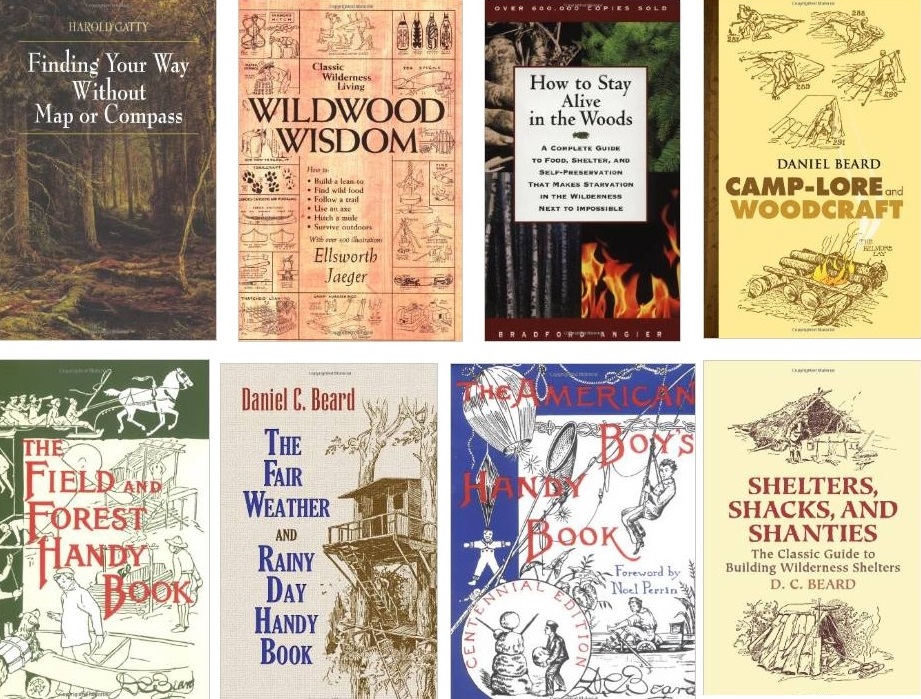
The books below embody some of that old time knowledge and know-how for outdoor projects, skills and survival. Many of these books have been in print, in one form another, for decades. They are for collectors of nostalgia, those who would like to get their hands dirty or people who want to learn their way through the woods without a GPS and survive without a grocery store.
Someday we may all wish we had taken the time to preserve the wisdom of those who came before us.


 Darrick Dean