education

Meta Study: How to Master Any Subject

Want to learn about Roman history? Have a desire to wrap your mind around astrophysics? Is your ongoing learning inhibited by bad memories of school learning, aka kid prison?

Don’t fret, there is a way to break down a subject, and learn it to a level at which you can discuss it intelligently.

In scientific studies, there is something called a meta-analysis where multiple reports or studies of a particular subject are synthesized into one new study. I’ve adapted this into the meta study which allows you to tackle a particular topic.

Step 1: Define Limits

This is the hard part where you have think a little bit. Here’s where you survey your subject of interest and define some limits. Any subject, whether history or health, or anything you can think of, is a bottomless pit of specializations. You’ll need a manageable bite. What in history do you want to study? Roman Empire? Divide this into time periods: Early Rome, Imperial Rome, Decline of Rome. Health your subject? What part of health? Proper human diet? Okay, determine what people are claiming are potential, proper human diets.

Step 2: Pick Sources

There are thousands, so you cannot read them all. Search out some of the most current and respected sources. There are some pitfalls here, because simply because something is popular, doesn’t make it true or valuable. Also, you cannot bring in your a priori bias in picking materials. Approach any subject as an independent researcher as if you have no knowledge of what you are about to study. Some topics may require you to read sources that have contrary conclusions.

Note: I default to books because of their depth of information and accessibility. These should be the core of your studies, but other sources such as interviews and documentaries are also useful.

Step 3: Start Reading

Once you have your initial books (you will likely need more), begin reading, but keep these items in mind:

  1. Take note of any things you come across you want to learn more about. That is, save these rabbit trails for later. Back in our Roman history example, you’ll run across many events, people, etc., that many volumes have been written providing much more detail. Stay on point for now.
  2. Watch for the saturation point. When your readings start becoming repetitive with not a lot of new material, you have reached a strong point of understanding of your subject.
  3. Explore some of those interesting items which you took note of until you reach understanding with them as well.

How do you really know if you have reached some level of mastery of your subject? Do you understand “experts,” real or otherwise, when they speak on the subject? Are you able to ask questions, detect discrepancies, while you or someone else is discussing the topic? Can you discuss the topic easily?

Realize there are people who spend a lifetime specializing in a topic, whether in formal or informal settings. You could get there, but your goal here is to understand subject, be intelligent in speaking about it, and not necessarily knowing every last detail.

Step 4: Maintenance Phase

Once you’ve reached a comfortable level of understanding there are a couple of actions to undertake. Look through all of your resources and keep the best of the best. That is, remove any that are repetitive, not as engaging, or as current. Secondly, check back every so often for new resources that are released. Some topics are very dynamic in new information, others are more static.

Good luck on your journey of learning. Be a time traveler in history, take control of your health, or travel the universe.

Whatever trail you choose, be prepared for some amazing, or startling, discoveries.

Categories: Critical Thinking, education, What You Can Do | Tags: , | 2 Comments

Your Health was Traded for Wealth: Will You Take it Back?

Virtually every chronic disease is preventable. Their common link: The food we eat. What we were told was safe and healthy to eat wasn’t based on science, but on corporate capture. That is, corporations funded the studies, wrote the government standards.


Your health traded for money.


Now we are paying for it. Drastic increases in chronic diseases. Fertility and birth rates dropping dramatically. People fighting over “reproductive rights” during this election season might want to ponder over this. No one is going to be able to reproduce. Ever see the dystopian film Children of Men? It’s coming true. The integrity of our health and food supply should be an issue that brings everyone together.

Casey Means and Calley Means have truly opened the eyes of millions. Is it enough to reverse the growing disaster? Will people put aside their differences – both real and imagined – before it’s too late?

Categories: Critical Thinking, education, health | Tags: , , , , , , , , | Leave a comment

Paradigm-Shifting, Thought-Provoking Discussions about the World We live In

“What people usually don’t think about, is what do you do in a world where the playgrounds are empty, and the nursing homes are all full?”

Watch Birthgap and learn how fears of overpopulation not only never materialized, but now we are in danger from not having enough children.


What if the dangers of nuclear energy have not only been false, but this plentiful energy source could solve all of our energy problems? See how the criminalization of nuclear energy put civilization on a backward course of development in Nuclear Now. Also check out Robert Zubrin’s new The Case For Nukes.


“The standard American diet (SAD) is what is killing people.” – Dr. Peter Attia, MD

American health has never been worse. Find out how we have been misled and take control of your health in this interview with Dr. Peter Attia.


“The pandemic forecasts in the United States were very grim. Experts were predicting that 60-70 percent of the population would ultimately be infected resulting in over 1.5 million deaths in just a few months. People on social media were in an absolute panic. Stories about empty shelves and runs on toilet paper were everywhere. Those who tried to refute these doomsday predictions were shouted down and eventually silenced.


“And yet, the science on the virus was very clear. Disease severity was age-stratified. Extreme measures would not drive it away and would cause a tremendous amount of collateral damage. Even if the worse-case scenarios were true, it was extremely important that we take measures based on evidence.


“But eventually, the cry to ‘do something’ became overwhelming, and the costs no longer mattered. Trying to calm people with wisdom about infectious disease became nearly pointless. Germophobia swept through society and political culture.


“How did people in our communities and around the world get to the point of hysteria over a pandemic with a clear age-stratified and comorbidity-amplified mortality? Why were young and healthy people with very little risk for disease and death treated as if they were a grave danger to others?” – from Fear of a Microbial Planet. Also listen to the interview with the author Steve Templeton.


“It became clear to us over time that the U.S. government had turned its propaganda and disinformation campaigns it had been waging abroad, and turned them against the American people. That’s where we started getting chills up our spine. There was something seriously sinister going on.” – Michael Shellenberger

Learn how the government chose the Orwellian Nightmare over your rights in this interview with Michael Shellenberger.

Categories: Books, Critical Thinking, education | Tags: , , , , , , , | Leave a comment

The Coming Energy Disaster

What if everything the politicians and activists have told us about green energy is wrong?

What if fossil fuels have so improved our quality of life, negating negatives, that abandoning them would condemn us to a dark age?

Alex Epstein‘s Fossil Future is a rare combination of science, intellectual analysis, and critical thinking so absent in discussions about energy and climate. It’s one of the few books deserved to be called paradigm changing.

Many have received their knowledge about climate and energy issues comes from anointed tv experts, activists, and politicians. Unfortunately, these sources are completely bankrupt of science. Epstein’s book is a major effort in returning reason to the discussions and debates. His identifying the current energy policies as leading us into a new dark age may be surprising, but it is rooted in fact. As an engineer, I can confirm the alleged miracle benefits of green energy are mythical. Unreliable, low-output, intermittent sources like solar and wind can never replace high-output, constant sources from fossil fuels or nuclear. It’s not a matter of making solar or wind better, or building more of them. There are limits dictated by physics radically handicapping these sources.

Abandoning fossil fuels (and nuclear) will put our society, and everything we take for granted, in peril. The headlong dive into unscientific energy policy is disturbing and dangerous.

Who we elect as our leaders will determine if humanity continues to rise upward, or spiral backwards into a time of scarcity and oppression.

Categories: Books, Critical Thinking, education | Tags: , , , | Leave a comment

Founding of America: The Story You Weren’t Taught

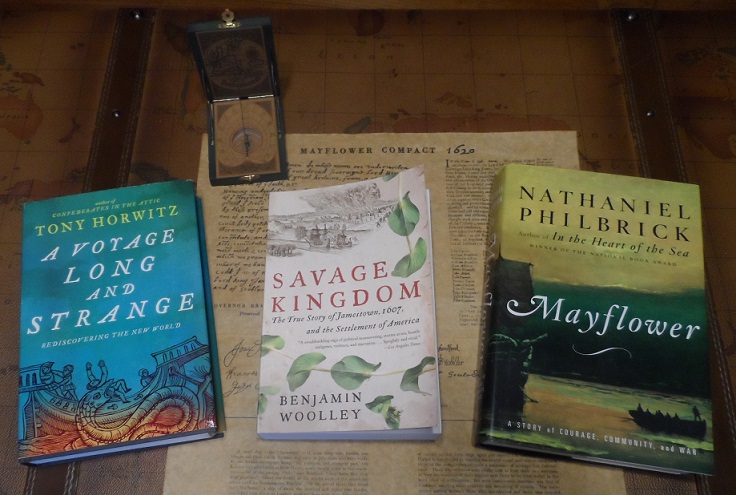
Tony Horwitz wrote in his revealing book, A Voyage Long and Strange, “Expensively educated at a private school and university — a history major, no less! — I’d matriculated to middle age with a third grader’s grasp of early America.” Horwitz would remedy this problem by beginning a cross-country adventure. He would uncover this missing history from first contact with the Vikings, to the forgotten era between Columbus’ landing in 1492, and the founding of Jamestown in 1607. Even those humanity-changing events have been reduced to mere sentences in our history lessons, as Horwitz discovered.

An artifact of our education system, history has long been neglected. Arguably, it’s the most important field once you realize how much our ancestors can teach us. There is little we experience or endure they didn’t experience first. In our hubris, we ignore the answers to the test they have handed us. By reducing our study to names and dates, they seem like myths. Many would be surprised how much we do know about the people who came before us. The best teachers and writers of history re-discover this past and allow us to time travel through the eyes of our ancestors. In Horwitz’s case, he found a “dramatic tale of conquistadors, castaways, French voyageurs, Moorish slaves, and many others who roamed and rampaged across half [of the continent of North America], long before the Mayflower landed.”

In Nathaniel Philbrick’s Mayflower, he finds while there is “a surprising amount of truth in the tired, threadbare story of the First Thanksgiving,” it was only the beginning of the story. That event was followed by “fifty-five years of struggle and compromise — a dynamic, often harrowing process of give an take. As long as both sides recognized that they needed each other, there was peace.” War eventually came, but “there was nothing inevitable about King Phillip’s War” which “caught almost everyone by surprise.” It’s a story with a powerful and relevant message for our time: “When violence and fear grips a society, there is an almost overpowering temptation to demonize the enemy.”

How could the settlement of Jamestown, its tenuous survival through famine and conflict, pushed to the edge of extinction many times, produce a transformative country a century and a half later? Benjamin Woolley’s Savage Kingdom, peels back the mythos often centered on John Smith and Pocahontas, and finds a motley but determined group who were “deposited…in America…ill prepared, badly equipped and poorly financed.” Where Plymouth was founded for religious freedom, Jamestown was a wholly economic enterprise. Yet even that doesn’t tell the whole story. This attempt to colonize America was “…about flawed, dispossessed, desperate people trying to reinvent themselves. It is about being caught in a dirty struggle to survive, haunted by failure, hungering for escape, dreaming of riches an hoping for redemption.”

These, then, are timeless stories of humanity’s struggles. Perhaps we should pause and listen to what our ancestors have to say.

Contact and connect with Darrick here. Get your copy of Among the Shadows and choose a side. Will it be on the side of Light? Or Darkness? Book 2, Awakening, coming soon.

Categories: education, History | Tags: , , , , , , , , , , , | Leave a comment

Are Readers an Endangered Species?

I hope not, for as Jeff Minick writes, “When we make readers of our children, when we ourselves read books, we help keep our culture and our civilization alive.”

Read the whole story here.

Categories: Books, education | Tags: , | Leave a comment

12 Rules to End Chaos in Your Life…and the World

{Part 1 of a series of posts reviewing Jordan Peterson‘s book, 12 Rules for Life: An Antidote to Chaos.}

Jordan Peterson‘s bestselling book, 12 Rules for Life: An Antidote to Chaos, challenges people to get their own lives under control before trying to change the world. No, this isn’t just another book about steps to success or happiness. This isn’t some fad book-of-the-week that are no different than the previous twenty forgettable books. Peterson asks readers to reach deep intellectually. Drawing on ancient history and science, and critical thinking, this clearly isn’t just some fuzzy book on “self care” or quick fixes.

Norman Doidge sets the stage in the forward writing:

…without rules we quickly become slaves to our passions — and there’s nothing freeing about that…Ideologues are people who pretend they know how to ‘make the world a better place’ before they’ve taken care of their own chaos within…Ideologies are substitutes for true knowledge, and ideologues are always dangerous when they come to power, because a simple-minded I-know-it-all approach is no match for the complexity of existence.

And in no time in recent memory are people in need of clear thinking in the face of ideologues and extremists. Peterson was attacked for his defense of free speech and academic freedom by those who claimed to be “open-minded” or “progressive.” Doidge notes, whether they realize it or not:

…millennials are living through a unique historical situation. They [have been]..thoroughly taught two seemingly contradictory ideas about morality…[leaving them] disoriented and uncertain…tragically deprived of riches they don’t even know exist.

And so a generation has been raised untutored in what was called, aptly, ‘practical wisdom,’ which guided previous generations…[suffering] a form of serious intellectual and moral neglect. The relativists…chose to devalue thousands of years of human knowledge about how to acquire virtue…

..made worse by this moral relativism; [people] cannot live without a moral compass, without an ideal at which to aim in their lives…So, right alongside relativism, we find the spread of nihilism and despair, and also the opposite of moral relativism: the blind certainty offered by ideologies that claim to have an answer for everything…Sometimes it seems the only people willing to give advice in a relativistic society are those with the least to offer.

Whereas many, in their hubris, think the past as nothing to offer, our ancestors knew differently:

For the ancients, the discovery that different people have different ideas about how, practically, to live, did not paralyze them; it deepened their understanding of humanity and led to some of the most satisfying conversations human beings ever had, about how life might be lived.

Then Peterson begins:

Through the elevation and development of the individual, and through the willingness of everyone to shoulder the burden of Being and to take the heroic path. We must each adopt as much responsibility as possible for individual life, society and the world…the alternative — the horror of authoritarian belief, the chaos of the collapsed state, the tragic catastrophe of the unbridled natural world, the existential angst and weakness of the purposeless individual — is clearly worse.

{In part 2 of this review, we will look at Peterson’s first three rules.}

Categories: Books, education | Tags: , | Leave a comment

When Education Fails

Each generation of American children has learned less real history than the generation before it. Each generation of American children has instead been subject to greater levels of indoctrination in place of genuine education. – Joy Pullman

And because of this “prejudiced ignorance” created from the failure to teach history, several monuments defaced by rioters in the United States are actually monuments of abolitionists and those who represent everyone.

History matters, yet it gets a backseat in education, if it gets a seat at all.

Categories: education, History | Leave a comment

Free Speech Under Assault

One of my maxims is:

If you cannot defend the right of free speech for the person you disagree with the most, you don’t believe in free speech.

As this article from The Economist relates, free speech is under attack around the world. It’s not surprising to see this in dictatorial countries, but suppression of free speech is alive and well in democracies. Most disturbing is how it is tolerated — encouraged even — in the American university. The purpose of universities is twofold: Preserve and pass on knowledge and history to one generation to the next; and promote the free exchange of ideas and foster new knowledge. Instead:

Free speech is hard won and easily lost…[even] in mature democracies, support for free speech is ebbing, especially among the young, and outright hostility to it is growing. Nowhere is this more striking than in universities in the United States…and an incredible 10% approved of using violence to silence [speech].

I have been following the Death of the University, which itself is a sad situation of this great institution of western culture. Just as bad is the trend of silencing speech — often by the very people who claim to be for it.

This trend must be stopped dead in its tracks.

Categories: Critical Thinking, education | Tags: , , , , | Leave a comment

Children & Books: Why #ReadingMatters

We’ve all been told how important reading is for the development of a child’s mind, not just so they can get an A in reading class, but for their intellectually well-being the rest of their life. This has become even more important in the age of electronic gadgets. Anna Mussmann writes:

[Children] must be able to hold large ideas in their minds. They must be able to recognize the differences between logic and propaganda. They must possess the self-discipline needed to focus on issues that are boring, and seek the wisdom to differentiate between what is right versus what is expedient or amusing. Most of all, they must possess the perspective of a true education in ideas so they can think outside the echo chamber of our era.

All of this is deeply connected to what and how we read. It is not that people who use their phones frequently are necessarily dumber than people who don’t. Like any tool, though, screens can be dangerous. They can fill the spare moments of life until no time is left for thought and deep learning. They can retrain our brains and make it hard to focus on a long-form conversation, whether in-person or in print.

Books are one of the best ways to guard our minds against a misuse of screens. Books aren’t magical mind-vitamins, of course. Yet in order to cultivate the ability to think, we must engage with good, wise, and true thoughts. And it happens that the works of humanity’s greatest thinkers are found in books.

She also writes on what it means to be a “reader,” and how to set an example to children. Kristen Mae shows us how to “trick” your kids into reading — in a good way. Michelle Woo details the sad truth of why some kids stop reading by age 9 — and how you can prevent this.

Reading is the gateway to all forms of thought and subject matter. It is a doorway to our past and a pathway to what our future will become.

Make sure it is wide open for your children and remove any and all roadblocks.

Categories: Books, education | Tags: , | Leave a comment

Blog at WordPress.com.