History

Sorry, Christmas and Christmas Trees Still Not Pagan

Every Christmas we hear people proclaiming Christmas and its traditions were once pagan or still are pagan (“pagan” in this context meaning a non-Christian religion). My first instinct is to laugh at those who think they discovered some long-lost, secret knowledge. My second thought is to turn to history for the truth.

Christianity has a long history of subverting — or appropriating — items, thoughts, days, and locations from other cultures if they agree with Christian teachings. Sometimes these things are given new meanings if they don’t agree Christian beliefs. This method of opening the door to Christianity for people was initiated by the Apostle Paul.

In the Areopagus Sermon, recorded in Acts 17:22–34, Paul argues to the Greeks at their high court on the reality of God by using the words of their own thinkers such as Epimenides, Aratus, and Cleanthes. He starts by pointing to one of their monuments: “I even found an altar with this inscription: TO AN UNKNOWN GOD. So you are ignorant of the very thing you worship — and this is what I am going to proclaim to you.” Paul is subverting parts of their own beliefs that can, or do, point to God, to open their mind to the discussion by highlighting what is already in agreement.

If we go further back, we find more examples of subversion. The Ark of the Covenant is very similar to Egyptian ark designs, and Israel’s temple also has likenesses to Egyptian temples. Why would God give the Israelites instructions to build these using Egyptian archetypes? Probably due their familiarity after living among the Egyptians for so long. However, the Israelites also let other things they had learned corrupt them. The Golden Calf could have been inspired by the Egyptian veneration of the Apis Bull. These are among many Egyptian details recorded in Exodus — including the name Moses which was borrowed from the Egyptian language — which lend credibility to the accounts. Skeptics who doubt the events in Exodus have to explain away all the subtle, and not so subtle, Egyptian references.

There are other examples, but here we have seen God, Paul, and later Christians appropriate objects and writings from other religions and give them new meaning. People who claim these things are bad because they once were pagan, are committing the genetic fallacy. In other words, as I like to say, Who cares what they once meant, what do they mean now? Sure, not everything can be easily appropriated. Some things not at all.

A popular rebranding method was when Christian denominations would take pagan festival dates and rename them and given them new meaning. Does Christmas Day and some of its associated traditions fall under this category as we are often told?

Actually, they do not.

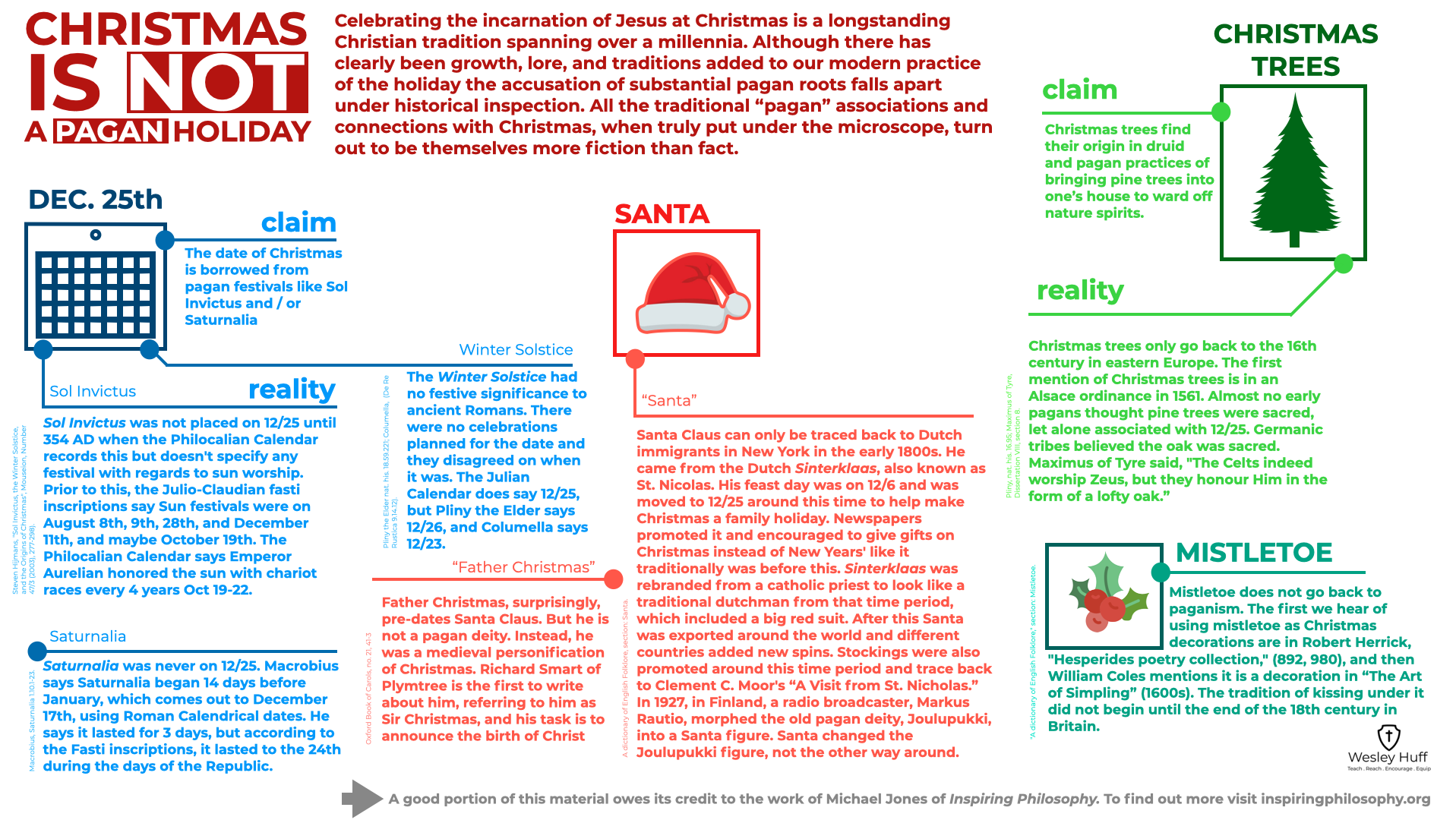
Biblical and ancient documents scholar Wes Huff explains in this video why “All the traditional ‘pagan’ associations and connections with Christmas, when truly put under the microscope, turn out to be themselves more fiction than fact.”

Historian William Tighe concluded after his research, “The ‘pagan origins of Christmas’ is a myth without historical substance.” Wes also provides these two infographics summarizing his research: Christmas is not a Pagan Holiday and So Where does Dec 25 Come from if it’s Not Pagan?

Check out those links for all the research. Most people don’t bother to test what they hear, especially if it fits a preconceived bias of one sort or another. Ultimately, the methodology of opening the door to discussing Christianity by finding points of agreement is a logical and sensical approach.

We can’t really say the same about all the drive-by scholars and their yearly attempts to rewrite history.

Categories: Ancient Documents, Bible, Critical Thinking, History, Traditions | Tags: , , , , , , , | Leave a comment

Learning From Thanksgiving

To our detriment, history is often distilled down to a few sentences in our schools. As writer Nathaniel Philbrick writes in Mayflower, “there is a surprising amount of truth” in our “threadbare story of the First Thanksgiving.” It is what happened before and after that people know so little about.

It is a vivid tale of “courage, community and war,” and out of this little told story, a country was shaped. Philbrick writes:

There are two possible responses to a world suddenly gripped by terror and contention…[one way is] to get mad and get even. But…unbridled arrogance and fear only feed the flames of violence. Then there is the [Benjamin] Church [a frontiersman born in Plymouth] way. Instead of loathing the enemy, try to learn as much as possible form him… try to bring him around to your way of thinking. First and foremost, treat him like a human being…and in this he anticipated the welcoming, transformative beast that eventually became — once the Declaration of Independence and the Constitution were in place — the Untied States.

In an age where politicians and their followers knowingly try to divide people only to hold on to power, where some believe violence is acceptable, where people think harassing people is a way to effect change, and others think its nothing to fabricate fake fears and crisis to scare people onto their side, perhaps we should for once look to our own history.

We could learn from their trials and tribulations, far worse than our own. Then with crystal clarity, those who seek to undo what was born out of the good and the bad, will be unmasked and exposed.

Categories: History | Tags: , , , , , | Leave a comment

Our Place in Time and History

For many people, remembering history from five years ago is a challenge. A few decades ago seems like eons, so people tend to ignore anything before their lifetime. It’s all ancient history.

Is it really that long ago?

I have previously discussed how we are all part of the continuity of civilization and a link the chain of history. Part of that concept is we know people who have lived decades before us, and they knew people from earlier eras, and so on since the beginning. Suddenly, the past doesn’t seem so distant through the connections we have, and from what has been passed down to us.

Neil Howe, writing in The Fourth Turning is Here, describes this as our personal history span, which can be double your natural life:

Most of us possess first-person personal contact, through our families, to an impressive span of historical time time…consider a Gen-X woman born in 1965…[and] the oldest person she personally got to know as a young child…Very likely, this was a…grandparent (or great-grandparent) born in the mid-1890s. Let’s then imagine how long this Xer will live. Suppose we project that she lies to a least age ninety (in 2055), when she gets to know a grandchild (or great-grandchild) who in turn could be expected to live to the year 2130.

Now let’s measure this total span of time—from the first moment in the life of the oldest person this Xer got to know personally as a child to the last moment in the life of the youngest person she will know personally before passing away…this stretch of years—let’s call it her personal history span—stretches from 1895 to 2130, or 235 years.

When you look at our lives like this, you can see the length of impact you can have, and your connections with a not-so distant past.

As Howe writes, “As we contemplate the full range of these experiences—in the lives of those who once cared for us and in the lives of those whom we will someday care for—we can’t help but look for structure, parallels, and lessons…[as] Ibn Khaldun observed at the very dawn of modernity: ‘The past resembles the future more than one drop of water resembles another.'”

Categories: History | Tags: , , , , | Leave a comment

Reclaiming Native History

“As with all historical events, it is a fool’s errand to judge it by contemporary standards.” – Michael Walsh

Far too often, historians, or those who pretend to be historians, try to understand history through modern eyes. Sometimes this is unintentional, but often in our era, it is purposeful revisionism driven by narratives and personal beliefs rather than a desire to understand the past.

One of the most interesting trends in history has been the changes in studies of Native American history. It is one of many historical subjects that have been battered by changing narratives and people with little regard for truth. This, though, is changing.

For many years, academia tended to paint Native Americans as helpless victims, wiped out by ruthless Europeans. Kathleen DuVal, in Native Nations, writes, “More recent U.S. history textbooks provide more coverage and rightly condemn the violence…but tend to emphasize victimization and decline.” Duval shows how influential writings on native history by Howard Zinn, Dee Brown, Jared Diamond, and Charles Mann enforced this idea that “Europeans dominated North America virtually from the moment they arrived here” and the natives were “helpless victims.” Even now, education still often portrays American Indians as peoples from the past, as if they no longer exist, and “overemphasize the periods of catastrophe” like the Cherokee Trail of Tears or the Wounded Knee Massacre.

This narrative has begun to crumble, a change often driven from natives themselves. They weren’t wiped out, and scholars trying to do native history justice, often have done the opposite with unsupported death, disease, and population numbers. Now, historians are recognizing, as Pekka Hämäläinen writes in Indigenous Continent, this was “a four-centuries-long war” and “Indians won as often as not.” While there “were colonists who utterly despised Indians and wanted to eradicate them” there were many who “sought to embrace them.”

Natives prospered from trade and contact, and sought out such activities. They suffered as well in this classic clash of different civilizations, not unlike what had played out thousands of times in history. However, they weren’t clueless, innocent hippies wandering through the woods, hugging trees. They weren’t much different from the Europeans, both good and bad. War, slavery, and torture were not uncommon.

There is a lot of overlap in DuVal and Hämäläinen’s books, and they are excellent histories of native history after contact. There are times where both authors seem to have trouble letting go of the very inaccurate histories they are trying to correct. DuVal likes to often remind readers the Europeans were white, not understanding ideas of racism weren’t the same as modern ones. For example, racist beliefs directed from one white European group to another were common well into the 20th Century. Nor did all Europeans base their perceptions of the natives based solely on skin color. Both authors talk about colonialism like it was a new invention in the Americas, as if this wasn’t a driving force in civilization’s expansion and growth since mankind began. These and some other points are artifacts of interjecting modernity into the past.

This why I think Jeff Fynn-Paul’s book, Not Stolen, adds good balance to these other studies. Fynn-Paul doesn’t obscure the bad events on the continent between natives and the newcomers, but he shows there was often more to the story. For example, the tragic Cherokee Trail of Tears was not something that went unnoticed at the time, nor was it widely supported. Quite the opposite, it was very controversial with the public, and the president was acting against a ruling of the Supreme Court. The point being, there wasn’t a widespread conspiracy to wipe out the natives. While DuVal and Hämäläinen sometimes throw around the word genocide, the individuals who were for such things didn’t have broad support for the total destruction of native nations.

Admittedly, trying to formulate a balanced history of such a complex era of the past, involving so many people, is no easy task. No one person can survey and collate every available source. We should all strive to examine a broad variety of sources on every subject we study, and do so with an open mind. As Fynn-Paul writes:

An ideal historian will look dispassionately at the evidence, the sources, and the probable facts of a case, and write a narrative interpretation based on reason, logic, and a well-honed sense of judgment. Personnel preference – including political opinions – is supposed to be relegated to secondary status.

Categories: Ancient America, History, Native Americans | Tags: , , , , , , , | 1 Comment

Would we Survive?

c.12,000 B.C.

1177 B.C.

535 A.D.

What do these three years have in common? Events occurring in each changed the course of human history.

A fragmented comet is thought by many to be the source of the first global catastrophe (12,000 B.C.). What caused the upheaval at the end of the Bronze Age is still uncertain (1177 B.C.). During the early years of what would become known as the Middle Ages, a supervolcano in what is ocean between Sumatra and Java sent the world into chaos (535 A.D.).

For eighteen months the Sun was veiled after the eruption in 535 (or 536 according to some sources). Failed crops, flood and drought, and the rise of devastating plagues in the wake of the eruption shaped history by the weakening and collapse of some empires, leading to the rise of others in the shadows of their ruins. It is fascinating to see the ripples spreading through time, from such a distant era, impacting the world even now.

There are many inputs in history, decisions big and small, known and unknown, that nudge or outright push the river of time. As David Keys writes in Catastrophe, this past is both an “explanation of our history, and a chilling warning for the future.”

The natural disasters of recent centuries have been largely localized and temporary in their effects. How long will our luck hold out? Supervolcanoes lay dormant under Yellowstone, Naples, and in Papua New Guinea and California. If one of them explodes, will humanity band together to survive the aftereffects, as they do in all those fictional disaster movies? Or will it be more like Mad Max?

Our hubris, and ignorance of history, puts us in danger of ignoring the natural world and what it can do, and has done, to humanity.

Our ancestors would prevail through the dark times, but as we look back, we realize we are a forgetful race of people. We have forgotten why nations and civilizations rose and fell, and think it won’t happen again.

Every nation or empire that came to an end, thought the same.

Categories: History | Tags: , , , , , | Leave a comment

Unforgettable Lessons

“To those of us who study history not merely as a warning reminder of man’s folies and crimes, but also as an encouraging remembrance of generative souls, the past ceases to be a depressing chamber of horrors; it becomes a celestial city, a spacious country of the mind, wherein [thousands]…still live and speak, teach and carve and sing.” – Will & Ariel Durant, The Lessons of History

I have written often on the importance of studying history, and Will & Ariel Durant’s short The Lessons of History is an attempt to distill such ideas. It also serves as a postlude to their massive, eleven volume, The Story of Civilization. In Lessons, the writers take a broad overview of history, focusing on ten topics, and what history can teach us. Here I will review three of the major themes from The Lessons of History.

Continue reading
Categories: History | Tags: , , , , , | 1 Comment

A Mythology for England?

Many claim J.R.R. Tolkien was creating “a mythology for England” when creating Middle Earth. Certainly there was some inspiration from his homeland, but he drew more from the mythos of Northern Europe, among other sources. This is why Tolkien scholars have disputed he was creating a myth for England. Jason Fisher writes in the J.R.R. Tolkien Encyclopedia, “This must surely be the most-often cited quotation that Tolkien never actually said.”

At any rate, Britannia has its own mythos, it always has. It has endured for centuries, since the age when Rome once ruled the island.

This is the story of King Arthur.

Perhaps no figure from Europe, legendary or historical, has been the focus of more writings – and in the modern era – film and television. Each era reinvents him through the culture-glasses of their time. Much like the tales told in The Iliad and The Odyssey, it is hard to unpack was is true, and what is not, in Arthur’s story. Like Homer’s stories, though, there is likely some truth hidden between the lines.

Our modern perception of Arthur, Merlin, and the Knights of the Roundtable, has been framed through medieval eyes, by the likes of Howard Pyle (who we also owe much of Robin Hood’s story to), and Thomas Malory. Many researchers, however, place the origins of Arthur to the end of the Roman era in Britain. Whispers of a king named Arthur during the time of Rome’s retreat and the arrival of new invaders exist in old Welsh tales.

For decades, Geoffrey Ashe documented the ongoing search for the real Arthur in many books such as The Discovery of King Arthur and The Quest for Arthur’s Britain. Many others joined the quest for the historical Camelot, including The Holy Kingdom and The Mystery of King Arthur. The fantasy versions, often centered around Merlin, are undeniably great fun. Some fiction tries a more historical approach – though often with a mix of myth.

A quick search reveals hundreds of books and films still re-imagining this mythos centuries after it began. Will some archaeological discovery finally reveal the man behind the legend? Or will we only ever have entangled stories from across the ages?

Arthur’s story won’t disappear anytime soon. This mythos of England tantalizes us with what may have been. More importantly, it has left us with a legacy of truth often coming to us wrapped in fiction.

This truth is one of a fearless hero who protects his people, oversees a golden age, and has been prophesied to return. He inspires us to undertake the Hero’s Journey, of our own longing for a lost creation, and perhaps, to remember another who is to return.

In every great Mythos, there is great Truth.

Contact and connect with Darrick here. Get your copy of Among the Shadows and choose a side. Will it be on the side of Light? Or Darkness? Book 2, Awakening, is out now.

Categories: History, Legend, Traditions | Tags: , , , , , , , , , , | Leave a comment

Ready to Open Your Mind?

Here’s a small selection of books I’ve read in 2024, some new, some not, but all important.

What did you read in 2024 and what will you read in 2025 to expand your mind?

Categories: Books, health, History | Tags: , , , , , , , , , , | Leave a comment

Would We See the End Coming?

“There is no certainty as scientific progress accelerates and leisure increases…[that] there is any corresponding advance in wisdom or morality, much less radical improvement in innate human nature.” – Victor Davis Hanson

In this absorbing book by historian Victor Davis Hanson, he looks to our past to remind us of the long-term consequences of war. We are also reminded of how power in the wrong hands can lead to the genocide of entire peoples. In an era where many world leaders have forgotten the ripple effects of war which endure for centuries, and treat it like another government program, perhaps we should look to our ancestors and the fates that befell them.

Categories: Ancient Sites, History | Tags: , , , , , , , , , , | Leave a comment

Dark and Light of Democracy

“We often forget how fragile a creation democracy is – a delicate eggshell in the rough-and-tumble of history. Even in the cradle of democracy, ancient Athens, rule by the people could barely survive for a couple of centuries. And throughout its brief history, Athenian democracy was besieged from within by the forces of oligarchy and tyranny. There were plots led by generals to impose military rule. There were secret clubs of aristocrat who hired squads of assassins to kill popular leaders. Terror reigned during these convulsions…

“Our country’s cheerleaders are wedded to the notion of American exceptionalism. But when it comes to the machinations of power, we are all too similar to other societies and ones that have come before us…no matter where power rules, there is the same determination by those in high places to keep their activities hidden.” – David Talbot

Allen Dulles was the father of the deep state. Anyone who thinks the problems of the national security state, undermining the Constitution, and abuse of power are something new, you’re in for a surprise. Talbot details how it all began. Like Dulles’ daughter said:

“It’s very important to understand it all – the dark and the light.”

Categories: government, History, Modern History | Tags: , , , , , | Leave a comment

Create a free website or blog at WordPress.com.