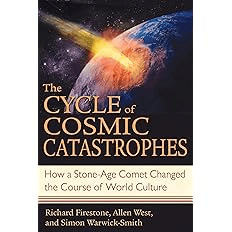
Destroyer of Worlds

“It is likely that hundreds of thousands of bodies, each capable of yielding a multimegaton explosion on Earth, are orbiting within the [Taurid meteor] stream.” – Victor Clube and Bill Napier, Cosmic Winter

Regular meteor showers are the periodic reminder we live in vast universe. For a few nights, they draw people away from their distractions to look at the heavens like their ancestors once did. What if these little fire balls have a darker history?

In Late October, the Taurid meteors often provide a little show — the Halloween Fireballs. These are the remnants of a fragmented comet that came apart 10,000 years ago. Lesser known are the June (or Beta) Taurids, when Earth passes through another part of this debris field. These are unseen since they occur during daylight hours.

They also may be the source of humanity’s near extinction.

As Earth emerged from the last Ice Age, something catastrophic interfered with climate cycles that persisted for hundreds of thousands of years. One result was the stable climate we now live in, which is a good thing, right? It is, unless the old cycles reassert themselves, or another disaster befalls us.

The bad part is the strong evidence comet fragments pummeled Earth during this apocalypse, the main impacts landing in North America, causing destruction around the globe. Humanity’s progress was set back centuries, if not more.

Could it happen again? Consider these other celestial events occurring during the June Taurids:

  • On June 25, 1178, an impact on the Moon created the massive Giordano Bruno crater.
  • On June 30, 1908, a fragment exploded over Tunguska in Russia, destroying 2000 square kilometers of forest. A few hours earlier, and Moscow would have been destroyed.
  • In late June 1975, a swarm of objects impacted the Moon.

Slightly different timing or trajectories, and these events could have had devastating effects on Earth. We aren’t out of the woods yet. Massive comet fragments are likely still floating in our orbit. Difficult to detect, but not impossible. Why isn’t planetary defense a higher priority, if not the highest? Why isn’t this a common cause among all humans?

Many stories come down to us telling of the time fire rained down from the heavens. Will we ever heed their warnings?

So next time you watch for meteors, or look to the sky every June, imagine what might be lurking in the darkness. Destroyer of worlds…

Categories: Prehistory | Tags: , , , , , , , , , , , , | 1 Comment

Being Moderate…or Exceptional

“If moderation means doing something harmful regularly, is it moderation or slow destruction?” – Azadeh Gharehgozlou

I always thought the “everything in moderation” line irrational, especially when it comes to health.

I’ve had people tell me “everything in moderation,” and in the same breath, talk about what chronic diseases they have had, or what prescription drugs they are on. Seriously?

Read more as Azadeh explains the fallacy of moderation and its impact on our health:


Chris Do ’s cousin once asked him:

“Everything in moderation, right?”

Chris replied:
“Sure… if you want to live a moderate life.”

Then he added:
“I want to live an exceptional life. I got this one shot—I’m going all in.”

That hit me.
For years, we’ve been told moderation is the key to health.
Yet, we’re sicker than ever.

So, what does moderation even mean?
A glass of wine every night?
A sugary snack every afternoon?
Processed foods just a few times a week?

If moderation means doing something harmful regularly, is it moderation or slow destruction?

This is how we got here:
We normalized small daily doses of things that make us sick, thinking it was “balanced.” But balance doesn’t mean habitual indulgence.

It means understanding trade-offs.

Here’s what real moderation (or the 80/20 rule) should look like:

✅ Eat whole, nutrient-dense foods most of the time.
✅ Enjoy indulgences occasionally—but intentionally, not habitually.
✅ Prioritize movement, sleep, and stress management over quick fixes.

I eat what I love. I indulge when I choose to.
But I don’t fool myself into thinking daily sugar, alcohol, or junk food is “moderation.”

And since today is Valentine’s Day…
Maybe moderation isn’t just misleading when it comes to health.
Maybe love is the same way.

Go all in—or don’t at all.
Happy Valentine’s Day. ❤️

Azadeh Gharehgozlou is an executive health coach. © Azadeh Gharehgozlou

Categories: health, What You Can Do | Tags: , , , , , , | Leave a comment

Where are our Sages?

Being a “mentor” or “life coach” appears to be a popular career choice. I don’t know if it’s a generational trend, or a sign of some underlying needs.  I tend to think it’s the latter, but I do know our fiction is full of these mentors, or Sages, that seek to pass on their guidance. The role of the Sage is not a new one, it’s part of the ancient tradition of one generation passing on to the next their wisdom.

Perhaps a lack of that transfer of wisdom is the cause of the growing trends. Fiction, though, has been reminding us all along of this lost responsibility of each generation. John Eldredge, on writing on the stages of a man’s life in The Way of the Wild Heart, explores the Sages of fiction:

Continue reading

Categories: Books, Fiction | Tags: , , | Leave a comment

The Awakening has Begun

A war has raged for millennia as most have been unaware. Hidden has this war been, yet it drives the chaos that often spills into the world. This war hasn’t always been unknown. What we now know as myth was once history. Those times have returned.

The Awakening has begun and it is far from over.

Become part of the epic battle between Light and Darkness. Order Among the Shadows and Awakening and join the fight!

Categories: Books, fantasy, Fiction | Tags: , , , | Leave a comment

Is the Hero’s Journey Dead?

Angelique Letizia shows us not only is the Hero’s Journey still very much alive, but it is embedded in the human story:


The hero’s journey isn’t dead. Stories are how we make sense of the world, how we pass down wisdom, and how we see ourselves reflected across time.

So when a producer recently told me that the hero’s journey was dead, I almost spit out my tea.

“How is that?” I asked, curious to see his response.

“It’s just been done. We’re looking for something new, fresh. Ya know, out with the old.”

You could almost hear my eyes roll. “Do you understand the significance of the hero’s journey and the role it plays in human consciousness?”

The widening of his eyes led me to believe the answer was no, and so I leaned in, unable to stop myself.

Every great story, whether ancient or modern, taps into this universal rhythm. The call to adventure, the trials, the descent into darkness, and the return with a boon (newfound wisdom)—mirrors our evolution, and that is why we resonate with them.

The hero’s journey, specifically, is embedded in the human psyche. It’s the path of awakening.

Why do we resonate with myths? Why do we follow legends? Fairytales? And why do we seek meaning in struggle?

Perhaps it’s because, in those stories, we see a reflection of our own. A roadmap of where we’ve been and where we might go. They are us, and we are them. Through their journeys, we live the adventure, learn the lessons, endure the agony of defeat, the pain of heartbreak, the joy of new love, and the thrill of victory—all through the power of imagination.

Every single human creation bears a part of our origin story, and that is the significance of the journey.

I was surprised to see that rather than argue, he smiled and shared that he had never thought of it that way, that he’d seen it more as a storytelling device rather than universal wisdom.

The hero’s journey lives. It breathes life into every story that moves us, every lesson passed down, and every trial we face and overcome. It’s not just the arc of storytelling—it’s the arc of humanity itself.

And only through sharing our journey with those on the path and those yet to walk it will our collective story echo through time as a testament to where we have been and where we might be destined to go.

Keep Shining ⭐

Angelique Letizia is the Founder & CEO of Starr Films. © Angelique Letizia

Categories: Uncategorized | Tags: , , , | Leave a comment

Meta Study: How to Master Any Subject

Want to learn about Roman history? Have a desire to wrap your mind around astrophysics? Is your ongoing learning inhibited by bad memories of school learning, aka kid prison?

Don’t fret, there is a way to break down a subject, and learn it to a level at which you can discuss it intelligently.

In scientific studies, there is something called a meta-analysis where multiple reports or studies of a particular subject are synthesized into one new study. I’ve adapted this into the meta study which allows you to tackle a particular topic.

Step 1: Define Limits

This is the hard part where you have think a little bit. Here’s where you survey your subject of interest and define some limits. Any subject, whether history or health, or anything you can think of, is a bottomless pit of specializations. You’ll need a manageable bite. What in history do you want to study? Roman Empire? Divide this into time periods: Early Rome, Imperial Rome, Decline of Rome. Health your subject? What part of health? Proper human diet? Okay, determine what people are claiming are potential, proper human diets.

Step 2: Pick Sources

There are thousands, so you cannot read them all. Search out some of the most current and respected sources. There are some pitfalls here, because simply because something is popular, doesn’t make it true or valuable. Also, you cannot bring in your a priori bias in picking materials. Approach any subject as an independent researcher as if you have no knowledge of what you are about to study. Some topics may require you to read sources that have contrary conclusions.

Note: I default to books because of their depth of information and accessibility. These should be the core of your studies, but other sources such as interviews and documentaries are also useful.

Step 3: Start Reading

Once you have your initial books (you will likely need more), begin reading, but keep these items in mind:

  1. Take note of any things you come across you want to learn more about. That is, save these rabbit trails for later. Back in our Roman history example, you’ll run across many events, people, etc., that many volumes have been written providing much more detail. Stay on point for now.
  2. Watch for the saturation point. When your readings start becoming repetitive with not a lot of new material, you have reached a strong point of understanding of your subject.
  3. Explore some of those interesting items which you took note of until you reach understanding with them as well.

How do you really know if you have reached some level of mastery of your subject? Do you understand “experts,” real or otherwise, when they speak on the subject? Are you able to ask questions, detect discrepancies, while you or someone else is discussing the topic? Can you discuss the topic easily?

Realize there are people who spend a lifetime specializing in a topic, whether in formal or informal settings. You could get there, but your goal here is to understand subject, be intelligent in speaking about it, and not necessarily knowing every last detail.

Step 4: Maintenance Phase

Once you’ve reached a comfortable level of understanding there are a couple of actions to undertake. Look through all of your resources and keep the best of the best. That is, remove any that are repetitive, not as engaging, or as current. Secondly, check back every so often for new resources that are released. Some topics are very dynamic in new information, others are more static.

Good luck on your journey of learning. Be a time traveler in history, take control of your health, or travel the universe.

Whatever trail you choose, be prepared for some amazing, or startling, discoveries.

Categories: Critical Thinking, education, What You Can Do | Tags: , | 2 Comments

Are Aliens Among us?

This is part 2 in a series. See part 1, Are we Alone in the Universe?

“But where is the evidence? It’s MIA. Neither [David] Grusch nor anyone else claiming to have knowledge of secret government UAP programs has ever been able to publicly produce convincing photos showing alien hardware splayed across the landscape. And remember, we’re not talking about a Cessna that plowed into a wheat field. We’re talking about, presumably, an alien interstellar rocket, capable of bridging trillions of miles of space, and sporting technology that is obviously alien.” – Astronomer Seth Shostak

I have found the recent UFO (now called UAPs) revelations a bit curious. The media is acting like this is something new. The public is surprised the government is studying UFOs? Ever hear about Project Blue Book? Since the end of World War II, this topic has entered the public mind ever so often. The cyclic nature of UFOs is something to keep in the back of your mind. It makes this all seem orchestrated. Why, at certain times, are the flames of UFO encounters fanned?

I’ve already explained the unlikelihood of aliens visiting Earth, but getting past that, we need to first address a problem in ufology. Many researchers, though not all, seem to start with the assumption that UFOs are extraterrestrial life from other planets. The problem with this assumption is it colors these studies. For example, we often hear UFO sightings increased after WWII due to humans acquiring nuclear weapons. The aliens are supposedly here to monitor us and stop us from destroying civilization.

Why would aliens, so much more advanced then us, care if we had nuclear weapons? Why are these advanced beings crashing all of the time? Why are they mutilating cattle?

None of it adds up. The exponential increase in technological research during the Cold War, much of it secret, is a much more rational explanation. Many UFO accounts, when looked at a little deeper, appear rather terrestrial from a technological aspect. Even events like the iconic Roswell crash, with its alleged alien bodies, has a terrestrial explanation, one that’s more diabolical than aliens harassing us (see the work of Annie Jacobsen and Joseph P. Farrell). What then of the whistleblowers who claim they have access to secret sources about UFOs?

In the 1980s, Bob Lazar revealed he had worked at a site associated with Area 51 where they were reverse engineering alien spacecraft. He also claims to have glimpsed strange bodies that may have been alien. I undertook a meta study of Lazar, and looked at a number of Lazar’s interviews, documentaries and writings. His story has stayed remarkably consistent over the decades, and he doesn’t come across as a deceiver, nor has he benefited financially in a significant manner. As a whistleblower, though, the government has largely left him alone. Here are what I think are the potential interpretations concerning Lazar:

  1. What Lazar is saying about aliens is true, and the government had recovered spacecraft.
  2. Lazar misidentified and misunderstood what he saw and worked with.
  3. The government wanted Lazar to believe there were aliens, when they weren’t, so he would spread misinformation to cover up classified projects.
  4. The government and Lazar, together, spread misinformation and there aren’t any aliens.

All things considered, I suspect it is #2 or #3. What about others in this UFO space like David Grusch, Luis Elizondo, or Steven Greer? Even when people have solid credentials, as many of these people do, it still comes down to “a guy says he knows a guy who knows another guy who heard from a guy that the government has alien spaceships” as astrophysicist Adam Frank wrote. We see a lot of secret sources, things that were seen but cannot be revealed, etc. Are these people being unknowingly used to spread disinformation? Are the efforts of some, like Greer, influenced by their own personal beliefs? Is the government about to use the alien scare as way to control us, as Werner Von Braun warned many decades ago? Whatever the case, over the past seventy years, no whistleblower or person with access to secret knowledge has brought us closer to evidence of aliens visiting Earth.

What of the small percentage of UFOs that can’t be explained away as misidentifications, frauds, or terrestrial technology? Astronomer Hugh Ross calls these RUFOs: Residual Unidentified Flying objects. These, as professor Diana Pasulka discovered in her research, are “UFO contact events [that] include supernatural and paranormal elements that influence people’s lives” much like similar events throughout history she had found in ancient archives, though those weren’t described as UFOs.

In part 3, we will take a look at what these encounters may be. Is there a part of this world our ancestors intimately knew, which we have relegated to myth?

Categories: Mysteries | Tags: , , , , , , , , , | 3 Comments

Are we Alone in the Universe?

“It’s impossible for [this] to be the only world…There are other intelligent entities out there, probably since life is so ardent…[do] you think that’s [life] only on this little rocky planet?” – William Shatner

The legendary Captain Kirk said these words after his flight on the Blue Origin NS-18 spaceflight. Is he right? Are the many people who have looked at the heavens and concluded, “There must be more life out there,” correct?

Probably not. What Shatner and others are saying is not a scientific argument. It is barely a viable statistical one. What we may think is true, or wish to be, must always give way to physics.

Life is very complex and requires very specific conditions, controlled tightly by very narrow constraints. We aren’t just talking about the obvious like temperature or air composition. There are a vast number of interconnected systems, large and small, terrestrial and cosmic, that allow us to be here at this time, in this place, on Earth.

For decades, astronomer Hugh Ross has been documenting the constraints that must be met, and cannot change, for life to exist. This is true of primitive life, to say nothing of complex life such as animals or humans. Among the hundreds of parameters he has identified from scientific studies:

  • A planet’s distance from a star, cannot be too far or too close (temperature and gravity).
  • A star’s size, age, luminosity, and type, among other things, must be in the right range for life to exist.
  • Tectonic activity (earthquakes) must not be too great (destructive), or too little (they recycle soil nutrient runoff from rivers).
  • Speed of a planet’s rotation (too fast creates hurricane speed winds, or too slow makes it too hot), its size (too much, or too little gravity), and a precise amount of oxygen (too much causes uncontrollable fires, too little, and large life can’t live), and even the size and distance of any satellites (like the Moon, which affects Earth’s rotation) impact the existence of life.

There are hundreds of such constraints, from the quantum level to the galactic. Even the Big Bang at the origin of time and space, had to be so fine-tuned for Earth to exist here and now as it does. Mathematically, there is zero chance of this occurring on its own from random processes. What does this mean? Two things: One, these constraints eliminate millions and billions of star systems from contention of harboring life. Two, only design can explain what science has discovered.

Naturalists don’t like the implication of design behind the universe’s origin, and call these constraints anthropic coincidences, even though chance cannot explain what we observe. Nonetheless, opponents to design try to sweep this all away with one or another version of the anthropic principle. The popular “weak” version states, “We ought not to be surprised at the order and fine-tuning we see in the universe around us, since if it did not exist…we would not be here to observe the fine-tuning.” This was from Oxford mathematician, John C. Lennox, who further explains why this doesn’t work:

All the anthropic principle says is that for life to exist, certain necessary conditions must be fulfilled. But what it does not tell us is why those necessary conditions are fulfilled, nor how, granted they are fulfilled, life arose.

Evangelists of chance-based, naturalistic explanations like Carl Sagan struggled with this. He marveled at the complexity and beauty of the universe, yet claimed Earth was just a “pale blue dot” and our place among the stars was “demoted” due to the discoveries of Copernicus and Galileo. It didn’t dawn on Sagan and his successors that scientists like Copernicus and Galileo studied the heavens to learn more about Creation and its Creator. Never did they think they were demoting humanity. As astronomer Guillermo Gonzalez has documented, not only have we not been demoted, the evidence points to Earth as being a “privileged planet” that could not be the result of chance, but was created in such a way to make the fine-tuning of the universe evident.

So while we cannot eliminate completely the possibility of life elsewhere among the stars, the physics of the universe guarantees it is exceptionally rare, at the very least. Should we feel despondent and depressed that we could, in fact, be on our own? Not at all. If, as the evidence points, everything from the moment of the Big Bang onward, conspired to allow Earth exist here and now, with its humans, we should feel quite special.

We aren’t a pale blue dot, but rather, we are a bright blue star in the cosmos. Rare and special, with design and purpose.

What does this mean for the current, how should I say, obsession, with UFOs/UAPs? I’ll be returning to this subject in part 2 as we explore what is going on in our skies.

Until then, ponder on what it means for little Earth, perhaps not at the center of the universe, but nonetheless being its central purpose.

Categories: Nature, Origins of Man | Tags: , , , , , , , , , , , , | 2 Comments

Unforgettable Lessons

“To those of us who study history not merely as a warning reminder of man’s folies and crimes, but also as an encouraging remembrance of generative souls, the past ceases to be a depressing chamber of horrors; it becomes a celestial city, a spacious country of the mind, wherein [thousands]…still live and speak, teach and carve and sing.” – Will & Ariel Durant, The Lessons of History

I have written often on the importance of studying history, and Will & Ariel Durant’s short The Lessons of History is an attempt to distill such ideas. It also serves as a postlude to their massive, eleven volume, The Story of Civilization. In Lessons, the writers take a broad overview of history, focusing on ten topics, and what history can teach us. Here I will review three of the major themes from The Lessons of History.

Continue reading
Categories: History | Tags: , , , , , | 1 Comment

A Mythology for England?

Many claim J.R.R. Tolkien was creating “a mythology for England” when creating Middle Earth. Certainly there was some inspiration from his homeland, but he drew more from the mythos of Northern Europe, among other sources. This is why Tolkien scholars have disputed he was creating a myth for England. Jason Fisher writes in the J.R.R. Tolkien Encyclopedia, “This must surely be the most-often cited quotation that Tolkien never actually said.”

At any rate, Britannia has its own mythos, it always has. It has endured for centuries, since the age when Rome once ruled the island.

This is the story of King Arthur.

Perhaps no figure from Europe, legendary or historical, has been the focus of more writings – and in the modern era – film and television. Each era reinvents him through the culture-glasses of their time. Much like the tales told in The Iliad and The Odyssey, it is hard to unpack was is true, and what is not, in Arthur’s story. Like Homer’s stories, though, there is likely some truth hidden between the lines.

Our modern perception of Arthur, Merlin, and the Knights of the Roundtable, has been framed through medieval eyes, by the likes of Howard Pyle (who we also owe much of Robin Hood’s story to), and Thomas Malory. Many researchers, however, place the origins of Arthur to the end of the Roman era in Britain. Whispers of a king named Arthur during the time of Rome’s retreat and the arrival of new invaders exist in old Welsh tales.

For decades, Geoffrey Ashe documented the ongoing search for the real Arthur in many books such as The Discovery of King Arthur and The Quest for Arthur’s Britain. Many others joined the quest for the historical Camelot, including The Holy Kingdom and The Mystery of King Arthur. The fantasy versions, often centered around Merlin, are undeniably great fun. Some fiction tries a more historical approach – though often with a mix of myth.

A quick search reveals hundreds of books and films still re-imagining this mythos centuries after it began. Will some archaeological discovery finally reveal the man behind the legend? Or will we only ever have entangled stories from across the ages?

Arthur’s story won’t disappear anytime soon. This mythos of England tantalizes us with what may have been. More importantly, it has left us with a legacy of truth often coming to us wrapped in fiction.

This truth is one of a fearless hero who protects his people, oversees a golden age, and has been prophesied to return. He inspires us to undertake the Hero’s Journey, of our own longing for a lost creation, and perhaps, to remember another who is to return.

In every great Mythos, there is great Truth.

Contact and connect with Darrick here. Get your copy of Among the Shadows and choose a side. Will it be on the side of Light? Or Darkness? Book 2, Awakening, is out now.

Categories: History, Legend, Traditions | Tags: , , , , , , , , , , | Leave a comment

Blog at WordPress.com.