Posts Tagged With: Astronomy

Time to Rediscover Ancient Skies

Autumn and winter are the perfect time to rediscover the night skies. It is also a way to connect with the past.

Our ancestors, not stuck in their homes at night staring at a loud, lit rectangle, spent a lot of time studying the heavens. So much so they built sophisticated calenders, marked alignments, and tracked time and planetary cycles with structures and monoliths.

They did it without computers, no alien intervention, and often minimal written language.

Constellations were a way to pass on stories and information – a type of “memory palace,” according to anthropologists. Some of those stories have been lost, but not all. Oral knowledge often spanned generations – now people struggle to remember a few things to buy at the store.

So step outside on clear nights. You only need your eyes – I’ll even allow a starmap app on your phone – and travel back in time.

Categories: Ancient Sites, Nature | Tags: , , , | Leave a comment

Destroyer of Worlds

“It is likely that hundreds of thousands of bodies, each capable of yielding a multimegaton explosion on Earth, are orbiting within the [Taurid meteor] stream.” – Victor Clube and Bill Napier, Cosmic Winter

Regular meteor showers are the periodic reminder we live in vast universe. For a few nights, they draw people away from their distractions to look at the heavens like their ancestors once did. What if these little fire balls have a darker history?

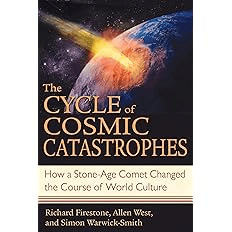
In Late October, the Taurid meteors often provide a little show — the Halloween Fireballs. These are the remnants of a fragmented comet that came apart 10,000 years ago. Lesser known are the June (or Beta) Taurids, when Earth passes through another part of this debris field. These are unseen since they occur during daylight hours.

They also may be the source of humanity’s near extinction.

As Earth emerged from the last Ice Age, something catastrophic interfered with climate cycles that persisted for hundreds of thousands of years. One result was the stable climate we now live in, which is a good thing, right? It is, unless the old cycles reassert themselves, or another disaster befalls us.

The bad part is the strong evidence comet fragments pummeled Earth during this apocalypse, the main impacts landing in North America, causing destruction around the globe. Humanity’s progress was set back centuries, if not more.

Could it happen again? Consider these other celestial events occurring during the June Taurids:

  • On June 25, 1178, an impact on the Moon created the massive Giordano Bruno crater.
  • On June 30, 1908, a fragment exploded over Tunguska in Russia, destroying 2000 square kilometers of forest. A few hours earlier, and Moscow would have been destroyed.
  • In late June 1975, a swarm of objects impacted the Moon.

Slightly different timing or trajectories, and these events could have had devastating effects on Earth. We aren’t out of the woods yet. Massive comet fragments are likely still floating in our orbit. Difficult to detect, but not impossible. Why isn’t planetary defense a higher priority, if not the highest? Why isn’t this a common cause among all humans?

Many stories come down to us telling of the time fire rained down from the heavens. Will we ever heed their warnings?

So next time you watch for meteors, or look to the sky every June, imagine what might be lurking in the darkness. Destroyer of worlds…

Categories: Prehistory | Tags: , , , , , , , , , , , , | 1 Comment

Are we Alone in the Universe?

“It’s impossible for [this] to be the only world…There are other intelligent entities out there, probably since life is so ardent…[do] you think that’s [life] only on this little rocky planet?” – William Shatner

The legendary Captain Kirk said these words after his flight on the Blue Origin NS-18 spaceflight. Is he right? Are the many people who have looked at the heavens and concluded, “There must be more life out there,” correct?

Probably not. What Shatner and others are saying is not a scientific argument. It is barely a viable statistical one. What we may think is true, or wish to be, must always give way to physics.

Life is very complex and requires very specific conditions, controlled tightly by very narrow constraints. We aren’t just talking about the obvious like temperature or air composition. There are a vast number of interconnected systems, large and small, terrestrial and cosmic, that allow us to be here at this time, in this place, on Earth.

For decades, astronomer Hugh Ross has been documenting the constraints that must be met, and cannot change, for life to exist. This is true of primitive life, to say nothing of complex life such as animals or humans. Among the hundreds of parameters he has identified from scientific studies:

  • A planet’s distance from a star, cannot be too far or too close (temperature and gravity).
  • A star’s size, age, luminosity, and type, among other things, must be in the right range for life to exist.
  • Tectonic activity (earthquakes) must not be too great (destructive), or too little (they recycle soil nutrient runoff from rivers).
  • Speed of a planet’s rotation (too fast creates hurricane speed winds, or too slow makes it too hot), its size (too much, or too little gravity), and a precise amount of oxygen (too much causes uncontrollable fires, too little, and large life can’t live), and even the size and distance of any satellites (like the Moon, which affects Earth’s rotation) impact the existence of life.

There are hundreds of such constraints, from the quantum level to the galactic. Even the Big Bang at the origin of time and space, had to be so fine-tuned for Earth to exist here and now as it does. Mathematically, there is zero chance of this occurring on its own from random processes. What does this mean? Two things: One, these constraints eliminate millions and billions of star systems from contention of harboring life. Two, only design can explain what science has discovered.

Naturalists don’t like the implication of design behind the universe’s origin, and call these constraints anthropic coincidences, even though chance cannot explain what we observe. Nonetheless, opponents to design try to sweep this all away with one or another version of the anthropic principle. The popular “weak” version states, “We ought not to be surprised at the order and fine-tuning we see in the universe around us, since if it did not exist…we would not be here to observe the fine-tuning.” This was from Oxford mathematician, John C. Lennox, who further explains why this doesn’t work:

All the anthropic principle says is that for life to exist, certain necessary conditions must be fulfilled. But what it does not tell us is why those necessary conditions are fulfilled, nor how, granted they are fulfilled, life arose.

Evangelists of chance-based, naturalistic explanations like Carl Sagan struggled with this. He marveled at the complexity and beauty of the universe, yet claimed Earth was just a “pale blue dot” and our place among the stars was “demoted” due to the discoveries of Copernicus and Galileo. It didn’t dawn on Sagan and his successors that scientists like Copernicus and Galileo studied the heavens to learn more about Creation and its Creator. Never did they think they were demoting humanity. As astronomer Guillermo Gonzalez has documented, not only have we not been demoted, the evidence points to Earth as being a “privileged planet” that could not be the result of chance, but was created in such a way to make the fine-tuning of the universe evident.

So while we cannot eliminate completely the possibility of life elsewhere among the stars, the physics of the universe guarantees it is exceptionally rare, at the very least. Should we feel despondent and depressed that we could, in fact, be on our own? Not at all. If, as the evidence points, everything from the moment of the Big Bang onward, conspired to allow Earth exist here and now, with its humans, we should feel quite special.

We aren’t a pale blue dot, but rather, we are a bright blue star in the cosmos. Rare and special, with design and purpose.

What does this mean for the current, how should I say, obsession, with UFOs/UAPs? I’ll be returning to this subject in part 2 as we explore what is going on in our skies.

Until then, ponder on what it means for little Earth, perhaps not at the center of the universe, but nonetheless being its central purpose.

Categories: Nature, Origins of Man | Tags: , , , , , , , , , , , , | 2 Comments

Our Universe: Designed for Humanity

Astrophysicist Neil deGrasse Tyson declared, “The universe is a deadly place. At every opportunity it’s trying to kill us.” When astronomers look out to the universe, some are struck by all the dangers it poses to life, especially to human life. In every region of the cosmos beyond Earth, they see gravitational disturbances, supernova, gamma-ray bursts…asteroids, comets, and solar and stellar flares that can easily destroy us.

This dark, doomsday perspective perspective makes sense for astronomers and others who’ve embraced the beliefs expressed by their predecessor Carl Sagan. His message — that the universe is all there is or was or ever will be — shapes their perspective…

What if all that appears so deadly and dangerous is actually what makes life, especially human life and its flourishing, possible? What if the cosmos is not all there is or was or ever will be? Such a perspective would alter the significance of everything about it and within it. – Dr. Hugh Ross, astronomer

When astronomer Hugh Ross first began writing about anthropocentric or theological science in 1991, many were surprised the universe appeared designed for Earth to exist. Not just Earth —but only Earth — and the human life on it. This was contrary to the alleged “great demotion” of humanity’s place in the cosmos, as naturalism evangelists like Carl Sagan preached. Some probably thought science would prove Ross wrong.

It didn’t.

In fact, the years since have become a golden age of astronomy. Discovery after discovery pointed to Earth’s uniqueness, but more importantly, that everything about the structure of the universe prefaced the coming of humans.

Ross has previously documented this growing body of evidence in books like Why the Universe the Way it Is, and Improbable Planet. His new Designed to the Core continues pulling this research together — and this is cutting edge science from around the world.

It’s the implications, however, that should give the chaotic peoples of this world pause. What if there was truly purpose to this existence? What if the reason no aliens have been discovered — and the constants of physics continue to rule out billions of worlds — is because Earth was the point of the universe’s coming into being?

As biologist Michael Denton writes in is recent book, The Miracle of Man, some may disagree with these conclusions, but the science is not in dispute. Those who disagree do from a place of philosophical bias, not a scientific one.

Why cling to a depressing view of the universe, where nothing ultimately matters, where chance decides everything, if the evidence points elsewhere?

Materialistic naturalistic philosophies have infected many fields. They have handcuffed science. Humanity doesn’t matter, if you follow these beliefs to their logical conclusion. Yet lives of millions contradict this every day, and like never before, so do the heavens.

From distant galaxies, to the Sun, and Earth itself; from the instant of the Big Bang, to the quantum and the atomic, it all has fingerprints of being designed to the core.

Categories: Uncategorized | Tags: , , , , , , , | Leave a comment

Among the Darkness

In the midst of all these shades of Sun, darkness, existence, and time are those shadows created by radiant light. Here is where the Light will dawn in the face of gathering darkness. As some men love the darkness, others search out the lights shining in the night. There, in the borderlands of existence as most people remain unaware, is where the conflict will play out. – Grayson Kirby, the Tower Keeper, Among the Shadows.

The conflict between Darkness and Light is a central theme in Among the Shadows, and throughout much of fiction. This face-off also exists in the physical world.

Paradoxically, Earth sits in one of the darkest corners of the Milky Way Galaxy, in a universe consisting of 99.73% darkness (dark matter and dark energy). A rare, bright blue orb floating in darkness — not the pale blue dot that the great evangelist of materialistic philosophy Carl Sagan often glumly intoned about.

Interestingly, if the properties of dark energy varied as little as one part in 10 to the 120th power, we would not exist. According to math and logic, chance cannot create such precision no matter how old the universe, nor how many fanciful multiverses one conjures.

Even the vast darkness of the universe is ultimately beholden to a bright blue light. As Darkness and Light battle it out on our world, the universe it sits in shows the war can be won.

mars

Categories: Nature | Tags: , , , , , , , | Leave a comment

Eclipses and Cosmic Purpose

Hundreds of moons, planets and other bodies in the Solar System, and  only ours — Earth and the Moon — have perfect solar eclipses.  Astronomers have long noted this strange phenomenon, and the unlikely parameters that cause it. Not only that, but they happen to occur in a time in Earth’s history where they can be observed.  Astronomer John Gribben writes:

Just now the Moon is about 400 times smaller than the Sun, but the Sun is 400 times farther away than the Moon, so that they look the same size on the sky. At the present moment of cosmic time, during an eclipse, the disc of the Moon almost exactly covers the disc of the Sun. In the past the Moon would have looked much bigger and would have completely obscured the Sun during eclipses; in the future, the Moon will look much smaller from Earth and a ring of sunlight will be visible even during an eclipse. Nobody has been able to think of a reason why intelligent beings capable of noticing this oddity should have evolved on Earth just at the time that the coincidence was there to be noticed. It worries me, but most people seem to accept it as just one of those things.

Even if we brush this off as coincidence, as some have tried to do, there is another layer to this. Many of the interconnected factors that allow the eclipse to occur, also allow life to exist on Earth. Continue reading

Categories: Critical Thinking, Nature | Tags: , , , , , , , , , , , , | 4 Comments

Ancient Mayan Astronomers

I’m sure 2012 fanatics will like this: “Ancient Mayan workshop for astronomers discovered.” The Mayans are well known for their sophisticated calendars which are at the root at 2012 fascination. This particular set of finds may extend their calendar beyond the Big End this December. Like many cultures, their science and religion were strongly linked and time keeping was needed for worship purposes. Yet all their knowledge didn’t keep their civilization from ending.

Perhaps something for our own to ponder.

Categories: Ancient America, Ancient Sites, Native Americans | Tags: , , | Leave a comment

Job’s Stars

The Book of Job is a most intriguing part of the Bible. The story of Job doesn’t fit into the sequence of Old Testament books and it seems Job is outside of the primary ancient Jewish world, perhaps not even Jewish. Difficult to date because of its lack of references to other history in the region, its date of writing could be anywhere from 700BC to 2000BC. It does seem that Job is well-traveled and educated. Job is full of references to older times and traditions or at least knowledge of them. As far back as Genesis, we see the establishment of stars for use in tracking time and the seasons. This was important in the millenia before clocks and calendars. Job mentions some of these stars in Job 38:31-32:

Canst thou bind the sweet influences of Pleiades, or loose the bands of Orion? Canst thou bring forth Mazzaroth in his season? Or canst thou guide Arcturus with his sons? (KJV)

This may not mean much at first glance, but consider the following. After Job implies God is not in control, God responds (Job 38:31-32) with a series of questions concerning the star cluster Pleiades, the constellation Orion and the star Arcturus. He asks Job if he can keep the stars of Pleiades together or break apart Orion or guide Arcturus and his sons. These questions appear to reveal the actual movements of these stellar bodies. How would the writer of Job know centuries ago that Arcturus is a runaway star traveling at immense speeds or that the stars of Orion’s famous belt are moving in such a way that someday it will no longer be a straight line or that the stars of the Pleiades cluster are moving together as one unit?

[Note: Arcturus comes from a Greek word that means “Guardian of the Bear” which is why some translations use “Bear with its cubs” (or something similar) instead of the star name. Arcturus is in the constellation Boötes (the herdsman) which is near Ursa Major and Ursa Minor (the bears/dippers).]

Blind luck? Coincidence? Lost ancient knowledge? Or something else?

Categories: Ancient Documents, Bible | Tags: , , , | 3 Comments

Blog at WordPress.com.