Posts Tagged With: fantasy

Shadowlight Saga

I recently started reading two fantasy series. The first was decent, but wasn’t holding my interest. At least not enough to go on to book two. The second series, the Shadowlight Saga by Mande Matthews, is another story.

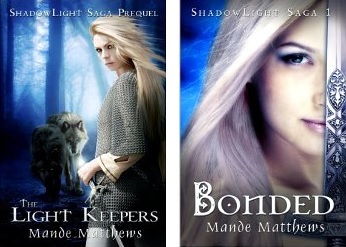
In Bonded, we begin with Hallad and his friends as they happen upon the mysterious mute woman Swan. The encounter in the woods might not have been all that remarkable had not his sister Emma then vanished into the Blackness.

Readers quickly find themselves immersed in a Norse-inspired fantasy world as the quest begins to discover who Swan is, what happened to Emma and Hallad’s family history is not quite what he thought it was. Once you reach the end, you realize this is only Act 1, and there is more to come. To get to the end, of course, will involve encounters with many peoples, beings and obstacles.

While this book is labeled as a “YA fantasy,” I think it’s written with depth and detail that all adults will enjoy. I have found that some authors try to impress us by over-complicating their books with plots, sub-plots, schemes and such that ultimately only bog down their story’s pace and destroy its realism. This isn’t one of those books. Matthews also has a short prequel to Bonded, The Light Keepers, which you don’t have to read first, but I did (and you’ll want to to read it one way or another). So now I look forward to reading part 2 of the trilogy, in what has established itself as a compelling Good vs. Evil fantasy series.

And it’s those kind of stories that are at the heart of the fantasy genre.

mm

Categories: Books, Fiction | Tags: , , , , | Leave a comment

Shannara: The Heir to Middle-Earth?

Nearly forty years ago, during a dark age where epic fantasy was hard to come by, Terry Brooks released The Sword of Shannara. In many ways, similar to The Lord of the Rings: An unaware, peaceful guy (Shea Ohmsford), happy in his own world, is tasked by a wise, mysterious stranger (Allanon) to obtain the Sword of Shannara before the Warlock Lord uses it to conquer Shannara. While some thought the plot too similar to Frodo/Gandalf/The Ring/Sauron, Tolkien’s books would ultimately establish the archtype for all fantasy that followed. And, in the following decades, Brooks would unveil his Shannara mythos in over 25 books (and it’s still going).

For those that wished Tolkien had written much more, Brooks is the perfect author. His books quickly would show their originality. Long-time readers were in for a welcome surprise when he connected them to his Word & Void series and linking high fantasy with the modern world. Since the series is made up of self-contained sequences (trilogies, duologies…), which makes it easier to pick a place to start (though Sword is still the best place). It also makes those who slogged through years of Robert Jordan’s epic one-story series, or those afraid to start, a little more at ease of taking on another never-ending fantasy. However, many Brooks fans probably wish he would go back and revisit some of his classic characters.

In the final analysis, fantasy fans will long remember Middle-Earth, Narnia and Shannara.

Categories: Books, Fiction, Writing | Tags: , , | Leave a comment

Light vs. Darkness

The supernatural and fantasy shelves at the bookstore are overflowing with books looking to be The Next Best Thing. As with any genre that hits high levels of popularity, it has become saturated with many all too similar tales. Yet there is always a couple that stand out.

Tosca Lee‘s Demon: A Memoir takes a turn away from the urban action or romance-centered supernaturals. What if a demon, who had been around since the beginning, showed up and wanted you to write its story? That’s exactly what happens to writer Clay one day. The demon Lucian, who appears as a different human in each encounter, relates his personal experience of the Universe’s creation, the rise of Evil and the arrival of man. Eventually, though, Clay and Lucian’s story become intertwined. In many ways a thought-provoking book as it progresses, which adds depth to an entertaining page-turned. Ironically, though, I have seen readers complain when they weren’t warned that a book might challenge them or leave them some items to ponder. Can’t make everyone happy, I suppose.

Mande Matthews introduces readers to her ShadowLight Saga with the short The Light Keepers. Astrid, oppressed and locked away by her mother, is no ordinary girl. Her abilities have been growing and, of course, the evil in the world wants her for their own insidious plans. This prologue also includes a sneak-peak at Bonded. The Light Keepers will definitely leave you wanting to know what is to become of Astrid in what looks to be an epic saga between Light and Darkness.

And speaking of that, I have previously reviewed Morgan L. Busse‘s Follower of the Word series that begins with Daughter of Light. It is the story of Rowen Mar, another young woman who is learning she is not another average human in the Lands. Evil is rising and she is being called to make a choice, lead the fight or deny her gifts. Good and evil here aren’t the vague ideas of many novels. There is something real and tangible behind both. This book seems almost a prologue to a much longer story. The characters are just beginning to realize who they are. Evil is still spreading through the countryside and they have yet to fully engage in the struggle.

All of these books are about the battle between Darkness and Light. Why do so many explore this conflict?

Quite simply because fiction is often inspired by fact.

bk1 bk3bk2

Categories: Books, Fiction, Writing | Tags: , , , , , , , | 2 Comments

Why “Fantasy” Fiction?

Fantasy author R.A. Salvatore answers this in The Guide to Writing Fantasy and Science Fiction:

Perhaps more than any other genre, fantasy is about the hero’s journey. In a world of seven billion people, with wars I can’t stop and legislation I can’t even read, the idea of one person being able to make a difference, the idea of one man or woman grabbing a sword and defeating the dragon and saving the village is quite appealing.

And perhaps it will inspire a hero or two in our own world to rise up.

Categories: Books, Fiction, Writing | Tags: , | 1 Comment

Immerse Yourself into Middle-Earth

A few months ago in my post More Than Just a Fantasy we looked at how the fantasy genre — in particular J.R.R. Tolkien’s vision — is relevant to us in its stories and themes. In particular, Matthew Dickerson’s book A Hobbit Journey: Discovering the Enchantment of J.R.R. Tolkien’s Middle-Earth, showed us how Tolkien’s worldview was populated with many deep ideas to ponder and learn from.

With the release of the second Hobbit film, it’s a good time for Tolkien fans to once again dig deep into his mythos and what formed what has become a classic part of 20th Century literature. There is no shortage of books to peruse, but a couple stand out.

There is the before-mentioned by Dickerson, which focuses on how Tolkien’s Christian beliefs were the foundation to his writings. Tom Shippey’s The Road to Middle Earth: How J.R.R. Tolkien Created a New Mythology is the go to biography of Tolkien and exploration of his many inspirations. John Garth expands on one aspect of Tolkien’s past, his serving in World War I, in Tolkien and the Great War. The War of the Ring had some very real life parallels.

For those just looking for guides through the incredibly realized Middle-Earth, The Atlas of Middle Earth and Tolkien’s World from A to Z are indispensable guides.

If you wish Tolkien himself had written more of his creation, he did in The Children of Hurin and The Silmarillion (both completed by his son after Tolkien’s death).

To top all this off, Christopher Snyder’s new The Making of Middle-Earth covers a little bit of everything of Tolkien’s world and legacy. It’s a great place to start for all Tolkien students and fans.

Do you need these books to enjoy Tolkien’s fiction? No. Do they make you want to go back and re-read and become immersed — deeply so — into Middle-Earth like it was the first time? Yes, they certainly do.

Categories: Books, Fiction | Tags: , , , , , , , , , , , | 3 Comments

Darkness Rises

The following post is a rerun. Why would I repost it? Because I made subtle changes that makes this a perfect example on how a little revision can make all the difference in the world. When you write, really write, you shape and reshape every word like clay.

There has been a war raging since before man first appeared on the Earth.

A war with Evil.

But it’s not what you see on the nightly news. This is far worse.

These shadows conspire in hidden places, whispering in the dark. They wait for times to emerge and spread terror over the land. While the world’s attention is elsewhere, they plan for chaos that few could imagine. They work to unleash horrors long banished to myth.

The Dark One is very pleased most believe such things fantasy. Others know better. Those who have stood among the shadows and crushed their campaigns. Pushing back incursions of the Followers of Darkness as the world was unaware, they asked for no reward. When humanity was propelled to the abyss time and time again, a few brought them back.

Now the Darkness has grown once more. Are there still those who are as the heroes of old? Will they rise?

The time is upon us.

It will be the beginning. Or the end.

Among the Shadows, Watchers of the Light Book 1, the first in a new fantasy series, coming soon.

Categories: Books, Fiction, Writing | Tags: , , , , , | 1 Comment

More Than “Just a Fantasy”

It’s not often that popular fiction stays in print for decades. Even less often does it have the depth that allows it to transcend the imaginary barrier from pop to literature or even to the status of classics. Even most of what is today referred to as literary fiction, well, won’t stand the test of time. Every so often there are books that do the impossible. J.R.R. Tolkien’s Middle-Earth, as embodied in The Hobbit, The Lord of the Rings and The Silmarillion, have done just that and have endured for over a half a century.

Many have only been exposed to Tolkien’s world through the recent movie versions. Or perhaps you think fantasy is just that, fantasy. Elves, trolls and big battles. Doesn’t sound very relevant to the real world, does it? There must be a reason why Middle-Earth is still the inspiration for an entire genre and still attacts millions of readers decades after its publication.

Because it is relevant.

Like any great book, the author has the primary responsibility for its success. Tolkien was a scholar, not a fiction writer. His mastery of history, language and culture allowed him to create an alternate history of Earth. This wasn’t his most important strength, however. Like any writer, his beliefs and convictions inform and influence his words on paper. As a great writer, he didn’t strive to lecture or teach as much as meant to entertain.

And so there have been endless books critically analyzing every aspect of Tolkien’s world. Most of today’s “literature” never warrants such study. One of the best such scholarly, yet accessible, endeavors is Matthew Dickerson’s A Hobbit Journey: Discovering the Enchantment of J.R.R. Tolkien’s Middle-Earth.

Dickerson explores Tolkien’s many themes such as the free will of men, moral responsibility and war. This last may be apparent from the film versions and people may think it the overwhelming part. Indeed it is in many ways, but Tolkien wove many subtleties in his stories.

War is at time necessary, but takes a terrible toll on all, even the victors. That is clear in the books, as is that the forces of good should never use evil to conquer evil. The means don’t always justify the end. The Ring could be used to destroy Sauron, but at what cost? What did it do to all that did use or want it, often with the best of intentions? Even the way the “good guys” treated captured enemies was diametrically opposed to how the Enemy treated their prisoners. Moral and military victories aren’t always the same thing. Discussions like these in Dickerson’s book reveal some very deep issues embedded in Tolkien’s books.

Thoughtful people will begin to realize that all the screaming “experts” on television who pretend to be intellectuals, never approach the mind of someone like Tolkien. Unlike them, he doesn’t preach, browbeat or lecture his readers. His beliefs are so well-thought out, they naturally flow within the story. They make his book an endless treasure chest to be searched.

The films captured Tolkien’s world better than any other book-to-screen adaptation, but there is much more. If you are someone who likes books that can reveal new depth at every reading, or you have never delved into a book for a literary study, Dickerson’s book will surprise and challenge you to do just that with Tolkien.

And no doubt you will pick up Tolkien’s books again and read them like it was the first time.

Categories: Books, Fiction, Writing | Tags: , , , , | 2 Comments

Who will be Ready to Oppose the Shadonae?

When someone has an innate ability to oppose Evil, they become a target. Evil will do whatever they can to suppress or destroy such people. The danger for Evil, though, is that the great Heroes are often refined by this, strengthened by it. What Evil tries to destroy, only gets stronger.

This is the path the reluctant heroes are faced with in Morgan L. Busse‘s absorbing new novel, Son of Truth, the sequel to Daughter of Light. Last time, we followed the reluctant outcast, Rowen Mar, as she finally chose who she was meant to be, even if she wasn’t entirely sure what would come with it. An Eldaran imbued with gifts of healing and Truthsaying, these great powers often take a toll on their user.

Now she is on the run because people fear her. This volume also sees the development of other characters from the first book, as they discover and come to terms with what they are meant to be. There’s a great interweaving of their paths here, even a bit of a love story. One of these people is, if you haven’t guessed from the title, a Guardian (another type of Eldaran), who is called to stand against Evil. Readers are left with the distinct feeling something big is looming just off stage. Where as the first novel was set against the backdrop against a war between men, the threat of the Shadonae is growing as is the strength of those who will ultimately oppose them. In a way, the trials of the characters remind of the breaking of the fellowship in Lord of the Rings. Not that all of these people were together initially, but they find themselves on differing paths that test their beliefs and resolve before their journeys converge.

Very much a character-driven story, Morgan keeps the adventure flowing forward with plenty of surprises and conflict. As good as the first volume was, she has truly found her rhythm here in a story that propels the reader to the next page. Some aspects of the Follower of the Word are a bit reminiscent of Terry’ Brooks Word and the Void series (which he later connected to his Shannara books), but Brooks never really developed what the Word was and what that meant. Morgan isn’t afraid to make this integral to her book, and the religious allusions are obvious, but in the way C.S. Lewis approached his fantasy. Allowing his beliefs to be the foundation of his work, not to overwhelm it. I only say this because all authors imbue their books with their beliefs, but I think the path Lewis or Morgan has taken is more realistic. Sure, there are those who like their books to be more in their face about everything or are mad when that’s what they discover while reading. Writers can’t, and shouldn’t try to, make everyone happy.

Most people will be more than happy with Morgan’s newest book. As always, in a series like this, it is always best to start with the first book. I don’t know how many books in this sequence she has planned, but I do know one thing. In a time where I have lost interest in many other books and their sequels, this is one that I can’t wait to see what happens next.

Categories: Books, Fiction, Writing | Tags: , , , , , , | Leave a comment

Whispers in the Dark

There has been a war raging since before man wandered about the Earth.

A war with Evil.

But it’s not what you see on the nightly news. This is far worse.

These shadows conspire in hidden places, whispering in the dark. They wait for times to emerge and spread terror over the land. While the world’s attention is elsewhere, they plan for chaos that few could imagine. They work to unleash horrors long banished to myth.

The Dark One is very pleased you think such things fantasy. Others know better. Those who have stood among the shadows and crushed their campaigns. Pushing back the incursions as the world was unaware, they asked for no reward. When humanity was pushed to the abyss time and time again, a few brought them back.

Now the Darkness has grown once more. Are there still those who are as the heroes of old? Will they rise?

The time is upon us.

It will be the beginning. Or the end.

Among the Shadows, the first in a new fantasy series, coming soon.

Categories: Fiction, Writing | Tags: , | Leave a comment

Gilgamesh: The Warrior King

Brian Godawa has been writing a fascinating fantasy series that takes place in the ancient Near East. It began with Noah Primeval which was rooted in the question, “What was going on in the world that was so horrible that mankind needed destroyed?” The series continued with Enoch Primordial (actually a prequel), which centered around the enigmatic Enoch. A man barely mentioned in the biblical accounts, but because he never died, and the other books attributed to him recount many a strange event, he has long been a person of high speculation.

Godawa now steps out from filling in between the lines of the biblical accounts with Gilgamesh Immortal. Taking off from events in the Noah episode, the tale of Gilgamesh provides a link to storie Godawa has next that is centered around Babel. One can’t study Near Wast cultures in a vacuum, so bringing in the most famous character from that region’s legends that isn’t chronicled in the biblical accounts was a perfect idea. Gilgamesh, a king and warrior of Mesopotamia, rules his empire with an iron fist. He has everything. Then he encounters a Wild Man that is his equal in many ways, and better in others. He begins to realize there has to be something more.

He wants immortality.

There begins his quest to conquer the weak and silent gods of old. These fallen angels had largely been destroyed and contained during the Great Flood, but he seeks out their remnant. It’s a journey full of adventure and death, while one of the most sinister of these “gods” is about to re-emerge and try to take Gilgamesh’s kingdom.

This book, along with the others, have Godawa’s trademark fast-paced storytelling. Their combination of fantasy and history is a largely original take on the people and places they are centered around. He also draws on the elusive references to Nephilim, Watchers and “sons of god” in the bible and other writings. For centuries, people have debated exactly what these beings were. Essentially Godawa is saying, “Maybe these references aren’t so mysterious. Maybe all of the ancient legends of battling gods aren’t just myth. Perhaps there are kernels of truth in them. Maybe there is a reason that the ancient cultures believed in them so much.”

It’s an intriguing premise. Perhaps it sounds irrational in our supposedly advanced world. But it’s perfectly reasonable to ask why did the ancient world pay so much credence to such things? Was it all just because of active imaginations? Or have we left behind part of our history we chose to forget?

Godawa’s series not only entertains, it asks such questions. And it gives us one possible imagining of the answers. It could have happened like this.

Categories: Bible, Books, Fiction, Legend, Prehistory, Writing | Tags: , , , , , , , , , , | Leave a comment

Blog at WordPress.com.