Posts Tagged With: Robert Zubrin

Atomic Age 2.0

With current technology, there is only one non-fossil fuel energy source that is reliable, high-output, and can power the entire world.

Nuclear.

Unfairly vilified for decades, and misunderstood by the public, the once-promised nuclear age didn’t fully materialize. Now, many countries are revisiting nuclear as green energy sources have failed to live up to the hype.

“But nuclear is unsafe!”

Is it?

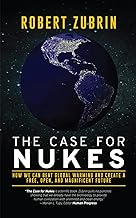
As Robert Zubrin details in his book, The Case For Nukes, fears have been unfounded. In the greatest of ironies, as governments treat nuclear weapons like toys and plan for worldwide genocide, nuclear powered warships sail around the world without incident. They steam by American cities, and into our ports. The submarines and aircraft carriers stationed at Norfolk and other bases aren’t encased in concrete bunkers. Their reactors are of the same type used in power plants. The Navy handles and stores nuclear fuel with frequent regularity.

It’s not that we cannot use nuclear safely; we do it every day.

Nor is nuclear physics a new, esoteric science. Commercial reactors have produced long past their design life. Next-generation reactors now in the works have far more promise. Where would we be had we not slowed nuclear power plant construction to near zero?

Someday, we will mine Helium-3 on the Moon for fusion reactors. In the meantime, we should go back to the future and revisit an old tech, shine it up, and power the entire world.

Categories: Books | Tags: , , | Leave a comment

Ready to Leave the Brave New World?

Everyone makes a choice:

  1. Commit to continuous learning to better themselves and the world.
  2. Make little or no effort to learn and trust the world to tell you what to think and know.
  3. Pretend you know everything and have nothing else to learn.

Option one comes with the realization that learning doesn’t stop when you graduate for high school or college. You’ve only scratched the surface. Also, as an adult you realize learning is a whole different experience outside of the structure of schools. Exploration, discovery, enlightenment. The kind of things that brought you wonder as a child, then snuffed out by the system, return in full force.

Option two comes when you succumb to an industrial education system that often teaches you not to question. Or if they do, someday they will say they didn’t mean it. They also want you to figure out your path by graduation. Then, they tell you, you’re stuck there forever. Don’t keep searching for your purpose. Trust us.

Option three is when you allow yourself to be drawn into a cult-like mindset. Often this is an extension of option two where you were encouraged not to question and test what you are told. When one falls into this abyss, they are used by others for their own purposes. Politicians love people like this.

This is all a long way of stating the best way to learn is to read. Commit to learning, studying, exploring. This isn’t the dull learning you may have experienced in school. However, you will face many far more important tests in life. You must be prepared. You will also learn you have an innate, critical responsibility to mentoring the younger generations.

I feel sorry for people who say “I don’t read.” “I don’t have time” they say as they binge-tv watch. They think the carefully crafted and controlled headlines and news constitute learning. They know their life feels unfulfilled, but make no effort to change. Or they look at the world and its problems and just hope for the best.

Don’t be that person.

Here’s a selection of some of the books I read in 2023. A wide array of topics sure to challenge, inform, and inspire.

Will you commit in 2024 to leaving the Matrix? Will you choose to exit The Brave New World?

Start your own path to learning. It will be exciting and disturbing. One thing it won’t be is regrettable.

Categories: Books, What You Can Do | Tags: , , , , , , , , , , , , , , | Leave a comment

Paradigm-Shifting, Thought-Provoking Discussions about the World We live In

“What people usually don’t think about, is what do you do in a world where the playgrounds are empty, and the nursing homes are all full?”

Watch Birthgap and learn how fears of overpopulation not only never materialized, but now we are in danger from not having enough children.


What if the dangers of nuclear energy have not only been false, but this plentiful energy source could solve all of our energy problems? See how the criminalization of nuclear energy put civilization on a backward course of development in Nuclear Now. Also check out Robert Zubrin’s new The Case For Nukes.


“The standard American diet (SAD) is what is killing people.” – Dr. Peter Attia, MD

American health has never been worse. Find out how we have been misled and take control of your health in this interview with Dr. Peter Attia.


“The pandemic forecasts in the United States were very grim. Experts were predicting that 60-70 percent of the population would ultimately be infected resulting in over 1.5 million deaths in just a few months. People on social media were in an absolute panic. Stories about empty shelves and runs on toilet paper were everywhere. Those who tried to refute these doomsday predictions were shouted down and eventually silenced.


“And yet, the science on the virus was very clear. Disease severity was age-stratified. Extreme measures would not drive it away and would cause a tremendous amount of collateral damage. Even if the worse-case scenarios were true, it was extremely important that we take measures based on evidence.


“But eventually, the cry to ‘do something’ became overwhelming, and the costs no longer mattered. Trying to calm people with wisdom about infectious disease became nearly pointless. Germophobia swept through society and political culture.


“How did people in our communities and around the world get to the point of hysteria over a pandemic with a clear age-stratified and comorbidity-amplified mortality? Why were young and healthy people with very little risk for disease and death treated as if they were a grave danger to others?” – from Fear of a Microbial Planet. Also listen to the interview with the author Steve Templeton.


“It became clear to us over time that the U.S. government had turned its propaganda and disinformation campaigns it had been waging abroad, and turned them against the American people. That’s where we started getting chills up our spine. There was something seriously sinister going on.” – Michael Shellenberger

Learn how the government chose the Orwellian Nightmare over your rights in this interview with Michael Shellenberger.

Categories: Books, Critical Thinking, education | Tags: , , , , , , , | Leave a comment

Humanity Today Faces a Choice

Ideas have consequences. Humanity today faces a choice between two very different sets of ideas…On the one side stands the antihuman view, which…continues to postulate a world of limited supplies, whose fixed constraints demand ever-tighter controls upon human aspirations. On the other side stand those who believe in the power of unfettered creativity to invent unbounded resources and so, rather than regret human freedom, demand it as our birthright…

If [the antihuman] idea is accepted…then each new life is unwelcome, each unregulated act or thought is a menace, every person is fundamentally the enemy of every other person…The ultimate outcome of such a worldview can only be enforced stagnation, tyranny, war, and genocide…the central purpose of government must not be to restrict human freedom but to defend and enhance it at all costs.

And that is why we must take on the challenge of space. For in doing so, we make the most forceful statement possible that we are living not at the end of history but at the beginning of history; that we believe in freedom and not regimentation, in progress and not stasis…in life rather than death, and in hope rather than despair.” – Robert Zubrin writing in The Case for Space

Categories: Uncategorized | Tags: , , , , | Leave a comment

Mars Awaits

This month, Mars moves into the best position for observers on Earth since 2003. What Mars book are you reading to welcome the Red Planet?

mars

Categories: Books | Tags: , , , , , , , , , | Leave a comment

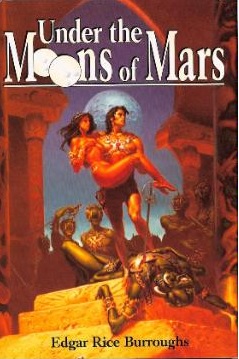
Under the Moons of Mars

Mars has always weighed heavy on man’s imagination. Since ancient times, the red planet has hung in the sky taunting us. Before space probes revealed it to be a dead world, it was where many authors set their adventures. Even afterwords, it has still lured writers there. First Burroughs and Bradbury explored the races among the red canyons and hills of the dying world. Even much later, Ben Bova’s manned mission to Mars found hints of a lost civilization.

John CarterBradburyBova

Perhaps the allure of Mars stays strong, in spite of being empty of cities and canals, because it still is seen as the most livable planet after Earth. That’s not saying much, considering how quickly one would die on its surface. But as planets go, it has resources that can be converted to fuels and supplies. And even better, perhaps it can be terraformed into a livable planet as outlined in Kim Stanley Robinson’s epic Mars Trilogy (starting with Red Mars). Robert Zubrin, in his The Case for Mars, describes how we can get there and why we should.

RobinsonZubrin

Recent years have seen a growing armada of robots to Mars. It is obvious that its ancient hold on us has not gone away. While many people can’t break away from their televisions, the distant red sands still call on that part remaining inside of many humans that wants to explore and push our race forward out of the mud. Yes, there are those alien enthusiasts who get excited every time a rock looks like a “bone” or something and then conspiracy theories come out of the woodwork. Sorry, as much as we would like otherwise, Mars has not been hospitable to complex life even in the best of times. In fact, the universe is likely very barren. Most people look out at all the stars and think, “There must be millions of worlds out there teeming with life!” Yet, even statistics must yield to physics. The requirements for life are so specific and narrow, there are few places out there that could harbor others like us (or unlike us).

Rare EarthTGHCosmos

Some think it depressing we may be all alone. Others still think advanced aliens are flying here in little ships that buzz cars in remote locations and crash a lot. Then perhaps, as many have suggested, maybe because we are here against impossible odds, we are special after all?

Even after all these centuries, Mars still calls on us to find our place and purpose in the universe. That is why writers will still explore the red sands until others finally set foot where water once flowed.

Categories: Uncategorized | Tags: , , , , , , , , , , , , , | Leave a comment

A Pioneer Looks to Our Future

I’ve long been a supporter of space exploration. It is often one of the few bright spots in the world of government-funded programs. However, I have come to realize that it’s that same government that has crippled our ventures in the final frontier. Nearly every new president rolls out a new “vision” for NASA, often discarding whatever the previous leader had promoted. Funding is just potential “get votes” for visionless Congress and has largely been stagnate as they prefer to send money to other countries or bailout only the companies that support them. So space exploration moves along in fits and starts. I was pleased to see that Apollo 11 astronaut Buzz Aldrin largely shares these views in his new book Mission to Mars.

For decades, Buzz has championed our expansion in space and in this new book discusses how our government-run program has both succeeded and failed. He also sees the recent growth in private efforts in space travel as a new turning point on the frontier. This is indeed correct, and creating an environment where these efforts can continue to thrive and expand is critical. NASA has already begun relying on private industry to supply the International Space Station. Soon they will deliver astronauts and companies have begun using the facilities that once launched the shuttles. NASA has laid the groundwork, now the people must take over. If they do, space will no longer be the realm of the few.

Buzz details how NASA shouldn’t be tied up in returning people to the Moon. Certainly they should be involved in technology transfer, training, design and U.S. participation, but their main thrusts should be elsewhere. They went to the Moon 45 years ago. Time to trailblaze elsewhere. And that place is Mars.

The Apollo veteran outlines his cycler design which would put spacecraft in continuous flight between Mars and Earth. It’s an ingenious design that uses physics and reusable vehicles. Is it the only option? No, and he briefly mentions the Mars Direct plan that Robert Zubrin laid out years ago. It uses current technology and in-situ use of resources on Mars to drastically lower costs of a mission. It was the baseline for NASA plans for a time. Buzz’s plan has some overlap with Zubrin’s, though I think both can be used. Mars Direct is still the simplest way for early missions to reach Mars. Later, it could be used in tandem with cyclers to increase travel opportunities to Mars (and I’m sure technology will improve both methods, see Case for Mars for more on Mars Direct).

We also read on the potential of mining asteroids and the real need to detect and deflect ones that threaten Earth. Buzz’s plan to first land humans on the Martian moon Phobos before Mars seems an unnecessary detour, though the satellite does have potential for the outposts he describes. He implores that whomever is president in 2019 to use the 50th Anniversary of Apollo 11 to commit to a Mars mission. I think this would be another empty vision from our politicians who cannot see past another election cycle. There is no Cold War to drive the project. Just as the people are taking over spaceflight, travel beyond our world will be up to them as well (perhaps Mars One).

NASA will surely be a part of it and maybe enough forward-thinking people exist in our government to support it. They can justify it anyway they want to: Jobs, technology, education, exploration, resources. It would certainly be a huge step forward against all of our steps backwards.

In 1989, Buzz stood on stage as President George Bush put forth a plan to reach Mars in 2019. The poorly conceived plan went no where. Now we are talking about announcing a mission in 2019 that won’t even happen for many years after. That, to me, isn’t very visionary. We need to get past the government-style pushing off the future to some indeterminate time that often never arrives. Buzz asks, “America, do you still dream great dreams?”

Do you?

Categories: Books, Modern History | Tags: , , , , , , , , , , | Leave a comment

Blog at WordPress.com.