Posts Tagged With: science

Destroyer of Worlds

“It is likely that hundreds of thousands of bodies, each capable of yielding a multimegaton explosion on Earth, are orbiting within the [Taurid meteor] stream.” – Victor Clube and Bill Napier, Cosmic Winter

Regular meteor showers are the periodic reminder we live in vast universe. For a few nights, they draw people away from their distractions to look at the heavens like their ancestors once did. What if these little fire balls have a darker history?

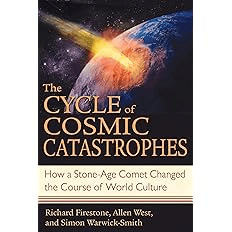
In Late October, the Taurid meteors often provide a little show — the Halloween Fireballs. These are the remnants of a fragmented comet that came apart 10,000 years ago. Lesser known are the June (or Beta) Taurids, when Earth passes through another part of this debris field. These are unseen since they occur during daylight hours.

They also may be the source of humanity’s near extinction.

As Earth emerged from the last Ice Age, something catastrophic interfered with climate cycles that persisted for hundreds of thousands of years. One result was the stable climate we now live in, which is a good thing, right? It is, unless the old cycles reassert themselves, or another disaster befalls us.

The bad part is the strong evidence comet fragments pummeled Earth during this apocalypse, the main impacts landing in North America, causing destruction around the globe. Humanity’s progress was set back centuries, if not more.

Could it happen again? Consider these other celestial events occurring during the June Taurids:

  • On June 25, 1178, an impact on the Moon created the massive Giordano Bruno crater.
  • On June 30, 1908, a fragment exploded over Tunguska in Russia, destroying 2000 square kilometers of forest. A few hours earlier, and Moscow would have been destroyed.
  • In late June 1975, a swarm of objects impacted the Moon.

Slightly different timing or trajectories, and these events could have had devastating effects on Earth. We aren’t out of the woods yet. Massive comet fragments are likely still floating in our orbit. Difficult to detect, but not impossible. Why isn’t planetary defense a higher priority, if not the highest? Why isn’t this a common cause among all humans?

Many stories come down to us telling of the time fire rained down from the heavens. Will we ever heed their warnings?

So next time you watch for meteors, or look to the sky every June, imagine what might be lurking in the darkness. Destroyer of worlds…

Categories: Prehistory | Tags: , , , , , , , , , , , , | 1 Comment

Are we Alone in the Universe?

“It’s impossible for [this] to be the only world…There are other intelligent entities out there, probably since life is so ardent…[do] you think that’s [life] only on this little rocky planet?” – William Shatner

The legendary Captain Kirk said these words after his flight on the Blue Origin NS-18 spaceflight. Is he right? Are the many people who have looked at the heavens and concluded, “There must be more life out there,” correct?

Probably not. What Shatner and others are saying is not a scientific argument. It is barely a viable statistical one. What we may think is true, or wish to be, must always give way to physics.

Life is very complex and requires very specific conditions, controlled tightly by very narrow constraints. We aren’t just talking about the obvious like temperature or air composition. There are a vast number of interconnected systems, large and small, terrestrial and cosmic, that allow us to be here at this time, in this place, on Earth.

For decades, astronomer Hugh Ross has been documenting the constraints that must be met, and cannot change, for life to exist. This is true of primitive life, to say nothing of complex life such as animals or humans. Among the hundreds of parameters he has identified from scientific studies:

  • A planet’s distance from a star, cannot be too far or too close (temperature and gravity).
  • A star’s size, age, luminosity, and type, among other things, must be in the right range for life to exist.
  • Tectonic activity (earthquakes) must not be too great (destructive), or too little (they recycle soil nutrient runoff from rivers).
  • Speed of a planet’s rotation (too fast creates hurricane speed winds, or too slow makes it too hot), its size (too much, or too little gravity), and a precise amount of oxygen (too much causes uncontrollable fires, too little, and large life can’t live), and even the size and distance of any satellites (like the Moon, which affects Earth’s rotation) impact the existence of life.

There are hundreds of such constraints, from the quantum level to the galactic. Even the Big Bang at the origin of time and space, had to be so fine-tuned for Earth to exist here and now as it does. Mathematically, there is zero chance of this occurring on its own from random processes. What does this mean? Two things: One, these constraints eliminate millions and billions of star systems from contention of harboring life. Two, only design can explain what science has discovered.

Naturalists don’t like the implication of design behind the universe’s origin, and call these constraints anthropic coincidences, even though chance cannot explain what we observe. Nonetheless, opponents to design try to sweep this all away with one or another version of the anthropic principle. The popular “weak” version states, “We ought not to be surprised at the order and fine-tuning we see in the universe around us, since if it did not exist…we would not be here to observe the fine-tuning.” This was from Oxford mathematician, John C. Lennox, who further explains why this doesn’t work:

All the anthropic principle says is that for life to exist, certain necessary conditions must be fulfilled. But what it does not tell us is why those necessary conditions are fulfilled, nor how, granted they are fulfilled, life arose.

Evangelists of chance-based, naturalistic explanations like Carl Sagan struggled with this. He marveled at the complexity and beauty of the universe, yet claimed Earth was just a “pale blue dot” and our place among the stars was “demoted” due to the discoveries of Copernicus and Galileo. It didn’t dawn on Sagan and his successors that scientists like Copernicus and Galileo studied the heavens to learn more about Creation and its Creator. Never did they think they were demoting humanity. As astronomer Guillermo Gonzalez has documented, not only have we not been demoted, the evidence points to Earth as being a “privileged planet” that could not be the result of chance, but was created in such a way to make the fine-tuning of the universe evident.

So while we cannot eliminate completely the possibility of life elsewhere among the stars, the physics of the universe guarantees it is exceptionally rare, at the very least. Should we feel despondent and depressed that we could, in fact, be on our own? Not at all. If, as the evidence points, everything from the moment of the Big Bang onward, conspired to allow Earth exist here and now, with its humans, we should feel quite special.

We aren’t a pale blue dot, but rather, we are a bright blue star in the cosmos. Rare and special, with design and purpose.

What does this mean for the current, how should I say, obsession, with UFOs/UAPs? I’ll be returning to this subject in part 2 as we explore what is going on in our skies.

Until then, ponder on what it means for little Earth, perhaps not at the center of the universe, but nonetheless being its central purpose.

Categories: Nature, Origins of Man | Tags: , , , , , , , , , , , , | 2 Comments

All Humans are Scientists

People who lack formal scientific credentials are nonetheless qualified to speak with authority on matters of common science. – Douglas Axe, Undeniable

In the last few years, especially during the pandemic debacle, authoritarian science has replaced the scientific method which follows the evidence wherever it leads. We heard many bureaucrats, politicians, and talking heads say things like “Follow the Science” or “Trust the Science.”

When anyone questioned them, the questioners were told not to question the science, to accept the word of strangers, and that you — the people — couldn’t understand, so just listen to the experts.

This isn’t how science works. This is anti-science. Real science — and real scientists — aren’t afraid of questions. They also know people are smart. Not everyone needs an academic degree, or to be anointed an expert by someone, to understand, interpret, and test allegedly scientific claims.

Molecular biologist Douglas Axe writes in Undeniable we all think, in some way, like scientists:

Basic science is an integral part of how we live. We are all careful observers of our world. We all make mental notes of what we observe. We all use these notes to build conceptual models of how things work. And we all continually refine these models as needed. Without doubt, this is science. I have called it common science to emphasize the connection to common sense.

There is technical science that requires mathematics, experimentation, and so forth, but you can still understand scientific claims and concepts without those. You can test claims from the experts. In an era where the experts are often shown wrong (such as in climate, disease, or origins of life), we need citizen scientists.

Don’t fear science. Study it, use it. Your mind is a superpower to wield in preserving your health and freedoms. Anyone who tells you to be quiet and don’t question is someone who fears the truth will become known.

Make the truth known.

Categories: Critical Thinking, What You Can Do | Tags: , , , , | Leave a comment

They Want You Unhealthy. You can Take Control.

“Fiat foods create fiat minds that enslave the human body to a revolving state of addiction, lethargy, and depression. Would the Wright Brothers have had the vision, skill, and initiative to expand their bicycle business to venture boldly and defy all established authority under the belief man could fly while on a steady diet of SnackWell cookies and Cheese Puffs?” – Matthew Lysiak

Think the nutritional advice you’ve been taught for decades is based on science? Well, take a good dose of corporate influence, government financial manipulation, fake or unscientific studies, and throw in some eugenics and a cult for good measure, and what do you get?

The worst health of humans in modern history.

Make Fiat Food number one on your to-read list for 2024. Matthew Lysiak takes you on a tour of the disturbing history of where our health “standards” came from, and why we have more chronic medical problems than ever in our history.

This new year can be the one where you take responsibility for your own health. Stop letting others make money off you by keeping you sick and miserable.

Categories: Books, health, What You Can Do | Tags: , , , , | Leave a comment

Be Sure Not to “Follow the Science” Over the Cliff

If any one age really attains, by eugenics and scientific education, the power to make its descendants what it pleases, all men who live after it are the patients of that power. [They will be] weaker, not stronger…a few hundreds of men [ruling] over billions upon billions of men. The final stage is come when Man…has obtained full control over himself. Human nature will be the last part of Nature to surrender to Man. – C.S. Lewis, The Abolition of Man , 1947

C.S. Lewis, best known for Narnia and books like Mere Christianity, was nearly prophetic in his warnings on what the abuse of science could become. Even the horrors of World War II and not cured people of turning science into a religion, or of the belief that humans could be altered and improved to the point of creating a new species. Here, in our own day, eugenics and transhumanism threaten once again to cross from helping humanity, to replacing us.

The Magician’s Twin: C.S. Lewis on Science, Scientism, and Society is a collection of essays on C.S. Lewis’ thoughts and writings which are all more relevant today. They are warnings we should not ignore. Some of his works best expressing his insight not only include The Abolition of Man, but his sci-fi trilogy, collectively (and uncreatively) known as the Space Trilogy

Warnings from seventy-four years ago, about the abuse of science, its replacement by scientism or scientific materialism, as contemporary as if they were written today. Will our ignorance of the past, and distraction from the present, deliver us right over the edge?

Unfortunately, history often repeats itself. Because we let it.

Categories: Books, Critical Thinking | Tags: , , , , , | Leave a comment

Climbing Out of Your Silo

I understand that in a sense we all live in a silo, following our preferred sources of information. But…[some] function in a cult-like manner. All competing information is excluded. Debate is avoided. Contact with outsiders is discouraged. Anyone who leaves the cult and goes over to the other side is demonized. To admit doubts even in private is to invite censure. The other side is demonized and distorted. Thus a consensus in favor of the ruling narrative is maintained. Sure, those in the cult are well aware of the existence of people outside, but rarely if ever converse with them. Why anyone would wish to live outside, unless they are stupid, deluded, or wicked, is a subject of distressed bewilderment. – David Klinghoffer

Klinghoffer’s article is directed at the evolution model of origins, a model that scientifically collapsed many years ago. Yet it is kept on life support not by science, but by philosophical materialism.

However, the main point of the piece (quoted above) applies to all subject matter and the abandonment of critical thought. Thinking and research isn’t hard, but we have been told otherwise. We pretend to educate people in how to critically think, while telling them not to question anything. I guess people feel safe in a silo of thought, but from the outside it looks sad. Cults and fundamentalist thinking always end in disaster.

We move so slowly forward, and so quickly backwards, and if you’re in a silo, you won’t see the bricks collapsing until it’s too late.

Categories: Critical Thinking | Tags: , | Leave a comment

Your Brain is a Superpower

Rather than codifying the ‘special’ wisdom and knowledge of a few fallible men into governmental law, we must base policy on the protection of the rights of all men. We need more critical thinking, less mindless trust; more responsible self-education and self-governance, less abdication of such responsibility to ‘experts’; more individual, informed decision-making, less acceptance of one-size-fits-all mandates.

We are not mindless robots; our politicians and their advisors are not infallible dictators. It’s time for us to send that message to them loud and clear. -Tabitha Alloway

What Ms. Alloway is writing about here and in the full article: The misuse of science; those who think if they use the word “science” then they should not be questioned; and those who act as if science is free of influence or possible error. I feel bad for those who think they are not capable of evaluating what they are told is true by experts (real or imagined). Testing and questioning is at the foundation of the sciences. Those who tell you not to question, or suppress questions, should be held in suspicion.

Your brain is a superpower. Use it.

Categories: Critical Thinking | Tags: , , , , | Leave a comment

Do the Impossible

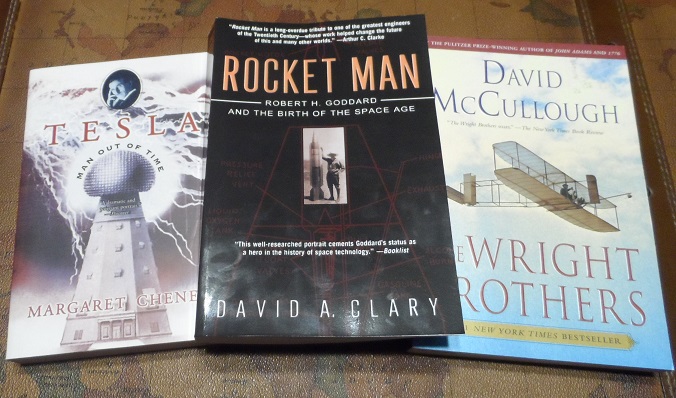
Thus something impossible will probably be accomplished through something else which has always been equally impossible, but which remains no longer. – Robert H. Goddard

Categories: History | Tags: , , , , , , , | 1 Comment

Is Humanity Doomed?

If you have ever read about our ancestors, you were probably taught that, at the end of the last Ice Age, the citizens of North America hunted the many species of megafauna (giant mammals) to extinction. After all, why not assume terrible humans are responsible for all that death?

As it turns out, evidence has been growing of a planet-altering catastrophe as the cause. Most likely an impact event centered over North America (which endured most of the extinctions), with indications of impact craters littered across the East Coast.

Why is this so fascinating? Because it reminded me of the tendency of some people to immediately blame humans for every terrible event to befall the planet. These are the same people, with their dour and glum outlook, whom have been predicting for decades, that we only have a decade or two before we destroy the planet, run out of energy, and starve to death.

Then the decades pass, and the apocalyptic scenarios do not. Continue reading

Categories: Ancient America, History, Native Americans, Prehistory | Tags: , , , , , , , , , | 1 Comment

Want to ‘save’ Science? Then Follow the Evidence, not the Consensus

Science has run into some problems as of late and the organized March for Science didn’t address these.  In fact, it turned out to be mostly about politics, and set an example of how to not do science.

The central issue is that people are being taught not to question what science tells us, or what is being passed off as science. The celebrity scientists of our day encourage STEM programs, wax on how amazing science is, and how important it is for you to study it.

But don’t question it. Anytime someone yells “the consensus says,” you should stop and shake your head in agreement.

This isn’t science. It’s pseudoscience at best, brainwashing into conformity at worst.

Continue reading

Categories: Critical Thinking, Nature | Tags: , , , , , , | Leave a comment

Blog at WordPress.com.