Monthly Archives: October 2014

Jesus, Real and Imagined

There’s seems to be a wave of folks of redefining Jesus: Some wandering hippie, a good guy, hobo, this-or-that-retinterpreted-through-modern-cause or just someone that someone else made up. No, I’m not getting into a religious discussion here, but a historical one. This is also a case study in rooting out bias and agenda. In today’s 24/7 Internet, there’s a demand for a constant flow of articles. We should keep our baloney detector on, no matter what the topic we are reading (whether we like the author’s overall position or not).

Take the article by Chris Sosa, journalist, entitled “Historical Jesus, Not so Fast.” It starts out as if he is going to do what journalists do: A careful examination of an important subject. Very quickly, however, it becomes apparent we have nothing of the sort. Rather it is a repeating of common skeptical claims, not really new to anyone versed in such studies. An agenda emerges quickly.

Especially to anyone who spends 5 minutes looking up the author’s claims.

Claim 1: The Quirinius census (Luke 2:2) was too late to coincide with Herod the Great’s reign (Mathew 2:1) (thus Jesus birth story all out of whack). A couple things Sosa leaves out: Some serious; scholars believe Quirinius was twice governor as implied in Lapis Tiburtinus; inscription.  Others have suggested the translation should be, “this census was before the census which Quirinius, governor of Syria, made.” Not all issues have clear cut answers, but nor is there lack of answers, as implied by the article.

Claim 2: Sosa claims the Gospel of Mark “does not say that Jesus resurrected” stating this was “added at a later date.” Actually, as the translation he references clearly marks, the disputed portion starts at Mark 16:9. The resurrection is mentioned before this in Mark 16:6. The author hasn’t followed his own advice of, “Grab a bible and read along.”

Claim 3: Then there this old stand-by, “…not a single [gospel] agrees with the others on who actually saw [the resurrection].” A cursory review of the gospels reveals that none claim who first saw the empty tomb. That’s an important point (or omission on Sosa’s part). All of the gospels choose different details to focus on of the same events, which is clearly not the same as disagreeing.

Claim 4: Okay, he doesn’t claim anything, only defaults to quoting Bart Ehrman, (infamous) New Testament scholar. Ehrman is a fave among Jesus-debunkers and their go-to guy. Problem is that those who actually test his claims find that he isn’t all that scholarly. In fact, his arguments fail quite spectacularly. That all is beyond the scope of this essay, but finding someone who affirms your view and not testing their claims is not the same as actually proving it. (And Ehrman, scholar he may be, likes to sell his books under tabloidish titled books like Forged).

Claim 5: Sosa then discounts extrabiblical mentions of Jesus, which, obviously, “disintegrate under close examination” when consulting only scholars that agree with predetermined view. Interestingly, though, he doesn’t list all the known references, only ones some people debate.

I’m sure Sosa can “go on for hundreds of pages about the contradictions and historical problems of the Jesus narrative” just as Ehrman has by ignoring thousands of pages — and years — of contrary scholarship. Among other things, they neglect the eyewitness issues and rapid spread of Christianity in face of persecution. Or, very importantly, few Jews ever denied Christ’s existence. By history’s standards, there is far more documentation for Christ than most others we accept as real in the ancient world.

Note here that I didn’t resort to “faith” or talking points or emotion, only history and looking at the documents. Sure, I haven’t gone into a lengthy scholarly dissertation here either, but that wasn’t the point. The point is that we shouldn’t get mad reading an article, or automatically agree with it, without basic verification. Tone can indicate an agenda. A brief article claiming to unseat two millennia of scholarship needs some scrutiny, to say the least.

Regardless of what you think of the New Testament, it is arguably one of the most important documents to come down from antiquity. We have more ancient copies of it than any other document from the ancient world. Even the most revisionist of skeptics and Jesus-debunkers see no reason to claim Jesus was a “myth.”

Earth is flat. Jesus wasn’t real. Aliens traveling light-years in little saucers to abduct humans and make circles in corn fields.

Sometimes we just need to think. Just a little.

jbk

Categories: Ancient Documents, Bible, Critical Thinking | Tags: , , , , | Leave a comment

Can Your Book Entertain and be Thoughtful?

Robert Bidinotto recently wrote:

…one cardinal rule, taught by many fiction instructors, is: Avoid expressing your personal views about politics, religion, and other controversial issues in your fiction. Your job as a novelist, they say, is solely to entertain—not to “preach.” If you get up on your soap box, you’ll only alienate many potential fans. To attract a broad readership, you should suppress the desire to push divisive “agendas.”

True art, which writing is, doesn’t shy away from controversy. How it is presented, however, is what sets apart good writers from the not so good. The not so good come off as preachy, overbearing or use drive-by attacks. You know the scenes, Robert does too:

In static scenes on porches, in drawing rooms, and around dinner tables, characters don’t converse; they deliver speeches and soliloquies. Too often, these wooden, one-dimensional “characters” are little more than premises with feet.

It doesn’t have to be way. The trick is to incorporate issues and ideas organically into the story:

I rejected the belief that there’s an inherent contradiction between entertaining fiction and thought-provoking fiction…I think many opinionated writers fail to entertain because they engage in extraneous pontificating, rather than make their ideas integral to the stories themselves. The trick is to weave a provocative theme or premise into the very fabric of your story, making it the thread that connects your characters to each other and to the events of the plot.

So when writing your stories, look for the characters who start speaking like a professor or some sort of activist. Sure, you have stuff rattling in your head you want to tell people. Everyone does. We all have strong beliefs. No one is going to listen if we lecture them. However, if you explore it thoughtfully, making it integral to your story, then even those who disagree with you will not be turned away. Most of them anyway.

You can’t make everyone happy, but you shouldn’t sacrifice your integrity either.

Categories: Books, Fiction, Writing | Tags: | 1 Comment

Where’s Your Money Going?

Apparently convicted war criminals are.

Unfortunately, not really surprised. After all, the U.S. grabbed up quite a few Nazis after the war, scrubbed their past, and put them to work for the military. Even as some were being prosecuted at Nuremberg — in fact, before the war even ended — others were being vetted for the usefulness in the Cold War in what was called Operation Paperclip. And there began a decades-long policy with Nazis that still doesn’t make much sense.

Those not so valuable to the country were kept out or sent home. Some became exemplary rocket scientists, until someone decided certain ones should be prosecuted years after being effectively give a free pass. We still hunt down aged SS guards with a few years to live, yet many jailed after the war were released early in Cold War Europe to join the new cause.

Yet another lesson highlighting the government’s long downward spiral.

op

Categories: Books, History, Modern History | Tags: , , , | Leave a comment

Orwell and Huxley, Who Was Right?

George Orwell and Aldous Huxley wrote two of the most prophetic warnings in fiction, 1984 and A Brave New World, respectively. Orwell foresaw a world where classic government oppression would erode democracy. In Huxley’s vision, he depicted humanity controlled by pleasure and distraction. It would seem that, to our dismay, they both got it right. Orwell’s Big Brother government is increasingly a reality at the same time Huxley’s populace’s lives are controlled by the trivial and consumerism.

They wrote their books as warnings. Most people weren’t paying attention.

If you are someone who wanders through life day-to-day, driven by wherever the winds blow you, these books are for you. If you are someone who thinks the elite few who run the governments are out there upholding your rights and looking out for you, first, where have you been? Second, these books are for you.

And if you are someone who thinks about the legacy we leave to generations yet to come, unlike our rulers who think election to election, these books are for you as well.

There are always those who look truth straight in the eye and ignore or dismiss it. They don’t want to ask questions or be questioned. Otherwise reasonable people who don’t want to upset their life and the cognitive dissonance they have created. It’s just hysteria or a conspiracy. It can’t happen here.

Until it does happen to them or someone they know. Then it’s a shock. A surprise.

Orwell and Huxley asked us to pay attention to signs. Think like adults. They knew what the corruption of men could lead to, right here, not in some far away place.

Their fiction has become fact. That is an inheritance we don’t want to leave the future.

Categories: Books, Fiction | Tags: , , | Leave a comment

Is the Horror Genre Evil?

I mentioned a book to someone awhile back that was in the horror genre. They were appalled, because they were under the impression that horror was equivalent to Satan making films. I understand where that idea comes from, given the tendency of uncreative horror books and films to be about gore, shock and attacking religion. To say these things are all of what horror is would be a gross stereotype.

Fans of Edgar Allan Poe, H.P. Lovecraft and Alfred Hitchcock all know that these authors explored the fears and dread of man in a more cerebral way. Most people find this approach more frightening than Freddy Part 500. Is there anything wrong with exploring the nature of man? The battle between good and evil? No, and the definition of horror is fluid and can cross into fantasy and sci-fi, and supernatural fiction is often just another name for it.

Christian writers, to the surprise of some, haven’t shied away from the field. Dante’s Inferno is quite hellish. There’s some heavy evil beings in The Lord of the Rings. Authors like Frank Peretti were writing supernatural fiction long before anyone came up with a name for it. Most shocking to all is that horror classics Frankenstein and Dracula were written with biblical worldviews. Gasp! Our perceptions of these two quintessential horror books have been colored by unfaithful adaptations reinterpreted through modern eyes. H. G. Ferguson writes:

It is hard cold fact that the horror story’s mother and father are Mary Shelley (Frankenstein) and Bram Stoker (Dracula), both of whom wrote out of a biblical worldview. Modern attempts by critics to discredit Stoker’s research in particular are significant. They don’t want to discredit Stoker so much as they want to discredit his worldview. They want the vampire amputated from the Judeo-Christian outlook Stoker held. They want Stoker’s vampire, but they do not want Stoker’s God. This is why so many — but not all — most recent treatments of vampires throw out the Cross as a means of dealing with them. The critics understand Dracula was written from a Christian worldview. Why don’t evangelicals?

There’s more to the Dracula story that leaves one wondering how modern versions and their offspring have managed to stray so far. That in of itself is not the point here:

Just like you don’t judge a book by its cover, nor should judge an entire genre by what low-budget movies have defined it as.

fd

Categories: Bible, Fiction | Tags: , , | 3 Comments

Indie Authors Continue to Change Publishing

This time it is publishers of Christian fiction taking notice. Indie authors are here forcing “the industry to adapt,” going beyond the “typical guidelines used to frame the culture’s concept of Christian fiction” and not limited by “genre restrictions.”  In other words, giving readers more choices.

Categories: Books, Fiction, Writing | Tags: , , | Leave a comment

13 Days to Halloween

Stores had Halloween decorations as early as August, and Christmas by October. Yes, we all know how nuts that is, but this isn’t about all that. This is about Halloween and its history (largely a re-post from last year).

What kids don’t like dressing up as superheroes or cartoon characters (or the old standby sheet as a ghost if you’re in a pinch) and collecting candy? The popularity of Halloween waxes and wanes with time and among people, but there’s much history behind it.

Halloween is technically part of Hallowmas, a three day Christian observance consisting of All Hallows’ Eve (Halloween), All Saints’ Day (All Hallows) and All Souls’ Day. Hallowmas is a time to remember all those who have departed this world. What does “hallow” mean? It’s derived from the Old English word halig, which means saint.

Some Christians object to Halloween because of the suspicion that it drew from the pagan holiday Samhain, but the connections are debated, other than using the same day. One has to ask, though, what does it matter? Christmas trees and Easter bunnies were reappropriated from nonchristian traditions. Crosses were popular in some pagan religions. In other words, we shouldn’t make the genetic fallacy and judge something on what it once was or how others celebrate it.

Because secular Halloween can be celebrated in a variety of ways by different people, some Christians have ceased recognizing it altogether. That’s fine, but asserting Halloween is simply a pagan or occultic festivity ignores a few centuries of Christian history (and have we all given up on Christmas as it has turned into an economic event for businesses?). I have also suspected that some groups perceive the Hallowmas days as Roman Catholic and have as such abandoned them. This too is in error, as many Protestant denominations still recognize these observances. In particular, All Saints Day has been fairly universal in large swaths of Christendom.

Fall festivals have replaced Halloween in other circles. These are actually another universal event among peoples of all beliefs, that reach into history. The last big hurrah before winter, a time to stock up on the summer’s harvest. So if Halloween is not celebrated because it’s “pagan,” why not apply that to fall fests? There’s nothing wrong with having such events (fall is the best time to have festivals, in my opinion), but don’t do it on false reasoning. I’ve seen some festivals that try to combine everything and come across as, “We want the kids to be able to do Halloween stuff, but we’ll call it something different.” Fall fests and Halloween are entirely two different things.

Perhaps there is a reason Christians should reclaim Hallowmas, instead of ignoring it. It’s a sad truth that we often avoid talking about those who have died. Out of a fear of sadness we fail to teach our children about those who came before them. Histories and people lost. It doesn’t have to be that way.

In fact, that’s what Halloween is all about.

Categories: History, Traditions | Tags: , , , , , | 2 Comments

Not Worried About Ebola?

I am a bit baffled and disturbed, that months after the Ebola epidemic started raging across Africa, we are still letting people from those areas into the U.S. If you are not baffled or disturbed, I’m thinking you don’t understand what Ebola is.

What it is not is the flu or measles. You have the flu and cough in a room full of people, most won’t even get sick, let alone die. You have Ebola and cough in a room, many may get it (no immunities) and, well, the fatality rate puts this disease somewhere above anthrax (which doesn’t spread very easily without sophisticated help).

While I’m sure there are plenty of dedicated people working around the clock to fight this disease, the laze-fair doctrine of non-existent control of our borders and who enters the country is ripe for a deadly scourge. The open borders, by some studies, is at fault for the recent re-emergence of other disease outbreaks — though none of the killing caliber of Ebola.

Many will say, “It’s only two or three, we can handle it.” Perhaps. But two or three can infect hundreds. This isn’t the chicken pox. You don’t give your kids some lotion, wash your hands a little more often, and go about your life. No, you and everyone you have been in contact goes into isolation lock-down and those who contact the disease fight for their lives.

The only way to stop a disease like this is to take it seriously.

Books like Germs and The Dead Hand detail the insidious nature of diseases like Ebola and, while many were worried about nukes, governments tinkered with weapons some argue are worse. Lab 257 reveals that even the knowledge of what bio agents can do, we didn’t always take them seriously. These books, while focused on biowarfare, hinge on what many viruses and bacteria are capable of doing in nature and among populations (the history of biowarfare research will be eye-opening to many in a troubling sort of way). Then take a look at the movie Contagion for a realistic depiction of what a widespread outbreak could look like.

We can discount, dismiss or explain away what the politicians do or don’t do because of our political preferences. Or we can hold them all accountable to their fundamental purpose: Defending borders, whether from disease or man. Or both.

So technically, if you prepare and take precautions, you no longer have to worry (if you had been to begin with). This is a winnable battle, but decisions now will decide how costly it will be.

gm

P.S. Many people have taken the either-or approach: Either “The media is just hyping Ebola” or “They’re under-reporting it and you need to be in a bubble.” People like to gravitate to extremes, often in emotional response to another extreme. What I am promoting here is simple: Don’t pretend Ebola is just the bad flu or some African disease, and taking simple precautions is common sense. Also, don’t be one of these people who say, “Oh, thousands die from the flu every year, so why worry about Ebola?” Other than that the “thousands” claim is a spurious stat, look at the mortality rates. Mortality rate of flu viruses: Less than 1% (effectively zero), Ebola: 70%.

Categories: Nature | Tags: , , , , , , , , , , | 1 Comment

Beware of Pirates

Since the World Wide Web made the Internet a button-click away from anyone, piracy (stealing) of others works has been a very easy occupation. Music downloads has been at the forefront of theft. Now, the proliferation of e-books has made books an easy target. If you don’t get what the big deal is, think of it this way: You spend weeks or months at your place of employment on a project. At completion, your company uses your work but doesn’t pay you. You’d be a bit upset and have some trouble paying the bills. Contrary to popular belief, most writers aren’t rolling in dough.

Robert Bidinotto wrote on this recently, ending with:

I hope readers tempted to download from a pirate site will pause to realize what will happen if your favorite writers finally give up, because piracy no longer makes it possible for them to write for a living. Ebooks aren’t expensive; in fact, they provide more value for their price tags than any other form of entertainment and information. Please remember that, and honor the authors who work so hard to provide you those values by purchasing their works only from authorized sites.


Categories: Books, Writing | Leave a comment

Take a Trip: Africa, Lost Islands, Pirate Ships

Sometimes modern readers roll their eyes at the suggestion of reading the “classics.” Can they really be better than the 1800th vampire novel? How can they compare to yet another teen-dystopian-sorta-adventure/romance novel?

Yes, there are some classics that leave one wondering who exactly voted them to those “must read before college lists.” Then there are those that have earned their title with generations of readers.

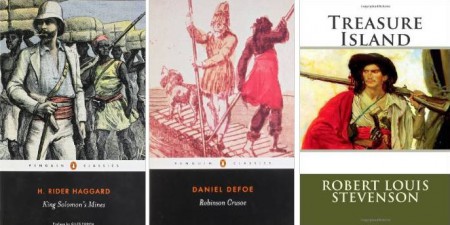
Long before Michael Crichton did so in Congo, H. Rider Haggard brought readers into the heart of Africa looking for the long lost King Solomon’s Mines in 1885. The original Indiana Jones, Allan Quartermain feared little.

Stranded on lost islands have been a of Hollywood for decades, but it was Daniel Defoe’s Robinson Crusoe that started it in 1719!

And if Robert Louis Stevenson hadn’t written Treasure Island in 1883, would countless pirate films held our fascination for so long?

These books have endured  — even after their many imitators have faded from memory — because the writers created atmospheric, detailed worlds that anyone could disappear into. Seriously, want to go on a treasure hunt across Africa and make it back? Live on an island by yourself for years and not worry about being saved? Or go on a high seas adventure and make it home for dinner?

Many books come and go. A few, though, we never forget.

adv

Categories: Books, Fiction | Tags: , , , , , , | Leave a comment

Create a free website or blog at WordPress.com.