Ancient America

The Fire of Exploration

Exploring the final frontier has never been easy. For decades, in fits an spurts, we have explored the Solar System and established manned outposts in orbit. We even reached the Moon, which has been so long ago now, that it seems a dream.  We can probably blame the tortoise pace of space exploration on it being largely controlled by the government and their ever changing, and short-sighted, whims. In recent years, private companies have taken up the torch. As witnessed by this week’s crash of the spacecraft Galactic, exploration on the edge of frontiers is still fraught with danger.

It always has been and always will be.

When the New World was being rediscovered by Europeans from 1492 on, it was much the same. Driven by politics, economics and the innate desire of humans to explore, not all went well. The early voyages were often about finding wealth and conquering lands. Later, though, it would be about building a better life, improving the human condition. The powerful desire to improve the existence of one’s family and future descendents has long been entwined with that frontier spirit. It’s often difficult to tell them apart. Interestingly enough, we would later learn that 1492 wasn’t the first rediscovery of what would later be named the Americas.

In 1000 A.D., the Vikings arrived in North America. It seemed almost inevitable that these quintessential seafarers and explorers would do just that. For centuries the sagas and rumors attesting to their arrival was largely discarded as myth. Then archaeological remains of a settlement were found in Canada in 1960.  Still, the idea of pre-Columbus explorers was seen as unlikely and supposed accounts quickly dismissed.

This was for two reasons: One, the level of required verified evidence is high. Is it too high? The Viking sagas told of exploring America, but were dismissed as legend. Even now, the extent of their exploration is unknown, but it is admitted that they voyaged to the coast for decades, if not longer. Only one settlement? These legendary warriors never ventured far from the beaches?

Two, early attempts to dismiss all natives as not much more than primitive cavemen saw many people ascribe anything of sophistication to foreign visitors. We now know the New World was replete with civilization and we know they arrived here longer ago than originally thought, through multiple paths. That paradigm shift has led many to wonder: Is it reasonable to think that people here for so long remained isolated from the rest world? A world that had many accomplished seafarers?  After all, didn’t the natives make it here at one point? Does any civilization live in isolation for over 10,000 years?

Of course, there are those who consider any suggestion of diffusion racist. They are driven by those who have, or still do, see natives as inferior. The other side of the coin are those who believe it did happen, repeatedly, and assert that it’s racist to say it couldn’t have happened.

So much for academic inquiry.

To be certain, the field has been full of fringe writers pushing many a bizarre theory or those motivated by ideology. Not all are so driven. Many are simply looking for the facts, some of which have always hidden in plain sight.

Sometimes it was intention, other times apparent chance, but in either case exploration burned in the souls of many men and women. What resulted wasn’t always good, but the overall condition of man usually improved. Does the fire of exploration still kindle? Are we too busy to see past tomorrow, buried in our televisions and self-created busyness?

Time will tell if humans will quit ignoring the calls to be something greater than what is pushed upon them. Modern steps into space are part of a long legacy that reaches back millennia. The crash of the Galactic won’t extinguish the flame.

It reminds us there are still those in which the fire still burns.

naex spcex

Categories: Ancient America, Ancient Sites, Books, History, Native Americans | Tags: , , , , , , | 2 Comments

Finding our Past, and Future, in the Jungle

Many of you have grown up with fictional characters like Indiana Jones. Swashbuckling tales of danger in search of lost cities. There was a time when such adventures weren’t the realm fiction.

In the last decades of the heyday of exploring the last wilds of the Earth, Colonel Percy Fawcett led an expedition into the Amazon to search for the fabled Lost City of Z.

He was never seen again.

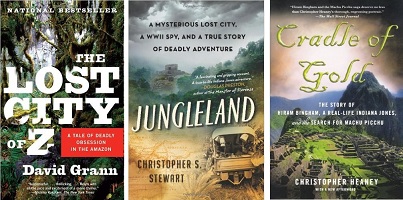
Decades of rumors of his fate ensued. Had he found the lost city? Was he living among the natives? Had he succumbed to the jungle many years before? David Grann takes us on a tour of Fawcett’s obsession in The Lost City of Z, in part by heading into the jungle himself following the footsteps of the lost explorer.

But Fawcett wasn’t the only one. Theodore Morde had claimed he had found the lost White City in Honduras. He never returned to explore his find and may have tried to obscure its location to dissuade others. Christopher S. Stewart dives into this man’s life in Jungleland. He too goes to the jungle and tries to locate Morde’s discovery and, perhaps, what haunted him to the end.

Then there was Hiram Bingham who discovered the legendary mountaintop city of Machu Picchu. This site was not lost and has become an iconic wonder of the Mesoamerican past. Christopher Heaney chronicles Bingham’s quest in Cradle of Gold. The classic journey of that era that has impacted history decades later to our time. Its forgotten history of a sprawling empire is still being revealed. And Machu Picchu has become the prime example of the need to return artifacts to their rightful nations that were acquired (not always honestly) during the age of relic hunting.

These books are windows into the bygone era of journeys into the unknown. Sometimes driven by fame or fortune, discovery or quest of knowledge, the explorers were nearly the last of their kind. Perhaps those who have left Earth into space are our only successors to them.

In any case, there are still discoveries to be made on our world; jungles that still cling to their secrets and can make men vanish in an eye blink. We are desperately in need of a generation that takes mankind’s history seriously while looking forward and are willing to explore new frontiers and push us beyond new thresholds.

Ignoring history, not seeing past tomorrow and thinking a new phone is “innovation” just doesn’t cut it.

Categories: Ancient America, Ancient Sites, Forgotten Places, Native Americans | Tags: , , , , , , , , , , , , , , , , , | 2 Comments

Were there Giants in Ancient America?

“Now that’s an odd question,” you ask. “Giants?”

Well, I haven’t posted on ancient history in awhile, so let me wander for a bit. The thing is, many of the old county histories detail the findings of giant human bones throughout the country. There have been hoaxes, so many are apt to discard all accounts. Why would history after history write about something nonexistent? These books aren’t full of fantastic tales, but report local history matter-of-factly.

Then we never hear about the giants again.

Suspicious? Perhaps. Why no discoveries since? A cover-up or were there simply not that many of them? Were they just inspired by the tall-tale-telling of the 19th Century? Was inserting giants into histories just a passing fad?

The tone and widely spread accounts seem to argue for authenticity in the face of no proof of hoaxing. So were they all misidentifications of mammoth or other animal bones, as some have suggested? Or perhaps we are just reading our understanding of the past into history.

Without actual bones, this is mostly an exercise in various views trying to disprove the other. Perhaps if some of the more extreme views have not clouded the issue, and others weren’t so quick to dismiss things that didn’t fit the status quo, maybe it wouldn’t be such a fringe topic.

Ultimately, we should ask, legends often have kernels of truth, so why not history itself?

Categories: Ancient America, Legend, Mysteries | Tags: , | Leave a comment

Mayans: Engineers of the Ancient America

Whereas many are focusing on the Mayan calendar’s supposed world-ending climax in December, others are using this focus on the Mayans to educate on this lost civilization. Engineer and explorer James A. O’Kon has written The Lost Secrets of Maya Technology, a fascinating look at the technology of these people who were for so long considered Stone Age folk.

From pyramids, to grand cities, irrigation and bridges, the Mayans matched and often surpassed civilizations of the Near East and Asia. They didn’t follow the standard model of emerging along riverways, use of animals and stayed relatively isolated from the rest of the world. Yes, they were preceded by the Olmecs, traded and eventually ruled by the Aztecs, and some suggest had at least some transoceanic contact. Yet, they largely seemed to develop on their own the technology that supposedly the primitives of the New World were too simple to figure out.

Eventually, drought and overuse of the land would lead to their downfall. Their cities already abandoned by 1492. Like many peoples, they couldn’t predict the future and thought time was on their side. In their success they felt invincible and they thought their world would never end. It did, as many before and since.

Will humans ever take seriously the history of those who fell before us?

Categories: Ancient America, Native Americans | Tags: , , | Leave a comment

Vikings in America…More Evidence?

For decades, rumors and sagas of Vikings in America before Columbus were ignored as fantasy. One of these evidences routinely dismissed was the Kensington Rune Stone, found in Minnesota. Even after remains of a Viking settlement in Canada, there was still a fierce reluctance to revisit this and other Viking evidences. Now geologist Scott Wolter has presented a detailed and scientific defense of the Kensington Rune Stone’s authenticity.

A potentially history-changing find.

Not the whimsical, logic-leaping theories of a revisionist, Wolter outlines the flaws in the arguments of hoax-claimers and the very serious and difficult-to-deny evidence of his position. (However, Wolter hurts his cause when he brings in the Templars into his theorizing – which wouldn’t be bad by itself, as they may come into play in all of this – but he includes many of the bizarre, untrue fancies that have been following them in recent years. Please, how many historians have to refute these things before people stop repeating them?)

Will the Viking presence in America continue to be ignored? Will these people, whose exploration skill was legendary, still be left on the Canadian coast?

Or perhaps we will finally let history tell its story.

Categories: Ancient America | Tags: , , | Leave a comment

Ancient Mayan Astronomers

I’m sure 2012 fanatics will like this: “Ancient Mayan workshop for astronomers discovered.” The Mayans are well known for their sophisticated calendars which are at the root at 2012 fascination. This particular set of finds may extend their calendar beyond the Big End this December. Like many cultures, their science and religion were strongly linked and time keeping was needed for worship purposes. Yet all their knowledge didn’t keep their civilization from ending.

Perhaps something for our own to ponder.

Categories: Ancient America, Ancient Sites, Native Americans | Tags: , , | Leave a comment

Pyramids in Wisconsin?

For decades there have been reports of geometric structures on the floor of Rock Lake in Wisconsin. And after decades of discussion, we still have a lot of fuzzy photos and disregard by most archaeologists.

Nearby, however, is the Aztalan State Park with remnants of mounds built by a Mississippian mound builder culture. Extensive earthworks were built. Did they build something in the lake when it was low? Why would they? Divers claim they found remains of stone pyramids — stone not being a prime material of mound builders. An Aztec outpost?

This is one of those tantalizing mysteries some people keep talking about, yet no convincing proof seems to come forward.

If there were claims of pryamids in any lake nearby me, I would like to know one way or the other if it were true.

Categories: Ancient America, Ancient Sites, Mysteries | Tags: , | Leave a comment

Spain Continues Plunder of Peru

After a legal battle, gold found in a sunken Spanish warship, from the days when they still had colonies in South America, arrived in Spain. If I understand correctly, because this is a warship, international law states Spain has rights to it and the discoverers do not. Perhaps, but what about Peru? This gold was taken from them after the Spanish forcibly took their country and destroyed the Inca civilization.

So centuries later, Spain apparently sees no problem with this dark chapter in its history and continues its legacy of stealing treasure. Perhaps if this were really an enlightened age, they would give it back.

Categories: Ancient America, Uncategorized | Tags: , , , | Leave a comment

Mysteries of Arizona

I dug out of the archives an article I wrote awhile back on the ancient world of Arizona’s past. Part travelogue, some history and of course a few lessons for today. Enjoy.

Categories: Ancient America, Native Americans | Tags: , , | Leave a comment

Viking Ghosts

I’ve discussed here and in books about the Viking voyages to America prior to Columbus. Once thought fanciful, ruins discovered in Canada in the 1960s changed all that. Yet any potential Viking finds other than these ruins are viewed with intense skepticism. True, science needs to weed out frauds. However, historians acknowledge the Norse visited here for centuries, so what’s the possibility of other artifacts?

At Last Kings of Norse America, cases for the authenticity of long-debated runestones found here are presented.

I’ve mentioned before the Newport Tower, which is detailed at length here. Many believe this to have been built by the Norsemen.

So what was their impact and scope in the Americas? Did these accomplished explorers that once traveled much of Europe only build one short-lived settlement and leave?

Someday, perhaps, we’ll know.

Categories: Ancient America | Tags: , , , | 2 Comments

Create a free website or blog at WordPress.com.