Critical Thinking

Sorry, Christmas and Christmas Trees Still Not Pagan

Every Christmas we hear people proclaiming Christmas and its traditions were once pagan or still are pagan (“pagan” in this context meaning a non-Christian religion). My first instinct is to laugh at those who think they discovered some long-lost, secret knowledge. My second thought is to turn to history for the truth.

Christianity has a long history of subverting — or appropriating — items, thoughts, days, and locations from other cultures if they agree with Christian teachings. Sometimes these things are given new meanings if they don’t agree Christian beliefs. This method of opening the door to Christianity for people was initiated by the Apostle Paul.

In the Areopagus Sermon, recorded in Acts 17:22–34, Paul argues to the Greeks at their high court on the reality of God by using the words of their own thinkers such as Epimenides, Aratus, and Cleanthes. He starts by pointing to one of their monuments: “I even found an altar with this inscription: TO AN UNKNOWN GOD. So you are ignorant of the very thing you worship — and this is what I am going to proclaim to you.” Paul is subverting parts of their own beliefs that can, or do, point to God, to open their mind to the discussion by highlighting what is already in agreement.

If we go further back, we find more examples of subversion. The Ark of the Covenant is very similar to Egyptian ark designs, and Israel’s temple also has likenesses to Egyptian temples. Why would God give the Israelites instructions to build these using Egyptian archetypes? Probably due their familiarity after living among the Egyptians for so long. However, the Israelites also let other things they had learned corrupt them. The Golden Calf could have been inspired by the Egyptian veneration of the Apis Bull. These are among many Egyptian details recorded in Exodus — including the name Moses which was borrowed from the Egyptian language — which lend credibility to the accounts. Skeptics who doubt the events in Exodus have to explain away all the subtle, and not so subtle, Egyptian references.

There are other examples, but here we have seen God, Paul, and later Christians appropriate objects and writings from other religions and give them new meaning. People who claim these things are bad because they once were pagan, are committing the genetic fallacy. In other words, as I like to say, Who cares what they once meant, what do they mean now? Sure, not everything can be easily appropriated. Some things not at all.

A popular rebranding method was when Christian denominations would take pagan festival dates and rename them and given them new meaning. Does Christmas Day and some of its associated traditions fall under this category as we are often told?

Actually, they do not.

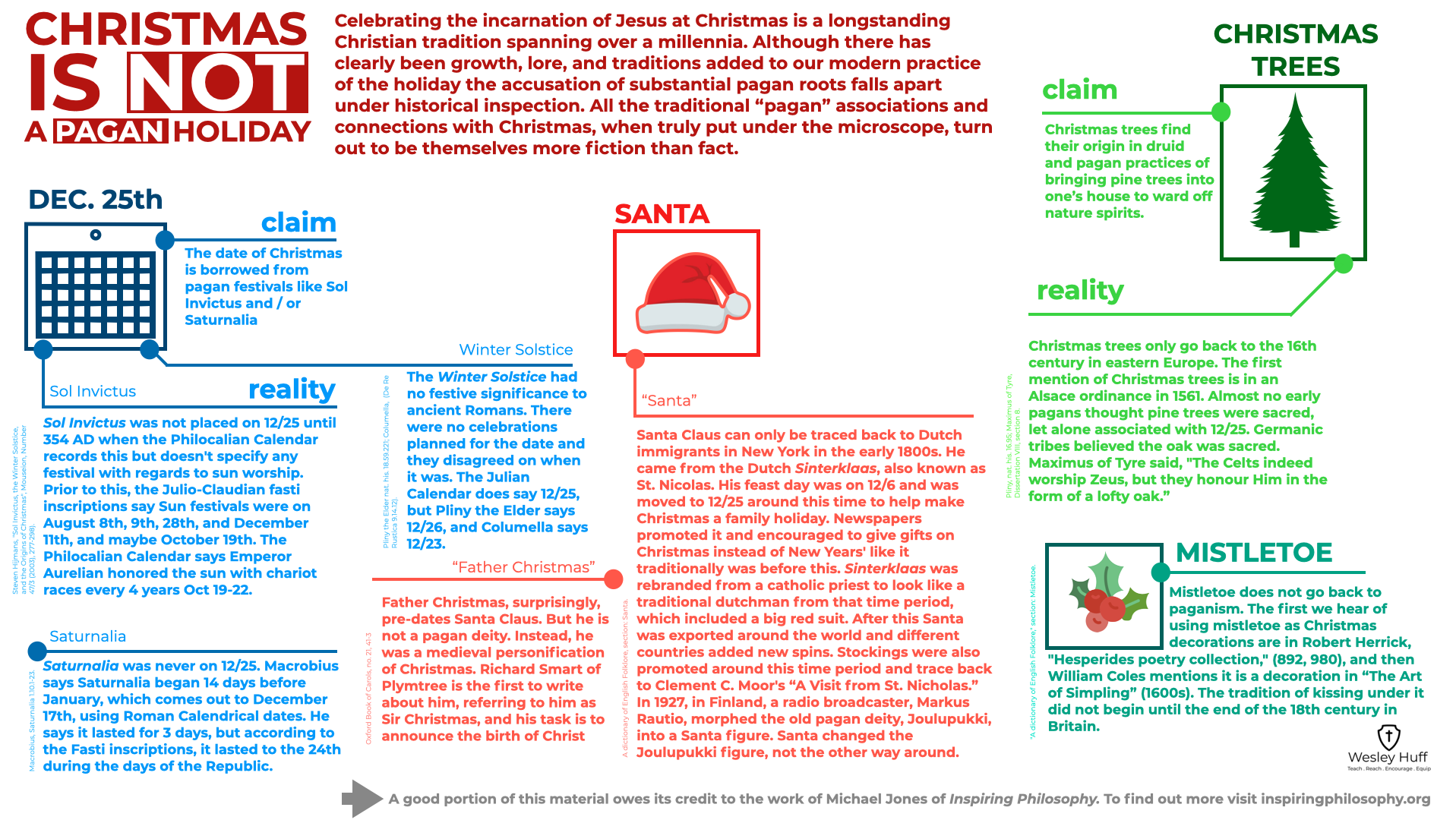
Biblical and ancient documents scholar Wes Huff explains in this video why “All the traditional ‘pagan’ associations and connections with Christmas, when truly put under the microscope, turn out to be themselves more fiction than fact.”

Historian William Tighe concluded after his research, “The ‘pagan origins of Christmas’ is a myth without historical substance.” Wes also provides these two infographics summarizing his research: Christmas is not a Pagan Holiday and So Where does Dec 25 Come from if it’s Not Pagan?

Check out those links for all the research. Most people don’t bother to test what they hear, especially if it fits a preconceived bias of one sort or another. Ultimately, the methodology of opening the door to discussing Christianity by finding points of agreement is a logical and sensical approach.

We can’t really say the same about all the drive-by scholars and their yearly attempts to rewrite history.

Categories: Ancient Documents, Bible, Critical Thinking, History, Traditions | Tags: , , , , , , , | Leave a comment

The Dark Side of AI

Artificial Intelligence can be a valuable tool, but like any piece of technology it can be misused unintentionally and intentionally. With so many jumping into AI without thinking, much like they did with the internet and then social media, we need to take a breath and perform some critical thinking.

Software engineer Vanessa Wingårdh has produced a number of discussions on the dark side of this rapidly expanding technology. She explores how insurance companies are using AI to deny healthcare. We also see people relying so much on generative AI programs, they are experiencing brain rot. Some have managed to turn AI into a disturbing cult, AI leading people into disturbing actions, and others think AI is a conscious being and try to have real relationships with it.

Clearly, many of these people had problems before encountering AI. We need to return to a time where people are allowed to recognize these issues in others. For all the talk of mental health, we still seem to brush these things under the rug or act like its okay for someone else. No, it’s time to reclaim objective truth before we lose more people to mental health issues and cult like thinking.

Robbi Jan has examined the dangers of AI blurring reality and the use of tech in transhumanism agendas. Transhumanism can very easily become a new 21st Century eugenics movement. She also takes a look at these trackable health devices everyone is embracing. Are they safe and private? How many hacked databases do we need before we take security more seriously?

Listen, you can ignore AI, or blindly jump into using it. Either case is the wrong choice. We’ve learned the hard way about social media, both information and people manipulation and tech addiction.

How about learning our lesson for once?

Categories: Critical Thinking | Tags: , , , , , | Leave a comment

The Rise (and Eventual Fall) of Darwinism

“What if Charles Darwin got it wrong? What if all the crises, alienations, and losses of faith we associate with the aftermath of the publication of The Origin of Species had been triggered by a false prospectus?” – Neil Thomas, Taking Leave of Darwin

Like many people, Neil Thomas, a scholar of logic and literature, accepted the Darwinian “narrative without demur” and he “deferred to what [he] imagined must be the properly peer-reviewed orthodoxy.” Yet when he began to study what was behind the curtain he found the “grand story of evolution by natural selection was little more than a creation myth to satisfy the modern age.”

In Taking Leave of Darwin, Thomas details this journey as he explores the evolution of a myth, the counter-theories and criticisms that allegedly don’t exist, and finds Darwin’s model of origins supported by materialistic philosophy, not by empirical science.

He writes Darwinism is a throwback to the “pre-scientific mind [which] imputed agency to Nature by way of personification of Nature’s various aspects as individual divinities…Darwin appears, wittingly or not, to have channeled the spirit of the older, polytheistic world by crediting Nature with an infinite number of transformative powers.” The mechanism of speciation, driven by chance, “…falls at every hurdle. It lacks explanatory force, empirical foundation, and logical coherence…nothing can ‘magically emerge’ or ‘naturally evolve’ without a supporting agency.”

Thomas’ second book, False Messiah, focuses in on Charles Darwin, his development of his origins theory, and the age in which this all unfolded. He found Darwin struggled to put his theory on solid ground, questioning some of its tenants, and its lack of data. His critics were aplenty, questioning the logic of the proposed mechanisms of speciation, or the feasibility of life spontaneously forming in a “warm little pond.” Even in Darwin’s day, his model appeared as a “just-so story” of “fog piled on fog” that ignored the reality of the impossibilities it claimed to explain. Some of Darwin’s own supporters wrestled with the claims in his books, so how did the model rise about all these obstacles?

It rode the zeitgeist of the Victorian culture wars, not empirical science. Thomas writes, “Many Victorians very much wished Darwinism to be true. On the slightly dubious principle that empirical facts should never be allowed to get in the way of a good story, many turned a blind eye to the scientific inadequacies [of Darwinism].”

The 1860s were a counter-culture era, where the intelligentsia was revolting against traditional thought and religion. Clearly not all were onboard with Darwin’s claims, many realizing “materialism could not account for the totality of human experience.” Nor could Darwinism explain the “sheer exceptionalism of our terrestrial biosphere.” Sometimes facts get overwhelmed by louder voices. Unfortunately, Darwinism would be used as the basis for a horrifying new zeitgeist, eugenics, for much of the Twentieth Century. This would be quickly memory-holed in subsequent decades.

In the end, to this day, Darwinism has been a theory “much modified, festooned with revisionary patches akin to the epicycles employed to prop up geocentricism.” Even as evangelists of neo-Darwinism claim it is unchallenged and solid, in the journals and research labs, there are frantic searches for replacements. In spite of over a century of work, Darwinism still cannot explain ultimate origins, complexity, information in DNA, consciousness or much else other than minor adaptations. In frustration, more supporters have gone back to panspermia or multiple-universe speculations. In other words, they are just moving the problems of Darwinism out of sight, out of mind.

Thomas’ two books are together a very readable, and non-technical history of Darwin’s theory of biological origins. For those unfamiliar with the subject, or those who have been taught not to question the reigning narrative, these short volumes are packed with well-documented history.

Ultimately, Darwin’s model would have died long ago, had it not been hijacked by materialistic and naturalistic philosophies. It’s a shame really, because Darwin appeared to be trying to practice science, even if was ultimately a strained attempt by piecing together various existing claims. His doubts grew over the years, but he was so invested by then, he never gave it up (though some of his supporters did).

Science has always been beset by personalities, influenced by movements and causes. Much of this can be exposed and avoided if, as Thomas asks of us, we commit to being truth-seekers.

Seek truth, wherever it leads you.

Categories: Books, Critical Thinking | Tags: , , , , , | Leave a comment

What Middle Earth Taught us about Evil

“The Shadow that bred them can only mock, it cannot make: not real new things of its own. I don’t think it gave life to the orcs, it only ruined them and twisted them; and if they are to live at all, they have to live like other living creatures.” – J.R.R. Tolkien 

J.R.R. Tolkien spent a lifetime creating a mythos with far more detail than most writers ever imagine. An Oxford professor, he approached his writing as if it were a scholarly pursuit. Yet it was still entertaining and captivating, full of themes and message (though he never intentionally preached, his beliefs informed his work). That’s why it has endured for so long (The Hobbit was originally published in 1937).

Tolkien drew on many influences in creating Middle-Earth. Most notably his Christian worldview, from which one of his most important themes came:

Evil exists.

Not only that, he witnessed the worst men could do while serving in World War I, which undoubtedly colored his writing. In fact, he began creating his world while in the trenches. Throughout his books, he made it clear evil was always there, even when not obvious, waiting for a time to explode or conquer. When it did, it must be stopped.

It’s funny how Lord of the Rings, in many ways a war novel, saw a resurgence during the 1960s. Though I doubt, because of his own experiences, Tolkien would ever promote rushing into war. He also knew we can’t pretend evil doesn’t exist or that it may just go away.

It always comes back.

In time of tragedy, people always ask why? That is the normal reaction and indeed there are many causes for terrible events. People look for targets to blame. That’s the easy way out. Thinking deeply about actual causes is difficult. Admitting evil exists scares us.

Given one of the cornerstones of most religions is evil exists, one wonders why so many pretend it doesn’t. We want to be safe, secure and happy, but we don’t want to be vigilant. We’ve been told evil isn’t real and we, through law and government, can stamp it all out. We downplay talk of evil in our religions, so not to scare people away. We have made religion into another helpful fad to get us through life. Then something horrible happens. We are forced back into reality.

Sadly, most who are not directly effected by the tragedy, soon forget and go back to their lives. Evil grows and prospers and is ignored.

Tolkien believed in it. He saw it in war and never forgot it.

Times of disaster and tragedy are the times we need to protect our rights the most, because in the end, if we don’t, far greater calamities will occur. Just look to history.

Some think “doing something about guns” will solve these problems. Timothy McVeigh didn’t use guns to massacre people. Nor did the terrorists on 9/11. Evil wants us to think it is just that simple, ban this or that. It wants us to look the wrong way.

Ask the right questions. If we don’t, evil will continue to win.

“Evil labours with vast power and perpetual success – in vain: preparing always only the soil for unexpected good to sprout in.” – J.R.R. Tolkien 

Categories: Books, Critical Thinking, Fiction | Tags: , , , , , , , , , , | Leave a comment

Making the Right Decisions

Sahil Bloom has collected 10 Life Razors to guide your decision making. Razors are simple tools that can produce bold results:


Smart choices start with simple rules (razors).

Here are 10 of the most powerful I’ve found:

  1. The Luck Razor: When choosing between two paths, choose the path that has a larger luck surface area. Your actions put you in a position where luck is more likely to strike.
  2. The Feynman Razor: Complexity and jargon are used to mask a lack of deep understanding. If you can’t explain it to a 5-year-old, you don’t really understand it. If someone uses a lot of complexity and jargon to explain something, they probably don’t understand it.
  3. The Optimist Razor: When choosing who to spend time with, prioritize spending more time with optimists. Pessimists see closed doors. Optimists see open doors—and probably kick down the closed doors along the way.
  4. The Young & Old Test: Make decisions that your 80-year old self and 10-year-old self would be proud of. Your 80-year-old self cares about the long-term compounding of the decisions of today. Your 10-year-old self reminds you to stay foolish and have some fun along the way.
  5. The Rooms Razor: If you have a choice between entering two rooms, choose the room where you’re more likely to be the dumbest one in the room. Once you’re in the room, talk less and listen more. Bad for your ego—great for your growth.
  6. Occam’s Razor: When you’re weighing alternative explanations for something, the one with the fewest necessary assumptions should be chosen. Put simply, the simplest explanation is often the best one. Simple Assumptions > Complex Assumptions.
  7. The Arena Razor: When faced with two paths, choose the path that puts you in the arena. It’s easy to throw rocks from the sidelines. It’s scary and lonely in the arena—but it’s where growth happens. Once you’re in the arena, never take advice from people on the sidelines.
  8. Hanlon’s Razor: Never attribute to malice that which can be adequately explained by stupidity. In assessing someone’s actions, we shouldn’t assume negative intent if there’s a viable alternative explanation—different beliefs, lack of intelligence, incompetence, or ignorance.
  9. The Lion Razor: If you have the choice, always choose to sprint and then rest. Most people are not wired to work 9-5—long periods of steady, monotonous work. If your goal is to do inspired, creative work, you have to work like a lion. Sprint when inspired. Rest. Repeat.
  10. The Gratitude Razor: When in doubt, choose to show MORE gratitude to the people who have mentored or supported you. Say thank you more. Tell someone you appreciate them. Not just on special occasions—every single day.

The quality of your life is a reflection of the quality of your decisions. Better decisions require better tools.

Start using these razors and your life will start to improve.

Sahil Bloom is an investor and entrepreneur, and the New York Times Bestselling author of The 5 Types of Wealth: A Transformative Guide to Design Your Dream Life. © Sahil Bloom.

Categories: Critical Thinking | Tags: , , , | Leave a comment

Are You Paying Attention?

Some highly recommended documentaries attempting to pull back the curtain on the government and social media. Are you ready for what will be revealed?

Categories: Critical Thinking, government, Modern History, Mysteries | Tags: , , , , , , , | Leave a comment

Meta Study: How to Master Any Subject

Want to learn about Roman history? Have a desire to wrap your mind around astrophysics? Is your ongoing learning inhibited by bad memories of school learning, aka kid prison?

Don’t fret, there is a way to break down a subject, and learn it to a level at which you can discuss it intelligently.

In scientific studies, there is something called a meta-analysis where multiple reports or studies of a particular subject are synthesized into one new study. I’ve adapted this into the meta study which allows you to tackle a particular topic.

Step 1: Define Limits

This is the hard part where you have think a little bit. Here’s where you survey your subject of interest and define some limits. Any subject, whether history or health, or anything you can think of, is a bottomless pit of specializations. You’ll need a manageable bite. What in history do you want to study? Roman Empire? Divide this into time periods: Early Rome, Imperial Rome, Decline of Rome. Health your subject? What part of health? Proper human diet? Okay, determine what people are claiming are potential, proper human diets.

Step 2: Pick Sources

There are thousands, so you cannot read them all. Search out some of the most current and respected sources. There are some pitfalls here, because simply because something is popular, doesn’t make it true or valuable. Also, you cannot bring in your a priori bias in picking materials. Approach any subject as an independent researcher as if you have no knowledge of what you are about to study. Some topics may require you to read sources that have contrary conclusions.

Note: I default to books because of their depth of information and accessibility. These should be the core of your studies, but other sources such as interviews and documentaries are also useful.

Step 3: Start Reading

Once you have your initial books (you will likely need more), begin reading, but keep these items in mind:

  1. Take note of any things you come across you want to learn more about. That is, save these rabbit trails for later. Back in our Roman history example, you’ll run across many events, people, etc., that many volumes have been written providing much more detail. Stay on point for now.
  2. Watch for the saturation point. When your readings start becoming repetitive with not a lot of new material, you have reached a strong point of understanding of your subject.
  3. Explore some of those interesting items which you took note of until you reach understanding with them as well.

How do you really know if you have reached some level of mastery of your subject? Do you understand “experts,” real or otherwise, when they speak on the subject? Are you able to ask questions, detect discrepancies, while you or someone else is discussing the topic? Can you discuss the topic easily?

Realize there are people who spend a lifetime specializing in a topic, whether in formal or informal settings. You could get there, but your goal here is to understand subject, be intelligent in speaking about it, and not necessarily knowing every last detail.

Step 4: Maintenance Phase

Once you’ve reached a comfortable level of understanding there are a couple of actions to undertake. Look through all of your resources and keep the best of the best. That is, remove any that are repetitive, not as engaging, or as current. Secondly, check back every so often for new resources that are released. Some topics are very dynamic in new information, others are more static.

Good luck on your journey of learning. Be a time traveler in history, take control of your health, or travel the universe.

Whatever trail you choose, be prepared for some amazing, or startling, discoveries.

Categories: Critical Thinking, education, What You Can Do | Tags: , | 2 Comments

All Humans are Scientists

People who lack formal scientific credentials are nonetheless qualified to speak with authority on matters of common science. – Douglas Axe, Undeniable

In the last few years, especially during the pandemic debacle, authoritarian science has replaced the scientific method which follows the evidence wherever it leads. We heard many bureaucrats, politicians, and talking heads say things like “Follow the Science” or “Trust the Science.”

When anyone questioned them, the questioners were told not to question the science, to accept the word of strangers, and that you — the people — couldn’t understand, so just listen to the experts.

This isn’t how science works. This is anti-science. Real science — and real scientists — aren’t afraid of questions. They also know people are smart. Not everyone needs an academic degree, or to be anointed an expert by someone, to understand, interpret, and test allegedly scientific claims.

Molecular biologist Douglas Axe writes in Undeniable we all think, in some way, like scientists:

Basic science is an integral part of how we live. We are all careful observers of our world. We all make mental notes of what we observe. We all use these notes to build conceptual models of how things work. And we all continually refine these models as needed. Without doubt, this is science. I have called it common science to emphasize the connection to common sense.

There is technical science that requires mathematics, experimentation, and so forth, but you can still understand scientific claims and concepts without those. You can test claims from the experts. In an era where the experts are often shown wrong (such as in climate, disease, or origins of life), we need citizen scientists.

Don’t fear science. Study it, use it. Your mind is a superpower to wield in preserving your health and freedoms. Anyone who tells you to be quiet and don’t question is someone who fears the truth will become known.

Make the truth known.

Categories: Critical Thinking, What You Can Do | Tags: , , , , | Leave a comment

Your Health was Traded for Wealth: Will You Take it Back?

Virtually every chronic disease is preventable. Their common link: The food we eat. What we were told was safe and healthy to eat wasn’t based on science, but on corporate capture. That is, corporations funded the studies, wrote the government standards.


Your health traded for money.


Now we are paying for it. Drastic increases in chronic diseases. Fertility and birth rates dropping dramatically. People fighting over “reproductive rights” during this election season might want to ponder over this. No one is going to be able to reproduce. Ever see the dystopian film Children of Men? It’s coming true. The integrity of our health and food supply should be an issue that brings everyone together.

Casey Means and Calley Means have truly opened the eyes of millions. Is it enough to reverse the growing disaster? Will people put aside their differences – both real and imagined – before it’s too late?

Categories: Critical Thinking, education, health | Tags: , , , , , , , , | Leave a comment

Dangers of Shiny New Things

We are easily distracted by the Next New Thing. That new, shiny gadget, device, or car – we must have it. Fear of Missing Out (FOMO), or is it Fear of Not Fitting In? Marketing exists to convince you that you need everything new or updated. Companies create “ecosystems” that you can’t live without, or is it they can’t live without you handing over your money? Sometimes “new things” come not in the form of products, but as social change. Policy makers and activists implore you to change your lifestyle to preserve the future of humankind.

We’ve been conditioned to not ask simple questions: Do I really need this? What does it really serve? Is its purpose really as advertised, or even the intent of the designer? What is the impact of this product or service on me and others? Sounds rather heavy to be asking such things, but to not do so is not without risk.

We repeatedly fail to ask the Right Questions because we are taught to act on emotion. Companies don’t want us to think before acting. There’s nothing wrong with making money, but let’s not pretend your well-being is always at the forefront of every new product. Nor are all companies concerned to look beyond dollar signs to the impact their plans or devices have on humanity. Here are some examples.

We are told electric vehicles (EVs) will save our world. They are more efficient over their lifetime in energy consumption and produce zero emissions. Neither of these claims are true. The other elephant in the room are the troublesome human and environmental costs of making batteries, including slave labor (see Cobalt Red). Someday EVs may make sense, but the current, best engineerable solution is hybrids.

Policy makers tell us we must move to renewable energy sources. Sounds like a commendable goal, right? It is, but unfortunately, sources like wind and solar are unreliable, intermittent, and low output. Solving these limitations isn’t simply a matter of scaling up: There are the limitations of physics, and environmental concerns with what are idealized as “green” energy sources.

To free up money and attract investors to these renewables, we are told fossil fuels are dirty. Truth is, as fossil fuel usage as increased, pollution has decreased. How? Through technology (see Fossil Future). High output energy sources have raised millions of people out of poverty. Excessively relying on solar or wind could reverse that progress. This is why more nations are revisiting nuclear. Unfairly vilified, nuclear is the only emission-free energy source capable of powering all of our world. It is a proven technology, and fears of it unfounded (see The Case For Nukes).

I recently read a post on the wonders of 3-d printed “meat.” It claimed this fabricated food can save the world, by feeding millions and protecting the environment. Problem is, processed foods are a primary reason for the worst health in human history. The industrial farming that produces these foods is the most environmental destructive process ever created. Why would we just double down and continue down that path? Just because it’s cool, new tech? Turns out, returning to farming the way nature taught us (see Dirt to Soil) fixes our problems. Nor is real meat dangerous to us or the planet (see Sacred Cow).

Ask the Right Questions. Does this wonder product or policy change provide a useful service? Does it solve a real problem or does it perpetuate existing issues, or create new ones?

We’ve been conditioned not to think, but thinking is not hard, nor time-consuming. Sometimes those who mislead do so intentionally, others are themselves misled. Sliding you into an ecosystem, a social cause, or a political cult, is a surefire way to replace reason with emotion in your decision making. And they know it. You ultimately must be responsible for your own health and wealth. Far too many others will never do it for you. They rather not and look only to their own.

Don’t be distracted by shiny new things. Sometimes the old way is better, other times the new. Be careful of jumping on any bandwagon that comes your way.

It may be driving off a cliff.

Categories: Critical Thinking, What You Can Do | Tags: , , , , , , , , , , , , , | Leave a comment

Blog at WordPress.com.