Native Americans

Choose Your Adventure

The busyness of the Christmas season has become nearly a tradition itself. Many are bogged down in the Retail Apocalypse right to the last hours of Christmas Eve. Stores will do anything to get in you in the door and our leaders will smile at the minor economic bump and run and hide when it’s erased with post-holiday debt. Nevertheless, perhaps you’re like me and try to carve some time out of these weeks to tone it down a bit. Perhaps you’d like to go on an adventure? Disappear into the jungles searching for lost cities like Indiana Jones?

No, seriously, you can for only a few dollars.

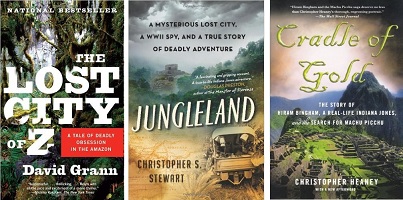
In The Lost City of Z, you can follow the trail of legendary explorer Percy Fawcett. In 1925, he disappeared into the Amazon looking for the fabled city. When you’re done, head to Honduras in Jungleland and search for Ciudad Blanca — perhaps the fabled El Dorado. Then head back down south and follow the footsteps of Hiram Bingham and explore Machu Picchu in Cradle of Gold.

So take a breath, turn the lights down, and vanish into another world.

Categories: Ancient America, Ancient Sites, artifacts, Books, Forgotten Places, History, Mysteries, Native Americans | Tags: , , , , , , | Leave a comment

Discovering Columbus

Last year I asked, Should Columbus be Celebrated? It is a controversial question, since that day in 1492 meant the eventual end of many cultures in the Western Hemisphere. The other side of the sword is that new cultures arose from those escaping the Old World. In all likelihood, using Columbus as the poster child for all that did go wrong is not fair.

One has to dig deep into many studies of the man to even begin to unravel his mind. He was secretive, put himself in the middle of politics and was the target of his enemies. All of this, and the distance of time, have made any study of the explorer a difficult one.

As Carol Delaney argues in Columbus and the Quest for Jerusalem, acquiring wealth for the Spanish crown was not his primary goal. He sought allies and money for one more Crusade to the Holy Lands. Religious motivation has been suggested before, but by writers couching everything in esoteric conspiracies. It has also been suggested he knew the New World existed. As plausible as that is, most of what we know seems to point elsewhere. Beyond that:

…Delaney depicts her subject as a thoughtful interpreter of the native cultures that he and his men encountered, and tells the tragic story of how his initial attempts to establish good relations with the natives turned badly sour. Showing Columbus in the context of his times rather than through the prism of present-day perspectives on colonial conquests reveals a man who was neither a greedy imperialist nor a quixotic adventurer, but a man driven by an abiding religious passion.

Contrast this to the later Conquistadors who were made up of mercenaries and those looking to set up their own little kingdoms of wealth. In Kim MacQuarrie’s The Last Days of the Incas, we get the distinct impression that most of these men cared little about religion other than some unconvincing attempts to use it to justify their actions.

Columbus’ life didn’t begin and end on his first voyage to the new world. It was his fourth that would unfold like an epic film and perhaps best give insight into his motivations. Martin Dugard’s The Last Voyage chronicles mutiny, shipwreck, storms and war. A far different tale than the simple one told in schools. Only by going beyond the simple tales, do we actually begin to peel away the misconceptions and mystery. That curtain will probably never be completely pulled away and certainly Columbus is imperfect and flawed like us all. And maybe that’s the lesson this Columbus Day.

Anyone can change the world, for better, or for worse.

colum

Categories: Books, History, Native Americans | Tags: , , , | Leave a comment

The Fire of Exploration

Exploring the final frontier has never been easy. For decades, in fits an spurts, we have explored the Solar System and established manned outposts in orbit. We even reached the Moon, which has been so long ago now, that it seems a dream.  We can probably blame the tortoise pace of space exploration on it being largely controlled by the government and their ever changing, and short-sighted, whims. In recent years, private companies have taken up the torch. As witnessed by this week’s crash of the spacecraft Galactic, exploration on the edge of frontiers is still fraught with danger.

It always has been and always will be.

When the New World was being rediscovered by Europeans from 1492 on, it was much the same. Driven by politics, economics and the innate desire of humans to explore, not all went well. The early voyages were often about finding wealth and conquering lands. Later, though, it would be about building a better life, improving the human condition. The powerful desire to improve the existence of one’s family and future descendents has long been entwined with that frontier spirit. It’s often difficult to tell them apart. Interestingly enough, we would later learn that 1492 wasn’t the first rediscovery of what would later be named the Americas.

In 1000 A.D., the Vikings arrived in North America. It seemed almost inevitable that these quintessential seafarers and explorers would do just that. For centuries the sagas and rumors attesting to their arrival was largely discarded as myth. Then archaeological remains of a settlement were found in Canada in 1960.  Still, the idea of pre-Columbus explorers was seen as unlikely and supposed accounts quickly dismissed.

This was for two reasons: One, the level of required verified evidence is high. Is it too high? The Viking sagas told of exploring America, but were dismissed as legend. Even now, the extent of their exploration is unknown, but it is admitted that they voyaged to the coast for decades, if not longer. Only one settlement? These legendary warriors never ventured far from the beaches?

Two, early attempts to dismiss all natives as not much more than primitive cavemen saw many people ascribe anything of sophistication to foreign visitors. We now know the New World was replete with civilization and we know they arrived here longer ago than originally thought, through multiple paths. That paradigm shift has led many to wonder: Is it reasonable to think that people here for so long remained isolated from the rest world? A world that had many accomplished seafarers?  After all, didn’t the natives make it here at one point? Does any civilization live in isolation for over 10,000 years?

Of course, there are those who consider any suggestion of diffusion racist. They are driven by those who have, or still do, see natives as inferior. The other side of the coin are those who believe it did happen, repeatedly, and assert that it’s racist to say it couldn’t have happened.

So much for academic inquiry.

To be certain, the field has been full of fringe writers pushing many a bizarre theory or those motivated by ideology. Not all are so driven. Many are simply looking for the facts, some of which have always hidden in plain sight.

Sometimes it was intention, other times apparent chance, but in either case exploration burned in the souls of many men and women. What resulted wasn’t always good, but the overall condition of man usually improved. Does the fire of exploration still kindle? Are we too busy to see past tomorrow, buried in our televisions and self-created busyness?

Time will tell if humans will quit ignoring the calls to be something greater than what is pushed upon them. Modern steps into space are part of a long legacy that reaches back millennia. The crash of the Galactic won’t extinguish the flame.

It reminds us there are still those in which the fire still burns.

naex spcex

Categories: Ancient America, Ancient Sites, Books, History, Native Americans | Tags: , , , , , , | 2 Comments

Finding our Past, and Future, in the Jungle

Many of you have grown up with fictional characters like Indiana Jones. Swashbuckling tales of danger in search of lost cities. There was a time when such adventures weren’t the realm fiction.

In the last decades of the heyday of exploring the last wilds of the Earth, Colonel Percy Fawcett led an expedition into the Amazon to search for the fabled Lost City of Z.

He was never seen again.

Decades of rumors of his fate ensued. Had he found the lost city? Was he living among the natives? Had he succumbed to the jungle many years before? David Grann takes us on a tour of Fawcett’s obsession in The Lost City of Z, in part by heading into the jungle himself following the footsteps of the lost explorer.

But Fawcett wasn’t the only one. Theodore Morde had claimed he had found the lost White City in Honduras. He never returned to explore his find and may have tried to obscure its location to dissuade others. Christopher S. Stewart dives into this man’s life in Jungleland. He too goes to the jungle and tries to locate Morde’s discovery and, perhaps, what haunted him to the end.

Then there was Hiram Bingham who discovered the legendary mountaintop city of Machu Picchu. This site was not lost and has become an iconic wonder of the Mesoamerican past. Christopher Heaney chronicles Bingham’s quest in Cradle of Gold. The classic journey of that era that has impacted history decades later to our time. Its forgotten history of a sprawling empire is still being revealed. And Machu Picchu has become the prime example of the need to return artifacts to their rightful nations that were acquired (not always honestly) during the age of relic hunting.

These books are windows into the bygone era of journeys into the unknown. Sometimes driven by fame or fortune, discovery or quest of knowledge, the explorers were nearly the last of their kind. Perhaps those who have left Earth into space are our only successors to them.

In any case, there are still discoveries to be made on our world; jungles that still cling to their secrets and can make men vanish in an eye blink. We are desperately in need of a generation that takes mankind’s history seriously while looking forward and are willing to explore new frontiers and push us beyond new thresholds.

Ignoring history, not seeing past tomorrow and thinking a new phone is “innovation” just doesn’t cut it.

Categories: Ancient America, Ancient Sites, Forgotten Places, Native Americans | Tags: , , , , , , , , , , , , , , , , , | 2 Comments

History Unshackled

Some people are under the impression that studying history is dull or of no interest. Maybe we can blame the way it’s presented in education: Quick, little bites that don’t get into the personalities, the drama and the earth-changing events. Don’t get me wrong, I had some history teachers that knew their stuff and were great at teaching, but they were always limited by time.

Education shouldn’t end at graduation. That’s a mistake most people make. It’s a mistake that can be overcome. Many authors are gifted with research and telling history that is every bit has exciting as a novel or film.

If Pilgrims arriving on the Mayflower and having the first Thanksgiving is about the extent of your backgrounder on the subject, Nathaniel Philbrick’s Mayflower will unveil a far more exciting and nation-shaping series of events. Similarly, after reading his The Last Stand, the Indian Wars and Custer will never be quite the same. Some parts of history don’t always end well, but we must learn from them just like any other.

If you ever wondered why so much focus has been put on a single battle like Gettysburg, Noah Andre Trudeau’s Gettysburg: A Testing of Courage, told largely through the eyes of those who fought, will show how war reveals the best, and worst, of men.

Everyone thinks of the Cuban Missile Crisis as the close call of the Cold War, but we were at the brink far more times than that. Books like 15 Minutes and The Dead Hand detail the frightening world that few knew existed.

So start stockpiling some books before winter sets in and prepare to fascinated, amazed and shocked. You’ll wonder why you ever stopped learning or thought it dull or unnecessary.

You are in charge of your education. That education didn’t stop years ago. It only barely had begun.

Categories: Books, History, Modern History, Native Americans | Tags: , , , , , , | 1 Comment

Apocalypse Time

Here’s something to read while you are hunkered down in your bunker tonight waiting for the Mayan Apocalypse: 6 Real Threats Facing the US. Note the article doesn’t list the government’s poor responses to disasters or their driving us to a financial collapse…

It’s probably too late now, but The Mayan and Other Ancient Calendars is an informative little book on the ancient world’s time-keeping. Or for a more detailed examination of their skywatching, try Stairways to the Stars. This book is far more fascinating than those by people who pretend to know something about the Mayans.

There’s still time to go buy canned chicken. Hey, doesn’t hurt to be prepared. It’s not like the government is going to help you out whether it’s Mayans, snowstorms or whatever may come your way.

Categories: Native Americans, Prehistory | Tags: , , , | Leave a comment

Mayans: Engineers of the Ancient America

Whereas many are focusing on the Mayan calendar’s supposed world-ending climax in December, others are using this focus on the Mayans to educate on this lost civilization. Engineer and explorer James A. O’Kon has written The Lost Secrets of Maya Technology, a fascinating look at the technology of these people who were for so long considered Stone Age folk.

From pyramids, to grand cities, irrigation and bridges, the Mayans matched and often surpassed civilizations of the Near East and Asia. They didn’t follow the standard model of emerging along riverways, use of animals and stayed relatively isolated from the rest of the world. Yes, they were preceded by the Olmecs, traded and eventually ruled by the Aztecs, and some suggest had at least some transoceanic contact. Yet, they largely seemed to develop on their own the technology that supposedly the primitives of the New World were too simple to figure out.

Eventually, drought and overuse of the land would lead to their downfall. Their cities already abandoned by 1492. Like many peoples, they couldn’t predict the future and thought time was on their side. In their success they felt invincible and they thought their world would never end. It did, as many before and since.

Will humans ever take seriously the history of those who fell before us?

Categories: Ancient America, Native Americans | Tags: , , | Leave a comment

Ancient Mayan Astronomers

I’m sure 2012 fanatics will like this: “Ancient Mayan workshop for astronomers discovered.” The Mayans are well known for their sophisticated calendars which are at the root at 2012 fascination. This particular set of finds may extend their calendar beyond the Big End this December. Like many cultures, their science and religion were strongly linked and time keeping was needed for worship purposes. Yet all their knowledge didn’t keep their civilization from ending.

Perhaps something for our own to ponder.

Categories: Ancient America, Ancient Sites, Native Americans | Tags: , , | Leave a comment

Mysteries of Arizona

I dug out of the archives an article I wrote awhile back on the ancient world of Arizona’s past. Part travelogue, some history and of course a few lessons for today. Enjoy.

Categories: Ancient America, Native Americans | Tags: , , | Leave a comment

“The Myth of 2012”

The current issue (Winter 2011/2012) of American Archaeology has a great article that all 2012 enthusiasts should read. Find out about the one (and only) vague Mayan 2012 reference. Learn that most believe this is simply an end of their calendar cycle, not the end of the world. Also see how 2012 has been made into a commercial opportunity, much like Y2K.

It’s going to be a fun year as the 2012 business gears up. I’m already having flashbacks to 2000. Stay tuned for more.

P.S. I fully expect the return of End Times Hysteria surrounding creative interpretations of Revelation and other biblical books. To head this off, try End Times Fiction and The Apocalypse Code.

Categories: Ancient America, Native Americans | Tags: , , , , | Leave a comment

Create a free website or blog at WordPress.com.