Around the web today, Morgan L. Busse writes about “writing dangerously,” knowing that this means she is “not going to make everyone happy.” Mike Duran tells writers that it is good to know when to ignore writing advice and stay true to your story. And finally, Robert Bidinotto discusses the challenges of writing gripping fiction.
Daring to Enter the Dreadlands
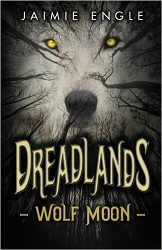
There are many fantasy stories that try too hard, or don’t try at all, in their storytelling. The best, as I wrote a few months ago, are reflective of the longings — both realized and not — inside us. Jaimie Engle‘s new Dreadlands is one of these stories.
Set in a lost Viking land in North America (you would know why this caught my attention quickly if you read this), we find Arud Bergson very quickly finding his world thrown into disarray. Shape-shifting ferine have begun attacking where none should be. His father is long overdue from a journey East and now his mother wants to send him off to a distant uncle with little explanation.
Leave. Take your sister Lykke. You must go now.
With this begins a journey where these young people learn who they are and about the world that they were shielded from. A classic coming of age tale, but also an engaging one (any book I read in one sitting certainly deserves some notice). Reminiscent of the detail, character development and the pacing of the Shannara stories — with a Middle Earth style epic battle to top it all off. A comparison of the story has been made to Twilight and this is unfair.
Dreadlands is better.
Admittedly, I haven’t read the Twilight books and my analysis is based on the films that focus on stretching out longing looks and angst between the leads at the expense of everything else. Jaimie’s approach to the history of the conflict between hybrids and humans, the creatures themselves, and planting the seeds of a romance is more mature and balanced. This is a fusion of epic and dark fantasy: Shannarra meets Underworld.
This genre is crowded, but put Dreadlands at the top of your list. The only disappointment you will encounter is finding out that part two has yet to be released.
401 A.D.: The Year Literature Changed
Thomas Cahill, the author of How the Irish Saved Civilization, called Augustine of Hippo “almost the last great classical man — and very nearly the first medieval man.” Augustine wrote in Confessions:
I carried inside me a cut and bleeding soul, and how to get rid of it I just didn’t know. I sought every pleasure — the countryside, sports, fooling around, the peace of a garden, friends and good company, sex, reading. My soul floundered in the void — and came back upon me. For where could my heart flee from heart? Where could I escape from myself?
Cahill responds to this:
No one had every talked this way before…we realize that with Augustine human consciousness takes a quantum leap forward — and becomes self-consciousness…From this point on, true autobiography becomes possible, and so does its near relative, subjective and autobiographical fiction. Fiction had always been there…But now for the first time there glimmers the possibility of psychological fiction: the subjective story, the story of the soul…[Augustine] is the father of not only of autobiography but of the modern novel.
In Augustine’s words we find someone searching for his true purpose and — shortly before the fall of the classical age — published his 13 part classical work Confessions in 401 A.D. Yet it often sounds like it was written yesterday.
We are no better or worse than those who walked before us centuries ago. Our troubles are rarely unique to us. Those ancient voices left us plenty to ponder, to learn from and to be warned by.
Perhaps we should take the time to listen?
Is Your Reason for Writing Wrong?
Everyone has a reason for writing. As I have often suggested here, everyone has a story to tell and everyone should do just that. But is there a wrong reason to write a book?
Jim Fletcher writes, “In the giant metaphorical landfill where most published books go to die, there is a strong common denominator: hubris.”
You see, as in film and music, many write to seek fame and fortune. Nothing wrong with making money — and making a living doing something you enjoy — but there should be some deeper fundamental causing moving you. Maybe to “elevate the life experience” of the readers? Fletcher quotes the famous Mark Twain line, “Write without pay until somebody offers pay.” I take that to mean: Pursue your dream until it happens.
Fletcher also writes on authors being seen as “cash cows” and expected to turn out sequels in rapid succession. This is no different than film and television, but indie publishing allows writers — the thoughtful ones — to make their own schedule. Of course, the caveat for even them is, don’t wait too long or your fans will forgot about you.
Ultimately, we all decide what our reasons are for whatever we do. Perhaps having a reason — any reason — is winning the first battle of a long war.
A war to win at telling our stories.
From Arabia to the New World
Most people love some sort of fiction whether it film, television or books. Yet, there are adventures to be had in the real world amidst all of its chaos and strife. We already took a look at some fantastic travels into Latin America where the ancient world still hides. Here are some more tales of authors who went on their own adventures to explore lost histories of our past:
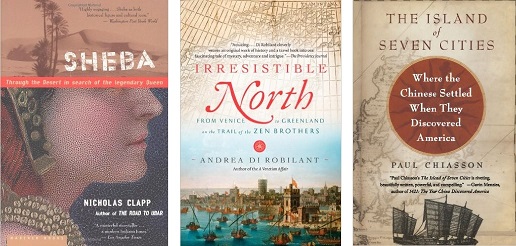
Few love stories can claim to have endured centuries, but that of Solomon and Sheba has done just that. Nicholas Clapp set out in Sheba: Through the Desert in Search of the Legendary Queen to uncover the truth to what is only briefly mentioned in biblical chronicles and some other sources. Traveling through unstable Yemen in Arabia, to ancient sites in Ethiopia and to the Jerusalem, the city of Solomon, he uncovers clues to the lost empire of Sheba that tantalize us with potentially much more hidden in the sands.
Legend has it that Venetian brother Antonio and Nicolo Zeno arrive in North America a hundred years before Columbus. Is it only a legend? Andrea di Robilant tracks them across Europe and to the fringes of the New World to uncover the truth in Irresistable North. Given a recent, new discovery of vikings, should we not take a little closer look at the Zenos?
The Zenos may not be the only ones to beat Columbus as Paul Chiasson writes in The Island of Seven Cities. Ruins on Cape Brenton in northeast Canada, not all that far from Viking sites, could be the remains of a Chinese outpost. If this wasn’t interesting enough, the Zeno brothers had mentioned encountering some sort of non-native settlement in the region. Vikings or Chinese or one of these intermixed with natives?
I’m thinking real life adventures like these beat television any day. So where do you want to go?

A Nonconformist? So was Tarzan.
We’ve often been told that adventure fiction is dead or not worthy of note other than a quick escape from reality. Apparently authors and film makers have not been made aware of this impending collapse of their world. In fact, they have been told for decades that there is no place for their fiction. Even over a century ago, when Edgar Rice Burroughs came on the scene, author Brian Stableford wrote in an introduction to a recent edition of Tarzan that, “…critics thought the Romantic tradition might be outdated and ripe for replacement.” What they called the “Romantic tradition” was embodied in the high adventures of H. Rider Haggard or Jules Verne. Burroughs added to the mix John Carter of Mars and Lord Greystroke — otherwise known as Tarzan. Stableford continues:
Burroughs demonstrated…that there is something in the Romantic tradition that offers a deep and fundamental appeal to the human imagination…[and] Tarzan does so by appealing to the frustrations of conformity that we all feel in living in a complex society…[but] Tarzan does not merely live an ideal existence in his symbolic jungle, but he also carries the skills learned there into his social intercourse with the damaged products of civilization.
Literary-level thought in Tarzan among the unrelenting action? Perhaps many have had their perception colored by the many bad films that stray from the source material. Even Burroughs considered the movie versions in his day “travesties.” A new film this summer may remedy that and provide a needed respite from superhero overload.
Ironically, Tarzan was one of the first modern superheros that inspired much of what followed. And he taught us a thing or two about society along the way.
Passion and Publishing
Here are some short videos by bestselling writers Tim Ferriss and Ramit Sethi where they discuss Writing What You’re Passionate About and Self-publishing vs. Publishing Companies. Check out the pros and cons and balance that needs to be struck in these approaches.
What the Vikings Can Teach Us
We’re all taught that Columbus “discovered” the New World in 1492, with the caveat that the Vikings arrived centuries earlier circa 1000 A.D. This is always added as a bit of a footnote, as if it’s not all that important. Sure, it didn’t have the impact of the Spanish-backed Columbus voyages, but the Viking voyages have always been begrudgingly admitted to existing. Even before ruins were found in the 1960s, the Viking Sagas and other accounts were largely written off as myth. Even after the finds, the story went like this, “Yes, they came here, probably over a couple centuries, but these infamous explorers never did much of anything.” Doesn’t really make much sense, does it? Why the reluctance to give the Vikings their due? In light of the discovery of a new Viking site in Canada, perhaps our prejudices in studying our own history need re-examined. Continue reading
Inside the Mind of a Master Procrastinator
Done Writing? Now Sell it.
Bestselling thriller author Robert Bidinotto has posted a video of his presentation, Ten Most Important Ways to Market Your Ebooks. Watch as Robert explains writing your story, to who and how you should be marketing your book and much more.