Posts Tagged With: space

Destroyer of Worlds

“It is likely that hundreds of thousands of bodies, each capable of yielding a multimegaton explosion on Earth, are orbiting within the [Taurid meteor] stream.” – Victor Clube and Bill Napier, Cosmic Winter

Regular meteor showers are the periodic reminder we live in vast universe. For a few nights, they draw people away from their distractions to look at the heavens like their ancestors once did. What if these little fire balls have a darker history?

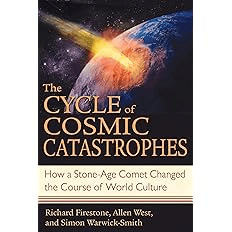
In Late October, the Taurid meteors often provide a little show — the Halloween Fireballs. These are the remnants of a fragmented comet that came apart 10,000 years ago. Lesser known are the June (or Beta) Taurids, when Earth passes through another part of this debris field. These are unseen since they occur during daylight hours.

They also may be the source of humanity’s near extinction.

As Earth emerged from the last Ice Age, something catastrophic interfered with climate cycles that persisted for hundreds of thousands of years. One result was the stable climate we now live in, which is a good thing, right? It is, unless the old cycles reassert themselves, or another disaster befalls us.

The bad part is the strong evidence comet fragments pummeled Earth during this apocalypse, the main impacts landing in North America, causing destruction around the globe. Humanity’s progress was set back centuries, if not more.

Could it happen again? Consider these other celestial events occurring during the June Taurids:

  • On June 25, 1178, an impact on the Moon created the massive Giordano Bruno crater.
  • On June 30, 1908, a fragment exploded over Tunguska in Russia, destroying 2000 square kilometers of forest. A few hours earlier, and Moscow would have been destroyed.
  • In late June 1975, a swarm of objects impacted the Moon.

Slightly different timing or trajectories, and these events could have had devastating effects on Earth. We aren’t out of the woods yet. Massive comet fragments are likely still floating in our orbit. Difficult to detect, but not impossible. Why isn’t planetary defense a higher priority, if not the highest? Why isn’t this a common cause among all humans?

Many stories come down to us telling of the time fire rained down from the heavens. Will we ever heed their warnings?

So next time you watch for meteors, or look to the sky every June, imagine what might be lurking in the darkness. Destroyer of worlds…

Categories: Prehistory | Tags: , , , , , , , , , , , , | 1 Comment

Are we Alone in the Universe?

“It’s impossible for [this] to be the only world…There are other intelligent entities out there, probably since life is so ardent…[do] you think that’s [life] only on this little rocky planet?” – William Shatner

The legendary Captain Kirk said these words after his flight on the Blue Origin NS-18 spaceflight. Is he right? Are the many people who have looked at the heavens and concluded, “There must be more life out there,” correct?

Probably not. What Shatner and others are saying is not a scientific argument. It is barely a viable statistical one. What we may think is true, or wish to be, must always give way to physics.

Life is very complex and requires very specific conditions, controlled tightly by very narrow constraints. We aren’t just talking about the obvious like temperature or air composition. There are a vast number of interconnected systems, large and small, terrestrial and cosmic, that allow us to be here at this time, in this place, on Earth.

For decades, astronomer Hugh Ross has been documenting the constraints that must be met, and cannot change, for life to exist. This is true of primitive life, to say nothing of complex life such as animals or humans. Among the hundreds of parameters he has identified from scientific studies:

  • A planet’s distance from a star, cannot be too far or too close (temperature and gravity).
  • A star’s size, age, luminosity, and type, among other things, must be in the right range for life to exist.
  • Tectonic activity (earthquakes) must not be too great (destructive), or too little (they recycle soil nutrient runoff from rivers).
  • Speed of a planet’s rotation (too fast creates hurricane speed winds, or too slow makes it too hot), its size (too much, or too little gravity), and a precise amount of oxygen (too much causes uncontrollable fires, too little, and large life can’t live), and even the size and distance of any satellites (like the Moon, which affects Earth’s rotation) impact the existence of life.

There are hundreds of such constraints, from the quantum level to the galactic. Even the Big Bang at the origin of time and space, had to be so fine-tuned for Earth to exist here and now as it does. Mathematically, there is zero chance of this occurring on its own from random processes. What does this mean? Two things: One, these constraints eliminate millions and billions of star systems from contention of harboring life. Two, only design can explain what science has discovered.

Naturalists don’t like the implication of design behind the universe’s origin, and call these constraints anthropic coincidences, even though chance cannot explain what we observe. Nonetheless, opponents to design try to sweep this all away with one or another version of the anthropic principle. The popular “weak” version states, “We ought not to be surprised at the order and fine-tuning we see in the universe around us, since if it did not exist…we would not be here to observe the fine-tuning.” This was from Oxford mathematician, John C. Lennox, who further explains why this doesn’t work:

All the anthropic principle says is that for life to exist, certain necessary conditions must be fulfilled. But what it does not tell us is why those necessary conditions are fulfilled, nor how, granted they are fulfilled, life arose.

Evangelists of chance-based, naturalistic explanations like Carl Sagan struggled with this. He marveled at the complexity and beauty of the universe, yet claimed Earth was just a “pale blue dot” and our place among the stars was “demoted” due to the discoveries of Copernicus and Galileo. It didn’t dawn on Sagan and his successors that scientists like Copernicus and Galileo studied the heavens to learn more about Creation and its Creator. Never did they think they were demoting humanity. As astronomer Guillermo Gonzalez has documented, not only have we not been demoted, the evidence points to Earth as being a “privileged planet” that could not be the result of chance, but was created in such a way to make the fine-tuning of the universe evident.

So while we cannot eliminate completely the possibility of life elsewhere among the stars, the physics of the universe guarantees it is exceptionally rare, at the very least. Should we feel despondent and depressed that we could, in fact, be on our own? Not at all. If, as the evidence points, everything from the moment of the Big Bang onward, conspired to allow Earth exist here and now, with its humans, we should feel quite special.

We aren’t a pale blue dot, but rather, we are a bright blue star in the cosmos. Rare and special, with design and purpose.

What does this mean for the current, how should I say, obsession, with UFOs/UAPs? I’ll be returning to this subject in part 2 as we explore what is going on in our skies.

Until then, ponder on what it means for little Earth, perhaps not at the center of the universe, but nonetheless being its central purpose.

Categories: Nature, Origins of Man | Tags: , , , , , , , , , , , , | 2 Comments

The Long Delay is Nearly Over

In early 1960s America, it was perfectly reasonable to imagine a world a century later with flying cars and permanent human space habitats. When Yuri Gagarin and John Glenn were orbiting Earth, you could forgive writers for their imaginations. The show was conceived during a period when people were breathtakingly optimistic about emerging technologies. But 2022 being the year of George Jetson’s “birth” is a funny yet startling reminder that such a future never came true. The cartoons many of us watched growing up with big dreams of the future have remained just that — cartoons and dreams. And people who were born after Gene Cernan and Harrison Schmitt took humanity’s last steps on the Moon are now old enough to have grandchildren.

But despite all this, 2022 may actually go down in the history books as the year we finally brought this long delay to an end. With the recent success of Artemis 1 — NASA’s test of the Space Launch System rocket topped by an Orion capsule, which splashed down on December 11 after a successful trip around the Moon — humanity’s return to our nearest neighbor appears to be imminent.

And for good reason: A report on the “State of the Space Industrial Base” released in August predicted that China would overtake the United States “as the dominant global space power economically, diplomatically and militarily by 2045, if not earlier.” There are potentially trillions of dollars of resources on the Moon, on asteroids, and on other celestial bodies. As with space research and development in the past, there will be spinoffs that will improve life on Earth. And space is the next frontier in the long story of human exploration.

After a fifty-year delay, we may at last be on the verge of fulfilling this dream.

Alex Dubin

Read the rest here.

| Tags: , , , , , , | Leave a comment

Our Universe: Designed for Humanity

Astrophysicist Neil deGrasse Tyson declared, “The universe is a deadly place. At every opportunity it’s trying to kill us.” When astronomers look out to the universe, some are struck by all the dangers it poses to life, especially to human life. In every region of the cosmos beyond Earth, they see gravitational disturbances, supernova, gamma-ray bursts…asteroids, comets, and solar and stellar flares that can easily destroy us.

This dark, doomsday perspective perspective makes sense for astronomers and others who’ve embraced the beliefs expressed by their predecessor Carl Sagan. His message — that the universe is all there is or was or ever will be — shapes their perspective…

What if all that appears so deadly and dangerous is actually what makes life, especially human life and its flourishing, possible? What if the cosmos is not all there is or was or ever will be? Such a perspective would alter the significance of everything about it and within it. – Dr. Hugh Ross, astronomer

When astronomer Hugh Ross first began writing about anthropocentric or theological science in 1991, many were surprised the universe appeared designed for Earth to exist. Not just Earth —but only Earth — and the human life on it. This was contrary to the alleged “great demotion” of humanity’s place in the cosmos, as naturalism evangelists like Carl Sagan preached. Some probably thought science would prove Ross wrong.

It didn’t.

In fact, the years since have become a golden age of astronomy. Discovery after discovery pointed to Earth’s uniqueness, but more importantly, that everything about the structure of the universe prefaced the coming of humans.

Ross has previously documented this growing body of evidence in books like Why the Universe the Way it Is, and Improbable Planet. His new Designed to the Core continues pulling this research together — and this is cutting edge science from around the world.

It’s the implications, however, that should give the chaotic peoples of this world pause. What if there was truly purpose to this existence? What if the reason no aliens have been discovered — and the constants of physics continue to rule out billions of worlds — is because Earth was the point of the universe’s coming into being?

As biologist Michael Denton writes in is recent book, The Miracle of Man, some may disagree with these conclusions, but the science is not in dispute. Those who disagree do from a place of philosophical bias, not a scientific one.

Why cling to a depressing view of the universe, where nothing ultimately matters, where chance decides everything, if the evidence points elsewhere?

Materialistic naturalistic philosophies have infected many fields. They have handcuffed science. Humanity doesn’t matter, if you follow these beliefs to their logical conclusion. Yet lives of millions contradict this every day, and like never before, so do the heavens.

From distant galaxies, to the Sun, and Earth itself; from the instant of the Big Bang, to the quantum and the atomic, it all has fingerprints of being designed to the core.

Categories: Uncategorized | Tags: , , , , , , , | Leave a comment

Last Man

When humans first entered the final frontier the very edge of technology was pushed to its limits. The race into space may have been driven by the Cold War, but ultimately there was something even greater behind it.

The human spirit.

That spirit has driven mankind to explore for millennia and space is no different. Every bit as dangerous as the New World, the Amazon and the Wild West, but this frontier has no bounds and is unforgiving. Unfortunately, the powers that be, quickly lost vision and returned to their myopia. In an age where technology is taken for granted, it is hard to believe this happened decades ago. It is also a reminder that we could do so much more than iPhones and smart cars.

There are some who still remain from that first wave; those who were there on the new frontier. This is the story of the last man to walk on another world:

shtv

Categories: History | Tags: , , , , , , | Leave a comment

Blog at WordPress.com.