Author Archives: Darrick Dean

Rediscovering the Proper Human Diet

[This is a repost from a few months ago. Since I have been updating it with new information, and this is the time of year many people evaluate their health with the intent to improve it in the next, this is a good time to revisit this critical subject.]

Many people get frustrated when comes to figuring out how to achieve better health. How often have you heard, or yourself have said, “Who am I supposed to listen to? Everyone has different information. Health advice is always changing. I give up!”

Does it have to be that hard, or are we making it harder than it really is? Perhaps, if we step back and apply some logic, history, basic science, and some common sense, we will find the answers. There are two basic maxims for optimal health:

Eat what your body is designed to use.

We are not designed to be couch potatoes.

These two maxims, derived from science and common sense, quickly cut away any confusion about proper human health and the proper human diet. We will dive deeper into the supporting details, and examine the insights and revelations supporting these maxims.

Are you tired of suboptimal health? Do you want to avoid chronic disease and degeneration in your future? Do you want the “secrets” to the Proper Human Diet? Read on.

Continue reading
Categories: health | Tags: , , , , , , , , , , , , , , , , | Leave a comment

Sorry, Christmas and Christmas Trees Still Not Pagan

Every Christmas we hear people proclaiming Christmas and its traditions were once pagan or still are pagan (“pagan” in this context meaning a non-Christian religion). My first instinct is to laugh at those who think they discovered some long-lost, secret knowledge. My second thought is to turn to history for the truth.

Christianity has a long history of subverting — or appropriating — items, thoughts, days, and locations from other cultures if they agree with Christian teachings. Sometimes these things are given new meanings if they don’t agree Christian beliefs. This method of opening the door to Christianity for people was initiated by the Apostle Paul.

In the Areopagus Sermon, recorded in Acts 17:22–34, Paul argues to the Greeks at their high court on the reality of God by using the words of their own thinkers such as Epimenides, Aratus, and Cleanthes. He starts by pointing to one of their monuments: “I even found an altar with this inscription: TO AN UNKNOWN GOD. So you are ignorant of the very thing you worship — and this is what I am going to proclaim to you.” Paul is subverting parts of their own beliefs that can, or do, point to God, to open their mind to the discussion by highlighting what is already in agreement.

If we go further back, we find more examples of subversion. The Ark of the Covenant is very similar to Egyptian ark designs, and Israel’s temple also has likenesses to Egyptian temples. Why would God give the Israelites instructions to build these using Egyptian archetypes? Probably due their familiarity after living among the Egyptians for so long. However, the Israelites also let other things they had learned corrupt them. The Golden Calf could have been inspired by the Egyptian veneration of the Apis Bull. These are among many Egyptian details recorded in Exodus — including the name Moses which was borrowed from the Egyptian language — which lend credibility to the accounts. Skeptics who doubt the events in Exodus have to explain away all the subtle, and not so subtle, Egyptian references.

There are other examples, but here we have seen God, Paul, and later Christians appropriate objects and writings from other religions and give them new meaning. People who claim these things are bad because they once were pagan, are committing the genetic fallacy. In other words, as I like to say, Who cares what they once meant, what do they mean now? Sure, not everything can be easily appropriated. Some things not at all.

A popular rebranding method was when Christian denominations would take pagan festival dates and rename them and given them new meaning. Does Christmas Day and some of its associated traditions fall under this category as we are often told?

Actually, they do not.

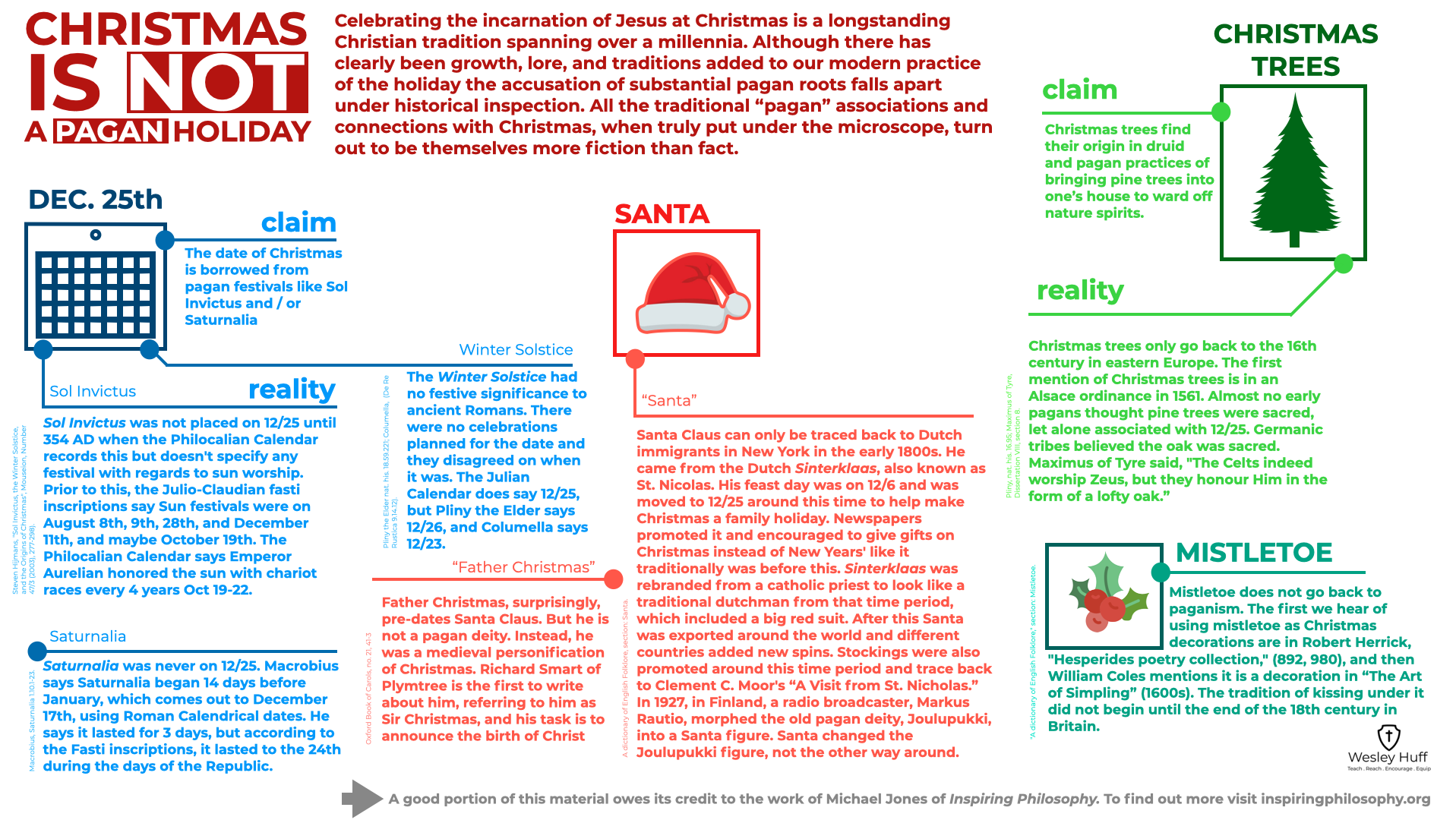
Biblical and ancient documents scholar Wes Huff explains in this video why “All the traditional ‘pagan’ associations and connections with Christmas, when truly put under the microscope, turn out to be themselves more fiction than fact.”

Historian William Tighe concluded after his research, “The ‘pagan origins of Christmas’ is a myth without historical substance.” Wes also provides these two infographics summarizing his research: Christmas is not a Pagan Holiday and So Where does Dec 25 Come from if it’s Not Pagan?

Check out those links for all the research. Most people don’t bother to test what they hear, especially if it fits a preconceived bias of one sort or another. Ultimately, the methodology of opening the door to discussing Christianity by finding points of agreement is a logical and sensical approach.

We can’t really say the same about all the drive-by scholars and their yearly attempts to rewrite history.

Categories: Ancient Documents, Bible, Critical Thinking, History, Traditions | Tags: , , , , , , , | Leave a comment

What Choice Will You Make in 2026?

Learning is a lifetime pursuit. You will, if you choose to, learn far more after school (no matter how many years you go or don’t go) than you will in the classroom. Every adult, I think, should make a choice:

Commit to a lifetime of exploration and discovery, or let others control your mind.

Here are some books I read in 2025. What choice will you make in 2026?

Categories: Books | Tags: , , , , , , , , , , , , , | Leave a comment

Learning From Thanksgiving

To our detriment, history is often distilled down to a few sentences in our schools. As writer Nathaniel Philbrick writes in Mayflower, “there is a surprising amount of truth” in our “threadbare story of the First Thanksgiving.” It is what happened before and after that people know so little about.

It is a vivid tale of “courage, community and war,” and out of this little told story, a country was shaped. Philbrick writes:

There are two possible responses to a world suddenly gripped by terror and contention…[one way is] to get mad and get even. But…unbridled arrogance and fear only feed the flames of violence. Then there is the [Benjamin] Church [a frontiersman born in Plymouth] way. Instead of loathing the enemy, try to learn as much as possible form him… try to bring him around to your way of thinking. First and foremost, treat him like a human being…and in this he anticipated the welcoming, transformative beast that eventually became — once the Declaration of Independence and the Constitution were in place — the Untied States.

In an age where politicians and their followers knowingly try to divide people only to hold on to power, where some believe violence is acceptable, where people think harassing people is a way to effect change, and others think its nothing to fabricate fake fears and crisis to scare people onto their side, perhaps we should for once look to our own history.

We could learn from their trials and tribulations, far worse than our own. Then with crystal clarity, those who seek to undo what was born out of the good and the bad, will be unmasked and exposed.

Categories: History | Tags: , , , , , | Leave a comment

The Dark Side of AI

Artificial Intelligence can be a valuable tool, but like any piece of technology it can be misused unintentionally and intentionally. With so many jumping into AI without thinking, much like they did with the internet and then social media, we need to take a breath and perform some critical thinking.

Software engineer Vanessa Wingårdh has produced a number of discussions on the dark side of this rapidly expanding technology. She explores how insurance companies are using AI to deny healthcare. We also see people relying so much on generative AI programs, they are experiencing brain rot. Some have managed to turn AI into a disturbing cult, AI leading people into disturbing actions, and others think AI is a conscious being and try to have real relationships with it.

Clearly, many of these people had problems before encountering AI. We need to return to a time where people are allowed to recognize these issues in others. For all the talk of mental health, we still seem to brush these things under the rug or act like its okay for someone else. No, it’s time to reclaim objective truth before we lose more people to mental health issues and cult like thinking.

Robbi Jan has examined the dangers of AI blurring reality and the use of tech in transhumanism agendas. Transhumanism can very easily become a new 21st Century eugenics movement. She also takes a look at these trackable health devices everyone is embracing. Are they safe and private? How many hacked databases do we need before we take security more seriously?

Listen, you can ignore AI, or blindly jump into using it. Either case is the wrong choice. We’ve learned the hard way about social media, both information and people manipulation and tech addiction.

How about learning our lesson for once?

Categories: Critical Thinking | Tags: , , , , , | Leave a comment

The Rise (and Eventual Fall) of Darwinism

“What if Charles Darwin got it wrong? What if all the crises, alienations, and losses of faith we associate with the aftermath of the publication of The Origin of Species had been triggered by a false prospectus?” – Neil Thomas, Taking Leave of Darwin

Like many people, Neil Thomas, a scholar of logic and literature, accepted the Darwinian “narrative without demur” and he “deferred to what [he] imagined must be the properly peer-reviewed orthodoxy.” Yet when he began to study what was behind the curtain he found the “grand story of evolution by natural selection was little more than a creation myth to satisfy the modern age.”

In Taking Leave of Darwin, Thomas details this journey as he explores the evolution of a myth, the counter-theories and criticisms that allegedly don’t exist, and finds Darwin’s model of origins supported by materialistic philosophy, not by empirical science.

He writes Darwinism is a throwback to the “pre-scientific mind [which] imputed agency to Nature by way of personification of Nature’s various aspects as individual divinities…Darwin appears, wittingly or not, to have channeled the spirit of the older, polytheistic world by crediting Nature with an infinite number of transformative powers.” The mechanism of speciation, driven by chance, “…falls at every hurdle. It lacks explanatory force, empirical foundation, and logical coherence…nothing can ‘magically emerge’ or ‘naturally evolve’ without a supporting agency.”

Thomas’ second book, False Messiah, focuses in on Charles Darwin, his development of his origins theory, and the age in which this all unfolded. He found Darwin struggled to put his theory on solid ground, questioning some of its tenants, and its lack of data. His critics were aplenty, questioning the logic of the proposed mechanisms of speciation, or the feasibility of life spontaneously forming in a “warm little pond.” Even in Darwin’s day, his model appeared as a “just-so story” of “fog piled on fog” that ignored the reality of the impossibilities it claimed to explain. Some of Darwin’s own supporters wrestled with the claims in his books, so how did the model rise about all these obstacles?

It rode the zeitgeist of the Victorian culture wars, not empirical science. Thomas writes, “Many Victorians very much wished Darwinism to be true. On the slightly dubious principle that empirical facts should never be allowed to get in the way of a good story, many turned a blind eye to the scientific inadequacies [of Darwinism].”

The 1860s were a counter-culture era, where the intelligentsia was revolting against traditional thought and religion. Clearly not all were onboard with Darwin’s claims, many realizing “materialism could not account for the totality of human experience.” Nor could Darwinism explain the “sheer exceptionalism of our terrestrial biosphere.” Sometimes facts get overwhelmed by louder voices. Unfortunately, Darwinism would be used as the basis for a horrifying new zeitgeist, eugenics, for much of the Twentieth Century. This would be quickly memory-holed in subsequent decades.

In the end, to this day, Darwinism has been a theory “much modified, festooned with revisionary patches akin to the epicycles employed to prop up geocentricism.” Even as evangelists of neo-Darwinism claim it is unchallenged and solid, in the journals and research labs, there are frantic searches for replacements. In spite of over a century of work, Darwinism still cannot explain ultimate origins, complexity, information in DNA, consciousness or much else other than minor adaptations. In frustration, more supporters have gone back to panspermia or multiple-universe speculations. In other words, they are just moving the problems of Darwinism out of sight, out of mind.

Thomas’ two books are together a very readable, and non-technical history of Darwin’s theory of biological origins. For those unfamiliar with the subject, or those who have been taught not to question the reigning narrative, these short volumes are packed with well-documented history.

Ultimately, Darwin’s model would have died long ago, had it not been hijacked by materialistic and naturalistic philosophies. It’s a shame really, because Darwin appeared to be trying to practice science, even if was ultimately a strained attempt by piecing together various existing claims. His doubts grew over the years, but he was so invested by then, he never gave it up (though some of his supporters did).

Science has always been beset by personalities, influenced by movements and causes. Much of this can be exposed and avoided if, as Thomas asks of us, we commit to being truth-seekers.

Seek truth, wherever it leads you.

Categories: Books, Critical Thinking | Tags: , , , , , | Leave a comment

Time to Rediscover Ancient Skies

Autumn and winter are the perfect time to rediscover the night skies. It is also a way to connect with the past.

Our ancestors, not stuck in their homes at night staring at a loud, lit rectangle, spent a lot of time studying the heavens. So much so they built sophisticated calenders, marked alignments, and tracked time and planetary cycles with structures and monoliths.

They did it without computers, no alien intervention, and often minimal written language.

Constellations were a way to pass on stories and information – a type of “memory palace,” according to anthropologists. Some of those stories have been lost, but not all. Oral knowledge often spanned generations – now people struggle to remember a few things to buy at the store.

So step outside on clear nights. You only need your eyes – I’ll even allow a starmap app on your phone – and travel back in time.

Categories: Ancient Sites, Nature | Tags: , , , | Leave a comment

Proper Human Health is Yours, If You Want it

People are tired of being sick. Never before in our history — our human history — have we had this level of chronic diseases, neurological disorders, and allergies. Add on top of those the problems of declining fertility and lifespans. I have been writing about the movement to return us to Proper Human Health, or as others have called it, the Proper Human Diet.

Still, many people, even doctors, are still locked in this endless cycle of misery of medication, physical decline, and refusal to address root causes. That we have convinced ourselves this is normal in only a few generations is mind-boggling and sad.

Here are a couple enlightening and important discussions on human health, and healthcare, to help you reclaim your health:


Dr. Nasha Winters speaks with Dr. Philip Ovadia on how surviving terminal cancer led her down a decades-long study on truly understanding cancer, and how we got so much wrong on this disease.


Artificial intelligence can be a powerful tool in medicine for research, breakthroughs, and efficiency. It can also exacerbate the problems in sick care – I mean healthcare – such as insurance deciding what is best for you, or dictating to the doctors what they are allowed to do.

Vanessa Wingårdh explores the problematic use of AI by healthcare providers. This is about making more money, not making you healthy. They know exactly what they are doing.


Is it a surprise science keeps confirming sunlight is good for us and necessary for our health? It shouldn’t be. Out ancestors innately knew this. We spend a lot of time and technology money relearning what was once known.

Check out this discussion on The Diary Of A CEO with Dr. Roger Seheult.


“We’ve destroyed the nutrient density of our entire food supply through industrial agriculture. The health of our soil is the very basis of our health. We cannot thrive until we rehabilitate the soil, the plants, and the animals. This isn’t hippie talk. This is hard science with staggering data.” – Mark Hyman, MD

Industrialized farming is one of the root causes of declining health. We can no longer afford to ignore where our food comes from, and how it is raised and processed.

Read more here and listen to Mark’s discussion with Autumn Smith.


And finally, check out Sandy Abram‘s 14 Harsh Truths about healthcare:

Categories: government, health | Tags: , , , , , , , , , , | Leave a comment

Our Place in Time and History

For many people, remembering history from five years ago is a challenge. A few decades ago seems like eons, so people tend to ignore anything before their lifetime. It’s all ancient history.

Is it really that long ago?

I have previously discussed how we are all part of the continuity of civilization and a link the chain of history. Part of that concept is we know people who have lived decades before us, and they knew people from earlier eras, and so on since the beginning. Suddenly, the past doesn’t seem so distant through the connections we have, and from what has been passed down to us.

Neil Howe, writing in The Fourth Turning is Here, describes this as our personal history span, which can be double your natural life:

Most of us possess first-person personal contact, through our families, to an impressive span of historical time time…consider a Gen-X woman born in 1965…[and] the oldest person she personally got to know as a young child…Very likely, this was a…grandparent (or great-grandparent) born in the mid-1890s. Let’s then imagine how long this Xer will live. Suppose we project that she lies to a least age ninety (in 2055), when she gets to know a grandchild (or great-grandchild) who in turn could be expected to live to the year 2130.

Now let’s measure this total span of time—from the first moment in the life of the oldest person this Xer got to know personally as a child to the last moment in the life of the youngest person she will know personally before passing away…this stretch of years—let’s call it her personal history span—stretches from 1895 to 2130, or 235 years.

When you look at our lives like this, you can see the length of impact you can have, and your connections with a not-so distant past.

As Howe writes, “As we contemplate the full range of these experiences—in the lives of those who once cared for us and in the lives of those whom we will someday care for—we can’t help but look for structure, parallels, and lessons…[as] Ibn Khaldun observed at the very dawn of modernity: ‘The past resembles the future more than one drop of water resembles another.'”

Categories: History | Tags: , , , , | Leave a comment

What Would They Have you Believe?

“Why you fool, it’s the educated reader who can be gulled…When did you meet a workman who believes the papers? He takes for granted that they’re all propaganda and skips the leading articles. He buys the papers for the football results and the little paragraphs about girls falling out of windows…He is our problem. We have to recondition him. But the educated public, the people who read the high-brow weeklies, don’t need reconditioning. They’re all right already. They’ll believe anything.” – That Hideous Strength (C.S. Lewis, 1945)


That Hideous Strength is part three of C.S. Lewis’ Space Trilogy, yet is so different from the first volumes, it stands as an independent tale – a dystopian one on par with its contemporary, 1984 by George Orwell. As with 1984, That Hideous Strength is just as relevant now, as it was decades ago.

A lesser author couldn’t pull off switching from a space setting to a terrestrial one, or changing the narration to that of the author, in this final volume. Nor could many authors successfully weave higher themes into a story, but Lewis was an intellectual – when that still meant something – with a penchant for converting high ideas into accessible stories.

Themes of manipulation and control by hidden powers, abuse of science, eugenics (now returning as transhumanism) all are very relevant in our day. Especially applicable are the dangers of turning science into a form of fundamentalism that reduces humans to nothing more than an accident. An accident with no real foundation of truth or reality. This fatal flaw was apparent in the materialist thinking of Lewis’ day, even more so now, with its modern evangelists like Richard Dawkins, Carl Sagan, Sam Harris, et al, masterfully camouflaging their beliefs with science, intermixing the two.

Lewis would also discuss these issues in his classic, The Abolition of Man, and even in the Narnian tale, The Magician’s Nephew. As postmodernism, secularism, transhumanism and other isms return – and the history of their past failures and terrors forgotten – Lewis’ works on the nature of man, science, scientism and society are more important than ever for those not content to be told by the oligarchies what to believe and how to live.

Lewis was a “prophetic critic” in his time, and apparently for our own.

Categories: Books | Tags: , , , , , , , | Leave a comment

Create a free website or blog at WordPress.com.