
“…of far greater power to you are not my stories but yours. Which Stories have you heard that shape your life? What do you believe? I mean what you really believe, when you are asked to lift the Swords in your life, or lay them down. What makes who you are? We can find answers in the Stories we tell.” – Randall Wallace (screenwriter of Braveheart, We Were Soldiers, Pearl Harbor).
Author Archives: Darrick Dean
The Long Delay is Nearly Over
In early 1960s America, it was perfectly reasonable to imagine a world a century later with flying cars and permanent human space habitats. When Yuri Gagarin and John Glenn were orbiting Earth, you could forgive writers for their imaginations. The show was conceived during a period when people were breathtakingly optimistic about emerging technologies. But 2022 being the year of George Jetson’s “birth” is a funny yet startling reminder that such a future never came true. The cartoons many of us watched growing up with big dreams of the future have remained just that — cartoons and dreams. And people who were born after Gene Cernan and Harrison Schmitt took humanity’s last steps on the Moon are now old enough to have grandchildren.
But despite all this, 2022 may actually go down in the history books as the year we finally brought this long delay to an end. With the recent success of Artemis 1 — NASA’s test of the Space Launch System rocket topped by an Orion capsule, which splashed down on December 11 after a successful trip around the Moon — humanity’s return to our nearest neighbor appears to be imminent.
And for good reason: A report on the “State of the Space Industrial Base” released in August predicted that China would overtake the United States “as the dominant global space power economically, diplomatically and militarily by 2045, if not earlier.” There are potentially trillions of dollars of resources on the Moon, on asteroids, and on other celestial bodies. As with space research and development in the past, there will be spinoffs that will improve life on Earth. And space is the next frontier in the long story of human exploration.
After a fifty-year delay, we may at last be on the verge of fulfilling this dream.
Alex Dubin
Read the rest here.
Tags: Artemis, future, Moon, NASA, SLS, space, space exploration
Leave a comment
Everything We’ve Been Taught About Health is Wrong
You may have heard how Americans are unhealthier than ever, in spite of billions spent on healthcare. Not surprising since healthcare tries to fix the problems after the fact, instead of addressing root causes. How did health begin to spiral out of control? One major reason began, not surprisingly, with government meddling.
The government’s devaluation of the dollar in 1971, allowing Congress to spend endlessly and thus devaluing the dollar even further, effectively destroyed vibrant, healthy, American agriculture. Saifedean Ammous details the history in The Fiat Standard, and here are some highlights:
Government policies begun in the 1970s “killed small-scale agriculture and forced small farmers to sell their plots to large corporations, consolidating the growth of industrial food production, which would in due time destroy America’s soil and its people’s health…” This brought down the prices of industrialized foods, but “the quality of food was degraded…[and] as prices of highly nutritious foods rise, people are inevitably forced to replace them with cheaper alternatives.”
Instead of issuing dietary guidelines based on science, they are often designed “to promote cheap industrial food substitutes” and are “shaped by an increasingly powerful agricultural industrial complex…The food pyramid is a recipe for metabolic disease, obesity, diabetes, and a plethora of health problems that have been increasingly common…” Industrial foods are often full of “toxic, heavily processed industrial chemicals misleadingly referred to as ‘vegetable oils’…as well as the abomination that is margarine.”
“Refined sugar and flour can be better understood as drugs…[the process] is similar to the refining process that has made cocaine and heroin such highly addictive substances…Government subsidies for the production of unhealthy foods-and government scientists recommending and requiring we eat them…[has resulted in a] dietary transition on Americans’ health [that] has been calamitous…their mental and physical health are deteriorating…increasing obesity is not a sign of affluence but a symptom of deprivation…The ever-increasing cost of medication and healthcare cannot be understood without reference to the destruction of health, diet, and soil, and the economic and nutritional system that promoted this calamity.”
Healthy cultures “relied heavily on animal products…junk food cravings are also a result of deep malnutrition caused by not eating enough meat.”
“Americans are not fat because of prosperity and abundance; Americans are fat because they are malnourished and nutritionally impoverished.”
Categories: Uncategorized
Tags: agriculture, diet, farming, food, food pyramid, health, healthcare, industrialized food, saifedean ammous
Leave a comment
Tired of Government Mandated Debt Slavery?
I’m old enough to remember when the first trillion dollar debts created outrage. Now politicians of all sides routinely sign off on tens of trillion dollars of deficit spending. If people took the time to understand economics, they would understand how detrimental this is to their lives, and to future generations. Such spending devalues an already devalued currency. This allows government to spend even more recklessly (funding endless wars and everything else), and means your wealth is a fraction of what it could be. Thus you can’t provide for the future, or even maintain the highest quality of life in the present.
Here’s some quotes from Saifdean Ammous’ books, The Bitcoin Standard and The Fiat Standard, introducing the dangers of deficit spending, and how it has ruined our buying power and wealth. His peerless books are an education in the history of economics and how it was grossly manipulated by our leaders at our expense. Someday the bubble will burst. If you want to prevent that, and provide a better future for your descendants, read Ammous’ books and help forge a brighter path.
Why deficit spending is a terrible idea:
“One of the most mendacious fantasies that pervades Keynesian economic thought [and government economics] is the idea that the national debt ‘does not matter, since we owe it to ourselves.’ Only a…disciple of Keynes could fail to understand that this ‘ourselves’ is not one homogeneous blob but is differentiated into several generations – namely, the current ones which consume recklessly at the expense of future ones…this policy…was employed by the decadent emperors of Rome during its decline…
“Debt is the opposite of saving. If saving creates the possibility of capital accumulation and civilizational advance, debt is what can reverse it, through the reduction in capital stocks across generations…[today’s] generation has to work to pay off the growing interest on debt, working harder to fund entitlement programs they will barely get to enjoy while paying higher taxes and barely being able to save for their old age.”
Why massive government spending isn’t needed:
“The end of World War II and the dismantling of the New Deal meant the U.S. government cut its spending by an astonishing 75% between 1944 and 1948, and it removed most price controls for good measure. And yet, the U.S. economy witnessed an extraordinary boom during these years…[and millions of men from the war] were almost seamlessly absorbed into the labor force…”
What this has all done to the spending power of your money:
“The average U.S. home price in 1915 was $3500. In 2021 it was $269,039…Had the fiat [government issued money] standard adopted a fixed supply in 1914…the average American house would today cost $411.”
Do you choose collapse, or freedom from slavery?
Categories: Uncategorized
Tags: debt, dollar, economics, fiat, government, inflation, money, saifedean ammous
Leave a comment
The Coming Energy Disaster
What if everything the politicians and activists have told us about green energy is wrong?
What if fossil fuels have so improved our quality of life, negating negatives, that abandoning them would condemn us to a dark age?
Alex Epstein‘s Fossil Future is a rare combination of science, intellectual analysis, and critical thinking so absent in discussions about energy and climate. It’s one of the few books deserved to be called paradigm changing.
Many have received their knowledge about climate and energy issues comes from anointed tv experts, activists, and politicians. Unfortunately, these sources are completely bankrupt of science. Epstein’s book is a major effort in returning reason to the discussions and debates. His identifying the current energy policies as leading us into a new dark age may be surprising, but it is rooted in fact. As an engineer, I can confirm the alleged miracle benefits of green energy are mythical. Unreliable, low-output, intermittent sources like solar and wind can never replace high-output, constant sources from fossil fuels or nuclear. It’s not a matter of making solar or wind better, or building more of them. There are limits dictated by physics radically handicapping these sources.
Abandoning fossil fuels (and nuclear) will put our society, and everything we take for granted, in peril. The headlong dive into unscientific energy policy is disturbing and dangerous.
Who we elect as our leaders will determine if humanity continues to rise upward, or spiral backwards into a time of scarcity and oppression.

Categories: Books, Critical Thinking, education
Tags: Alex Epstein, Fossil Fuels, green energy, nuclear energy
Leave a comment
Founding of America: The Story You Weren’t Taught
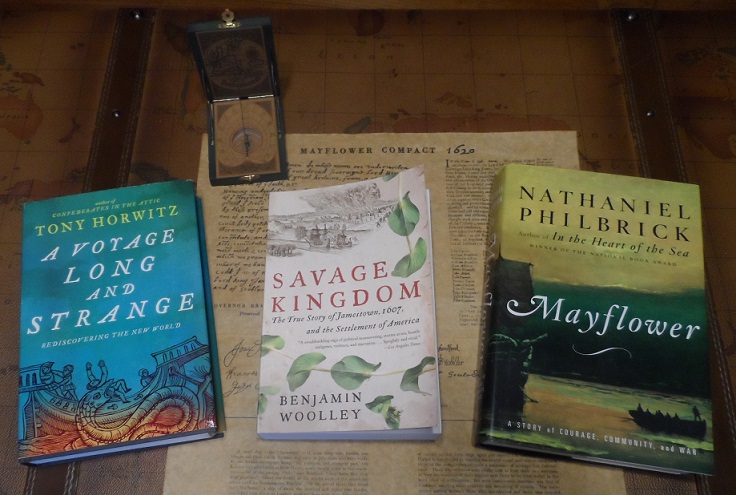
Tony Horwitz wrote in his revealing book, A Voyage Long and Strange, “Expensively educated at a private school and university — a history major, no less! — I’d matriculated to middle age with a third grader’s grasp of early America.” Horwitz would remedy this problem by beginning a cross-country adventure. He would uncover this missing history from first contact with the Vikings, to the forgotten era between Columbus’ landing in 1492, and the founding of Jamestown in 1607. Even those humanity-changing events have been reduced to mere sentences in our history lessons, as Horwitz discovered.
An artifact of our education system, history has long been neglected. Arguably, it’s the most important field once you realize how much our ancestors can teach us. There is little we experience or endure they didn’t experience first. In our hubris, we ignore the answers to the test they have handed us. By reducing our study to names and dates, they seem like myths. Many would be surprised how much we do know about the people who came before us. The best teachers and writers of history re-discover this past and allow us to time travel through the eyes of our ancestors. In Horwitz’s case, he found a “dramatic tale of conquistadors, castaways, French voyageurs, Moorish slaves, and many others who roamed and rampaged across half [of the continent of North America], long before the Mayflower landed.”
In Nathaniel Philbrick’s Mayflower, he finds while there is “a surprising amount of truth in the tired, threadbare story of the First Thanksgiving,” it was only the beginning of the story. That event was followed by “fifty-five years of struggle and compromise — a dynamic, often harrowing process of give an take. As long as both sides recognized that they needed each other, there was peace.” War eventually came, but “there was nothing inevitable about King Phillip’s War” which “caught almost everyone by surprise.” It’s a story with a powerful and relevant message for our time: “When violence and fear grips a society, there is an almost overpowering temptation to demonize the enemy.”
How could the settlement of Jamestown, its tenuous survival through famine and conflict, pushed to the edge of extinction many times, produce a transformative country a century and a half later? Benjamin Woolley’s Savage Kingdom, peels back the mythos often centered on John Smith and Pocahontas, and finds a motley but determined group who were “deposited…in America…ill prepared, badly equipped and poorly financed.” Where Plymouth was founded for religious freedom, Jamestown was a wholly economic enterprise. Yet even that doesn’t tell the whole story. This attempt to colonize America was “…about flawed, dispossessed, desperate people trying to reinvent themselves. It is about being caught in a dirty struggle to survive, haunted by failure, hungering for escape, dreaming of riches an hoping for redemption.”
These, then, are timeless stories of humanity’s struggles. Perhaps we should pause and listen to what our ancestors have to say.
Contact and connect with Darrick here. Get your copy of Among the Shadows and choose a side. Will it be on the side of Light? Or Darkness? Book 2, Awakening, coming soon.
What Lies Beneath the Sands?
Egypt’s fabled Labyrinth, well, was never a fable. Ancient historians visited and wrote about it. Then it was lost, buried under the sands. In 2008, explorers believe they found evidence of the Labyrinth’s location, but the Egyptian government shut down their operation, and haven’t allowed any further exploration. Perhaps they are afraid of what may be found, locked away for ages.
In Awakening, Book 2 of the Watchers of the Light, the Labyrinth may hold the key to humanity’s survival.
Or its ruin.
Awakening, coming soon.
#WarIsUponUs #WhoIsTheShadowmancer #ChooseASide
Categories: Books, fantasy, Forgotten Places, Writing
Tags: Awakening, Egypt, shadowmancer, Watchers of the Light
Leave a comment
Our Universe: Designed for Humanity
Astrophysicist Neil deGrasse Tyson declared, “The universe is a deadly place. At every opportunity it’s trying to kill us.” When astronomers look out to the universe, some are struck by all the dangers it poses to life, especially to human life. In every region of the cosmos beyond Earth, they see gravitational disturbances, supernova, gamma-ray bursts…asteroids, comets, and solar and stellar flares that can easily destroy us.
This dark, doomsday perspective perspective makes sense for astronomers and others who’ve embraced the beliefs expressed by their predecessor Carl Sagan. His message — that the universe is all there is or was or ever will be — shapes their perspective…
What if all that appears so deadly and dangerous is actually what makes life, especially human life and its flourishing, possible? What if the cosmos is not all there is or was or ever will be? Such a perspective would alter the significance of everything about it and within it. – Dr. Hugh Ross, astronomer
When astronomer Hugh Ross first began writing about anthropocentric or theological science in 1991, many were surprised the universe appeared designed for Earth to exist. Not just Earth —but only Earth — and the human life on it. This was contrary to the alleged “great demotion” of humanity’s place in the cosmos, as naturalism evangelists like Carl Sagan preached. Some probably thought science would prove Ross wrong.
It didn’t.
In fact, the years since have become a golden age of astronomy. Discovery after discovery pointed to Earth’s uniqueness, but more importantly, that everything about the structure of the universe prefaced the coming of humans.
Ross has previously documented this growing body of evidence in books like Why the Universe the Way it Is, and Improbable Planet. His new Designed to the Core continues pulling this research together — and this is cutting edge science from around the world.
It’s the implications, however, that should give the chaotic peoples of this world pause. What if there was truly purpose to this existence? What if the reason no aliens have been discovered — and the constants of physics continue to rule out billions of worlds — is because Earth was the point of the universe’s coming into being?
As biologist Michael Denton writes in is recent book, The Miracle of Man, some may disagree with these conclusions, but the science is not in dispute. Those who disagree do from a place of philosophical bias, not a scientific one.
Why cling to a depressing view of the universe, where nothing ultimately matters, where chance decides everything, if the evidence points elsewhere?
Materialistic naturalistic philosophies have infected many fields. They have handcuffed science. Humanity doesn’t matter, if you follow these beliefs to their logical conclusion. Yet lives of millions contradict this every day, and like never before, so do the heavens.
From distant galaxies, to the Sun, and Earth itself; from the instant of the Big Bang, to the quantum and the atomic, it all has fingerprints of being designed to the core.

Categories: Uncategorized
Tags: Astronomy, design, galaxies, Hugh Ross, physics, purpose, space, teleology
Leave a comment
Are Readers an Endangered Species?
I hope not, for as Jeff Minick writes, “When we make readers of our children, when we ourselves read books, we help keep our culture and our civilization alive.”
Read the whole story here.


 Darrick Dean