
We’re all taught that Columbus “discovered” the New World in 1492, with the caveat that the Vikings arrived centuries earlier circa 1000 A.D. This is always added as a bit of a footnote, as if it’s not all that important. Sure, it didn’t have the impact of the Spanish-backed Columbus voyages, but the Viking voyages have always been begrudgingly admitted to existing. Even before ruins were found in the 1960s, the Viking Sagas and other accounts were largely written off as myth. Even after the finds, the story went like this, “Yes, they came here, probably over a couple centuries, but these infamous explorers never did much of anything.” Doesn’t really make much sense, does it? Why the reluctance to give the Vikings their due? In light of the discovery of a new Viking site in Canada, perhaps our prejudices in studying our own history need re-examined. Continue reading
Ancient Sites
What the Vikings Can Teach Us
Choose Your Adventure
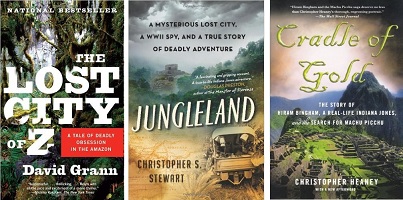
The busyness of the Christmas season has become nearly a tradition itself. Many are bogged down in the Retail Apocalypse right to the last hours of Christmas Eve. Stores will do anything to get in you in the door and our leaders will smile at the minor economic bump and run and hide when it’s erased with post-holiday debt. Nevertheless, perhaps you’re like me and try to carve some time out of these weeks to tone it down a bit. Perhaps you’d like to go on an adventure? Disappear into the jungles searching for lost cities like Indiana Jones?
No, seriously, you can for only a few dollars.
In The Lost City of Z, you can follow the trail of legendary explorer Percy Fawcett. In 1925, he disappeared into the Amazon looking for the fabled city. When you’re done, head to Honduras in Jungleland and search for Ciudad Blanca — perhaps the fabled El Dorado. Then head back down south and follow the footsteps of Hiram Bingham and explore Machu Picchu in Cradle of Gold.
So take a breath, turn the lights down, and vanish into another world.

The Fire of Exploration
Exploring the final frontier has never been easy. For decades, in fits an spurts, we have explored the Solar System and established manned outposts in orbit. We even reached the Moon, which has been so long ago now, that it seems a dream. We can probably blame the tortoise pace of space exploration on it being largely controlled by the government and their ever changing, and short-sighted, whims. In recent years, private companies have taken up the torch. As witnessed by this week’s crash of the spacecraft Galactic, exploration on the edge of frontiers is still fraught with danger.
It always has been and always will be.
When the New World was being rediscovered by Europeans from 1492 on, it was much the same. Driven by politics, economics and the innate desire of humans to explore, not all went well. The early voyages were often about finding wealth and conquering lands. Later, though, it would be about building a better life, improving the human condition. The powerful desire to improve the existence of one’s family and future descendents has long been entwined with that frontier spirit. It’s often difficult to tell them apart. Interestingly enough, we would later learn that 1492 wasn’t the first rediscovery of what would later be named the Americas.
In 1000 A.D., the Vikings arrived in North America. It seemed almost inevitable that these quintessential seafarers and explorers would do just that. For centuries the sagas and rumors attesting to their arrival was largely discarded as myth. Then archaeological remains of a settlement were found in Canada in 1960. Still, the idea of pre-Columbus explorers was seen as unlikely and supposed accounts quickly dismissed.
This was for two reasons: One, the level of required verified evidence is high. Is it too high? The Viking sagas told of exploring America, but were dismissed as legend. Even now, the extent of their exploration is unknown, but it is admitted that they voyaged to the coast for decades, if not longer. Only one settlement? These legendary warriors never ventured far from the beaches?
Two, early attempts to dismiss all natives as not much more than primitive cavemen saw many people ascribe anything of sophistication to foreign visitors. We now know the New World was replete with civilization and we know they arrived here longer ago than originally thought, through multiple paths. That paradigm shift has led many to wonder: Is it reasonable to think that people here for so long remained isolated from the rest world? A world that had many accomplished seafarers? After all, didn’t the natives make it here at one point? Does any civilization live in isolation for over 10,000 years?
Of course, there are those who consider any suggestion of diffusion racist. They are driven by those who have, or still do, see natives as inferior. The other side of the coin are those who believe it did happen, repeatedly, and assert that it’s racist to say it couldn’t have happened.
So much for academic inquiry.
To be certain, the field has been full of fringe writers pushing many a bizarre theory or those motivated by ideology. Not all are so driven. Many are simply looking for the facts, some of which have always hidden in plain sight.
Sometimes it was intention, other times apparent chance, but in either case exploration burned in the souls of many men and women. What resulted wasn’t always good, but the overall condition of man usually improved. Does the fire of exploration still kindle? Are we too busy to see past tomorrow, buried in our televisions and self-created busyness?
Time will tell if humans will quit ignoring the calls to be something greater than what is pushed upon them. Modern steps into space are part of a long legacy that reaches back millennia. The crash of the Galactic won’t extinguish the flame.
It reminds us there are still those in which the fire still burns.


Raising Giza
The pyramids of Giza. The last of the Seven Wonders of the World. They have spawned endless speculation into the methods of their construction and purpose. Much of it bizarre: Aliens built it. It’s a power plant. A weapon. Vault of lost knowledge.
This all makes for a lot of absurd — I mean interesting — speculation. And occasional fun fiction. In this case, though, fact is far more interesting.
In The Secret of the Great Pyramid, Egyptologist Bob Brier chronicles the quest of architect Jean-Pierre Houdin to unlock the secret of the Great Pyramids assembly. Rather than resorting to stargates and levitation, Houdin looked at it with an eye honed by design and engineering: Moving and raising blocks is physics. No advanced math is needed. No spaceships either. That doesn’t mean it was easy.
Realize that Egyptians wrote about nearly everything, except how they built pyramids, which adds even more to their mystique. Brier recounts their history, which began with others before those at Giza. A bit of science, a bit of trial and error. Eventually it was perfected. I won’t reveal the details here, but it seems we may have long been looking for an answer too complicated. Sometimes simple is all that is needed.
Perhaps most fascinating is that pyramids came early in Egyptian history rather than later. We continue to learn that the ancients were quite intelligent. Too often we look back and down on those who have faded into history — “chronological snobbery” C.S. Lewis called it. They were smart, just had a different level of technology and knowledge base. Discoveries continue to show that mankind’s intelligence existed very early, if not from the beginning.
Our modern nations have existed for an eye-blink in time. Will we approach the longevity of ancient empires? Or will we be crushed under the weight of our misplaced stones?
So perhaps the pyramids carry a message after all.

Finding our Past, and Future, in the Jungle
Many of you have grown up with fictional characters like Indiana Jones. Swashbuckling tales of danger in search of lost cities. There was a time when such adventures weren’t the realm fiction.
In the last decades of the heyday of exploring the last wilds of the Earth, Colonel Percy Fawcett led an expedition into the Amazon to search for the fabled Lost City of Z.
He was never seen again.
Decades of rumors of his fate ensued. Had he found the lost city? Was he living among the natives? Had he succumbed to the jungle many years before? David Grann takes us on a tour of Fawcett’s obsession in The Lost City of Z, in part by heading into the jungle himself following the footsteps of the lost explorer.
But Fawcett wasn’t the only one. Theodore Morde had claimed he had found the lost White City in Honduras. He never returned to explore his find and may have tried to obscure its location to dissuade others. Christopher S. Stewart dives into this man’s life in Jungleland. He too goes to the jungle and tries to locate Morde’s discovery and, perhaps, what haunted him to the end.
Then there was Hiram Bingham who discovered the legendary mountaintop city of Machu Picchu. This site was not lost and has become an iconic wonder of the Mesoamerican past. Christopher Heaney chronicles Bingham’s quest in Cradle of Gold. The classic journey of that era that has impacted history decades later to our time. Its forgotten history of a sprawling empire is still being revealed. And Machu Picchu has become the prime example of the need to return artifacts to their rightful nations that were acquired (not always honestly) during the age of relic hunting.
These books are windows into the bygone era of journeys into the unknown. Sometimes driven by fame or fortune, discovery or quest of knowledge, the explorers were nearly the last of their kind. Perhaps those who have left Earth into space are our only successors to them.
In any case, there are still discoveries to be made on our world; jungles that still cling to their secrets and can make men vanish in an eye blink. We are desperately in need of a generation that takes mankind’s history seriously while looking forward and are willing to explore new frontiers and push us beyond new thresholds.
Ignoring history, not seeing past tomorrow and thinking a new phone is “innovation” just doesn’t cut it.
News From the Past & A Warning From Above
If you have completely lost interest in what the media chooses for news every night and in the daily papers, and the incompetence of the government makes you want to never turn the news on again, here’s some interesting recent stories:
The latest finds on Stonehenge indicate it started as a huge graveyard. Stonehenge’s importance for the dead has long been known, but these finds continue to roll back myths about aliens and druids building the ancient structure.
There’s a lot of empty space in Pacific Ocean and there has long been speculation of lost lands (and civilizations). Now the remains of a micro-continent scientists have named Mauritia have been found.
The Sahara continues to reveal North Africa was more than a desert in ancient times, giving up remains of stone age peoples.
And while the government can’t agree on what to waste our money on next, asteroids have been making a number of visits to Earth as of late. Impact events have changed Earth’s, and our, history in the past.
But, hey, Congress is busy buying each other’s votes and pretending they are looking out for you. You have nothing to worry about.
Small Books, Big Ideas
I ran across the Wooden Books series nearly ten years ago. These small books are 58 pages long and each cover one topic or another of fascinating interest. They are profusely illustrated in an old-fashioned drawing kind of way and packed with information and history. By now, they have quite a collection of different subjects, many unusual, arcane or esoteric. Many I have no interest in and a few are out there on the fringe (Crop circles? UFOs? No thanks.). There are a number of them that I have found quite good. And here they are.
If your interests lie in the underlying patterns and math that describes our universe, Symmetry: The Ordering Principle, Sacred Geometry, The Golden Section: Nature’s Greatest Secret, A Little Book of Coincidence and Sun, Moon & Earth will give you endless paths to explore.
If archaeology and ancient history is more your style, Stonehenge, The Mayan and Other Ancient Calendars, Glastonbury: Isle of Avalon and Leys will allow you to begin your world exploring from your home.
This is like having a library of forgotten knowledge at your fingertips. Ideas and places that most people have no clue about. When they do crack the covers, they may be surprised that there are far more interesting things to be learned not on their phone or television.
Sometimes epic journeys start with small steps.
Lost Pryamid at Giza?
Frederic Norton wrote in his 1700s era book Travels in Egypt and Nubia of four large pyramids at Giza.
The only problem is that there are currently only three.
It wouldn’t be impossible to cart off a pyramid, but it wouldn’t be easy either. Shouldn’t there be some evidence left? Some suggest Norton was talking about a pyramid further away from Giza, but his map has it very close. I haven’t found much on this “lost” ruin, other than at here. Yeah, I know, it’s a conspiracy site, but it has scans of some of the old maps.
There is undoubtedly much to be found in Egypt, a civilization that lasted for 3000 years. The ancient world has yet to give up all of its mysteries. It may surprise us yet.
3000 Years: Will We Make It?
The United States has been around for 236 years. We think that’s a long time. Rome endured over twice that. Ancient Egypt: Over 3000 years. Try to imagine that. They had periods of chaos longer than the U.S. has been a nation, and we think this recession is bad.
The length of their existence is one reason they fascinate people to this day. How did they do it? That’s what draws people to study them. So do the temples and pyramids. Archaeologists have spent decades peeling back layers of the history beneath the sands. That many millenia of history piled over each other can make it difficult, but it’s amazing what we do know.
They weren’t cavemen, but also not super-geniuses. Their math that built the pyramids was rather simple. Their astronomy was less advanced than the Mayans. Yet, in many ways, they were like us. We often think we are the only people to work, play, love and fight. People stuck in the modern world would surprised at how similar the peoples of the ancient world were. On the other hand, us moderns wouldn’t want to stranded in the ancient lands with their primitive medicine and short lives.
It’s hard finding readable, yet scholarly, material on Egypt. Bookstores are full of strange, bizarre theories on ancient Egypt. Some just cannot believe the ancients could figure out how to move stones and stack them. Toddlers figure that out.
A great place to start your learning would be Bob Brier’s engaging course, History of Ancient Egypt. If you have no interest in this ancient world, you will after listening to his informative and fun lectures. Then there is Barbara Mertz’s two part history Temples, Tombs, and Hieroglyphs and Red Land, Black Land: Daily Life in Ancient Egypt which have been the best intro to Egyptian history for decades.
Both Brier and Mertz are Egyptologists. It’s fun to see where they agree and disagree (mainly the former). The books and course are good complements. Ironically, Brier supports the theory of women driving the leadership in Egypt more than Mertz does. Mertz overlooks Egyptian links in the bible, whereas Brier explores it. Brier is a mummy expert, and Mertz loves showing how human the ancients were. Both actually reference each other.
Far more fascinating than fringe theorists. As exciting as a fictional world. Try something different.
Try time travel into an ancient world.
Sands of Egypt Reveal More Pyramids
Read more here. Will the desert ever cease revealing the world of the ancients? Delve deeper into this ancient land with the audio class, Great Pharaohs of Ancient Egypt.


 Darrick Dean