
This time it is publishers of Christian fiction taking notice. Indie authors are here forcing “the industry to adapt,” going beyond the “typical guidelines used to frame the culture’s concept of Christian fiction” and not limited by “genre restrictions.” In other words, giving readers more choices.
Fiction
Indie Authors Continue to Change Publishing
Categories: Books, Fiction, Writing
Tags: indie authors, indie publishing, publishing
Leave a comment
Take a Trip: Africa, Lost Islands, Pirate Ships
Sometimes modern readers roll their eyes at the suggestion of reading the “classics.” Can they really be better than the 1800th vampire novel? How can they compare to yet another teen-dystopian-sorta-adventure/romance novel?
Yes, there are some classics that leave one wondering who exactly voted them to those “must read before college lists.” Then there are those that have earned their title with generations of readers.
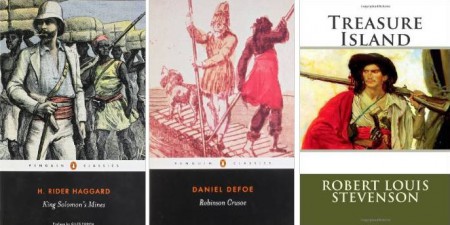
Long before Michael Crichton did so in Congo, H. Rider Haggard brought readers into the heart of Africa looking for the long lost King Solomon’s Mines in 1885. The original Indiana Jones, Allan Quartermain feared little.
Stranded on lost islands have been a of Hollywood for decades, but it was Daniel Defoe’s Robinson Crusoe that started it in 1719!
And if Robert Louis Stevenson hadn’t written Treasure Island in 1883, would countless pirate films held our fascination for so long?
These books have endured — even after their many imitators have faded from memory — because the writers created atmospheric, detailed worlds that anyone could disappear into. Seriously, want to go on a treasure hunt across Africa and make it back? Live on an island by yourself for years and not worry about being saved? Or go on a high seas adventure and make it home for dinner?
Many books come and go. A few, though, we never forget.
Messing with Nature
Long before genetic engineering, or people even knew of DNA, fiction has been warning us of taking our tinkering with nature too far. Books like The Island of Doctor Moreau, Frankenstein and The Monster Men are all at least a century or more old. Yet these authors all saw the age-old hubris in man to try to “improve” on nature, for good or evil.
Some may think the hideous creations in these books will never happen. In the decades after these books were written, we saw how naive this thinking is with experimentation by the Nazis and Imperial Japanese. Since then, genetic science has made it easier…
Is some government or group making fiction fact? Unfortunately, the answer is probably.
Science is an amazing gift, created in the minds of men. Too bad some of those men turned science into a god — a religion of scientism. Others abandoned good for evil.
No wonder such books have endured for so long. We all — whether we admit to it or not — instinctively know danger lurks in the shadows.
And there must always be someone to stop it.

Breathing in Autumn
Fall is hard to appreciate when you are younger because it always meant going back to school. Now it is the time of harvests, festivals, and the changing of the leaves if your region is so lucky. Dreadfully short, autumn is that transitional season that must be experienced before winter sets in. A few months ago I wrote how Dandelion Wine was a quintessential book of summer. Do any books do the same for autumn?
Sleepy Hollow comes to mind. Maybe partly because stories like this also preface the coming of Halloween, which is nearly smack in the middle of the season (and retailers have been reminding us of its coming since August). Hollow and those of Edgar Allan Poe are very different than what often passes as “horror” these days. Where the modern genre often tries to shock and scare, back in the day it was more psychological and creepy. Rather than being something you soon forgot, they were something to long ponder.
Perhaps the uniqueness of fall is meant to do the same: Remind us to slow down and stop and take look around us. Ponder and prepare.
See what is all around us for the very first time.
P.S. Perhaps you aren’t ready to say goodbye to summer yet. Check out Bradbury’s Farewell Summer.

Categories: Books, Fiction
Tags: autumn, Dandelion Wine, Edgar Allan Poe, fall, Farewell Summer, Ray Bradbury, Sleepy hollow
Leave a comment
Shannara: The Heir to Middle-Earth?
Nearly forty years ago, during a dark age where epic fantasy was hard to come by, Terry Brooks released The Sword of Shannara. In many ways, similar to The Lord of the Rings: An unaware, peaceful guy (Shea Ohmsford), happy in his own world, is tasked by a wise, mysterious stranger (Allanon) to obtain the Sword of Shannara before the Warlock Lord uses it to conquer Shannara. While some thought the plot too similar to Frodo/Gandalf/The Ring/Sauron, Tolkien’s books would ultimately establish the archtype for all fantasy that followed. And, in the following decades, Brooks would unveil his Shannara mythos in over 25 books (and it’s still going).
For those that wished Tolkien had written much more, Brooks is the perfect author. His books quickly would show their originality. Long-time readers were in for a welcome surprise when he connected them to his Word & Void series and linking high fantasy with the modern world. Since the series is made up of self-contained sequences (trilogies, duologies…), which makes it easier to pick a place to start (though Sword is still the best place). It also makes those who slogged through years of Robert Jordan’s epic one-story series, or those afraid to start, a little more at ease of taking on another never-ending fantasy. However, many Brooks fans probably wish he would go back and revisit some of his classic characters.
In the final analysis, fantasy fans will long remember Middle-Earth, Narnia and Shannara.

Are You Prepared?
It’s National Preparedness Month and I can’t help to wonder why something so simple is so overlooked by many. Just look how quickly shelves went bare a few weeks ago when water supplies went bad in northern Ohio. Or how people wipe out the bread, milk and toilet paper in the face of a two day snow storm.
Sometimes I wonder how civilization made it this far. What would happen in a far larger, sustained disaster? It doesn’t take much time or money to prepare. I don’t mean you have to be one of those hardcore prepper types, but could you and your family make it a few days without electricity and access to stores? Would your life break down and spiral out of control without a phone and the internet? What would you eat and drink? If it is winter, how would you heat?

Fiction is littered with apocalyptic tales of survival. These imagine what would happen in a complete collapse. What attracts so many to these tales is that they are way to explore the best, and worst, in man.

They also serve as a warning: Pay attention. Don’t get lost in the useless and let others be responsible for the direction of yourself, your nation or humanity. Don’t take life for granted. Many a civilization has fallen, ones far older than our own. We think ourselves as unsurpassed in intelligence and greatness.
So did they.
Categories: Books, Fiction, What You Can Do, Writing
Tags: apocalyptic, be prepared, Cody Lundin, Emergence, One Second After, prepare, survival, The Road
Leave a comment
Lost on Venus
While Mars gets all the attention in sci-fi, Edgar Rice Burroughs (of course) penned a five volume series back in the day (1930s) and has been the epic adventure on the clouded planet ever since.
He uses his classic formula: Earth man lost on another world, meets the girl of his dreams (native of the other world), must face peril after peril, often losing and rescuing his girl in the process. In spite of being a well-used plot in his books — and an archtype for much of pulp fiction that would come later — he creates fresh backdrops of alien cultures and beasts. One can detect allusions to nations or ideologies of our own world in his creations, yet he’s always subtle, never in your face with parallel meanings.
Is there anything wrong with an entertaining story that lets the reader disappear into another world? Must every book be on some sort of crusade? No, but all good books have some depth to them. Others try too hard and come off unintelligent to the thoughtful reader. Yes, there are those who like books that explicitly affirm their worldviews, no matter how poor the presentation.
Burroughs’ books, however, decades after they were written remain fresh, relevant and, above all, entertaining.

Categories: Books, Fiction, Writing
Tags: Carson Napier, Edgar Rice Burroughs, sci-fi, Venus
1 Comment
Burroughs’ Dystopian Earth
Edgar Rice Burroughs is best known for his pulp-sci-fi Barsoom series (John Carter of Mars) and Tarzan. His swashbuckling heroes and their over-the-top adventures influenced countless authors and movies ever since. He’s not known for dystopian tales like those so popular today. Yet, before Orwell and Huxley, he wrote one, a lesser known book, The Moon Men.
A sequel to The Moon Maid, it takes a decidedly different tone than that volume. Maid is the typical Burroughs adventure: Hero finds himself in perilous situations, always perseveres and rescues the girl in the end. In Men, Flash forward a few centuries after these events, and we find Earth invaded and conquered.
Earth, after its own wars, had created “peace” by disarming all. The world’s militaries also all abandoned. A world lulled into a false Eden, ripe for someone to take advantage of it. What follows is a subjugated population who worships in secret, books are rare and people are stolen by those aligned with the invaders. Fall out of line and face death and being fed to the alien race. But Julian has had enough.
Burroughs, writing in the 1920s, had seen the destructive Great War and writes of the follies of war in the first book, but also of the futility of pretending evil is conquered and peace can be forced. He then shows how tyranny can begin to falter because of one man. The master of pulp fiction showed that this genre could give us as much to think about as any “literary” work.
And any worthwhile book should entertain and make us think.

Categories: Books, Fiction, Writing
Tags: dystopian, Edgar Rice Burroughs, sci-fi, The Moon Maid, The Moon Men
4 Comments
Bad Deeds
Tired of the System run by the corrupt that protects the corruption? You could call Batman. Or you could find Dylan Hunter.
In Robert Bidinotto‘s Hunter, we were introduced to investigative reporter Dylan Hunter who has, let’s just say, a bit of a past. Nor does he like when the criminal element gets away with murder.
In Bad Deeds, we find Hunter and his woman friend Annie on a much needed holiday in the towering forests of northern Pennsylvania. It’s not long before they find themselves in a middle of a war as ecoterrorists attempt to take down the evil corporate gas drillers. Soon, the trail leads to the cesspool of corruption known as Washington, DC, where the Hunter finds himself up against those who will do anything to cling on to power. They believe themselves untouchable. Hunter may have a thing or two to say about that.
Is this second installment, Bidinotto has built on the first and taken the story to a new level, as any sequel should. Readers find themselves in a “ripped from the headlines” tale that is all too plausible. Political games and money trails are all too the norm in our world. As are cover-ups and the near immunity of politicians from the rules the rest of us play by. This all unfolds in a page-turning fashion that exceeds Hunter’s last adventure. Of course, in the tradition of all memorable thrillers, Hunter finds himself in some over-the-top situations. At the same time, there is much to provoke thought in the thinking reader. When will more people become fed up with the status quo? Maybe not necessarily in the way Hunter goes about justice.
Then again, when are we going to stop letting the corrupt define justice?

Categories: Books, Fiction, Writing
Tags: Bad Deeds, Dylan Hunter, Hunter, Robert Bidinotto
1 Comment
Of Martians and Details
Have you ever read a book where you feel like you are bogged down in a swamp? The author wants to tell you every little detail of his or her world. The color of every last button, the exact feel of every object, every inch of every person in vivid color. It’s as if they are afraid the reader will perceive something, anything, different from what was imagined in the author’s mind.
It’s true that too little detail is boring. Just as certain is that not allowing a story to breathe, to capture the reader and bring them in, is just as boring. It doesn’t take a lot of detail to paint a picture in the mind. A perception. A feeling. An immersive book doesn’t have to be 200,000 words long. Fewer and purposefully chosen words can ignite the reader’s imagination, draw them inside and propel them forward.
One of my favorite books is Ray Bradbury’s Martian Chronicles. Relatively short, it’s a collection of short stories, mostly connected only by the Martian setting. But Bradbury’s descriptions of the ancient, dead (or dying) Martian world leave an impression in one’s mind, one that stays with you long after. Maybe each reader’s image in their mind’s eye of the red planet is a little different in reading these stories. Yet long after they forget every exact word, character and event, the mere mention of the book brings up imagery and feeling like a memory of place actually walked.
And that is one of the traits that distinguishes remembered books from those forgotten.


 Darrick Dean