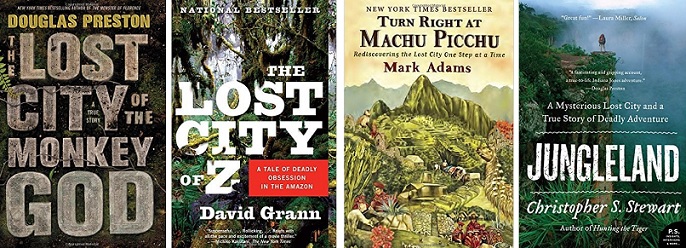
David Grann‘s book The Lost City of Z reintroduced readers to the true story of Percy Fawcett‘s epic search for the legendary Lost City of Z in the Amazon. Now, it is being told on the big screen this spring and may be a welcome respite to the same old, action films. Check out the trailer here:
History
Lost City of Z
The West that Was
Like many topics, the expansion into the West and the wars with the Indians (Native Americans) gets some short blurbs in history class before moving onto the next era. The Oregon Trail, ’49 Gold Rush, Pony Express, famous cowboy outlaws, Transcontinental Railroad, wagon trails and Custer’s Last Stand are among the familiar touchstones.
Yet he details of this history are far more vivid, fascinating and, sometimes, disturbing.
These three books, by different authors, serve as a trilogy to the western expansion and the “Indian Wars” of the 1800s: The Heart of Everything That Is: The Untold Story of Red Cloud, An American Legend, Empire of the Summer Moon: Quanah Parker and the Rise and Fall of the Comanches, the Most Powerful Indian Tribe in American History and The Last Stand: Custer, Sitting Bull, and the Battle of the Little Bighorn.
Most now understand that pushing out the natives was often driven by greed and viewing them as primitives. Custer is no longer a hero. Few, though, know how brutal those wars were, or the hardships of settlers caught in the middle. Nor were many of the Indian nations peaceful peoples. Even fighting among themselves, their warfare was barbaric. That doesn’t justify their extermination; nor does their defense justify all of their own actions. Sometimes, in real history, it’s hard to pick out the villains and heroes. Other times, they aren’t who you thought they were.
For better or for worse, this was a defining era in U.S. history. It is a reminder, that in the not so distant past, people could be convinced to take terrible actions. A much greater nation managed to emerge from the blood and dust, so we should be thankful for that. Now we must respect the past so the wrongs don’t become our future, and those who should have lived are finally remembered.
Lost Cities & Deadly Jungles
The search for lost cities is what movies are made of — and many of the films were inspired by real life. A number of authors have set out following the trails and clues left by others in search of what may still be lost. The latest is thriller writer Douglas Preston‘s book The Lost City of the Monkey God.
Rumors of the White City hidden in the impenetrable jungles of Honduras have persisted for centuries. Preston joined a team of explorers and archaeologists, using a combination new technology and old-fashioned fight-your-way-through-the-jungle, to search for lost ruins.
Indeed, they find a lost city and indications of others. This a true story of adventure into a land of deadly animals and diseases, cartels and fixers, and forgotten histories that may still hold messages for modern man.
As Preston and the authors below have shown us, there is still much of our past to be uncovered. And there are still adventures to be had.
Honoring Our Past
The past seems so distant to us and, perhaps more than any other people in hisrory, we tend to look down at those who came before us. We think we are sophisticated and have endless knowledge, our lives superior. Yet, our ancestors weren’t so primitive or mired in darkness. That’s why it’s a shame when some try to rewrite history to discount certain peoples, cultures or beliefs — all to rationalize their own beliefs or to feel better about themselves.
In particular, the myth of the Middle Ages being “dark” has been rapidly unraveling. Why should anyone other than history enthusiasts care? Because the Middle Ages is where modern culture was born. It was then that the Western world blossomed, while much of the remainder struggled. To downgrade their achievements, and pretend the Renaissance appeared out of nowhere, is disrespectful of our ancestors.
The Greeks honored the Egyptians; the Romans the Greeks. The West took the ruins of Rome and built something better. A true dark time was our own 20th Century with its unprecedented wars. Maybe that’s when we started to ignore the voices from the past?
We don’t want to gloss over the failures of the past, but nor do we want to look down upon our ancestors and ignore their achievements. So perhaps this is the perfect time of year to think about these things, surrounded as we are in Christmas traditions — many of which come down to us from the Middle Ages. Check out this video and take a moment to remember where many of us came from:
Hacksaw Ridge
Veteran’s Day is on November 11th and it once marked the end of World War I. Now it honors all veterans of all wars. Perhaps a good way to remember the sacrifice of many is to see this new film of true events during the Battle of Okinawa during World War II:
1492
In 1492, Columbus sailed the ocean blue…
That little rhyme was once taught to all kids. Now, the name Columbus isn’t uttered much, and people just know the mail isn’t delivered today, the banks are closed, and they might have they day off.
However, for a historical perspective on the man who rediscovered America, check out my post from last year.
And, perhaps, we can look forward to the day that mankind rediscovers its spirit of exploration.
America: Miracle or the Titanic?
So I ran across The 5000 Year Leap, subtitled A Miracle That Changed the World: Principles of Freedom 101, at a book sale. Here, in one volume, is an accessible volume on the principles that went into writing the U.S. Constitution. The chapter I opened today reads:
3rd Principle: The Most Promising Method of Securing a Virtuous and Morally Stable People is to Elect Virtuous Leaders
Isn’t that a novel idea?
Turn Right, and Meet Me in the Lost World
In my review of travel adventure books, we have searched for Sheba and explorers of the New World. We have also disappeared into the jungles of Latin America on the trail of lost cities. Now we will return to uncovering the ancient world.
Mark Adams set a benchmark for travel adventure lit with his Turn Right at Machu Picchu. This fish-out-of-water follows the trail of legendary explorer Hiram Bingham who brought Machu Picchu, the hidden Inca mountain refuge, to the world’s attention. A perfect combination of Adams’ travails and history — every bit a page turner as a novel.
Adams followed this adventure up with Meet Me in Atlantis. Here he tries to hunt down the true experts of the legendary lost city, among a field known for, how should I put it, fringe thinkers. His hunt leads to many possibilities, and even though not as much adventuring as his first book, it is a refreshing change to the libraries full of bizarre Atlantis speculations.
Now we turn to David Roberts‘ The Lost World of the Old Ones where he continues his many years of hiking off-trail into the Southwest. Readers will be amazed at how much lies undiscovered and unknown about the civilizations that once populated these states. Roberts chronicles the politics, history and conflicting visions that have attempted to preserve the past — not always successfully. A fascinating and entertaining account that will remind people that United States has its own lost civilization still waiting for discovery
Turn: America’s First Spies
Less and less on television holds my attention. Repetition, little creativity and stories that don’t go anywhere. And I’m always asking myself, “Isn’t there something else I could be doing?” So, halfway through last year’s television season, I gave up on what few shows I was watching. There was one big exception, Amazon’s excellent A Man in The High Castle. Now, another gem of a find, AMC’s Turn:
Spies. Revolutionaries. War.
Where can you get this on network tv?
401 A.D.: The Year Literature Changed
Thomas Cahill, the author of How the Irish Saved Civilization, called Augustine of Hippo “almost the last great classical man — and very nearly the first medieval man.” Augustine wrote in Confessions:
I carried inside me a cut and bleeding soul, and how to get rid of it I just didn’t know. I sought every pleasure — the countryside, sports, fooling around, the peace of a garden, friends and good company, sex, reading. My soul floundered in the void — and came back upon me. For where could my heart flee from heart? Where could I escape from myself?
Cahill responds to this:
No one had every talked this way before…we realize that with Augustine human consciousness takes a quantum leap forward — and becomes self-consciousness…From this point on, true autobiography becomes possible, and so does its near relative, subjective and autobiographical fiction. Fiction had always been there…But now for the first time there glimmers the possibility of psychological fiction: the subjective story, the story of the soul…[Augustine] is the father of not only of autobiography but of the modern novel.
In Augustine’s words we find someone searching for his true purpose and — shortly before the fall of the classical age — published his 13 part classical work Confessions in 401 A.D. Yet it often sounds like it was written yesterday.
We are no better or worse than those who walked before us centuries ago. Our troubles are rarely unique to us. Those ancient voices left us plenty to ponder, to learn from and to be warned by.
Perhaps we should take the time to listen?