History

From Arabia to the New World

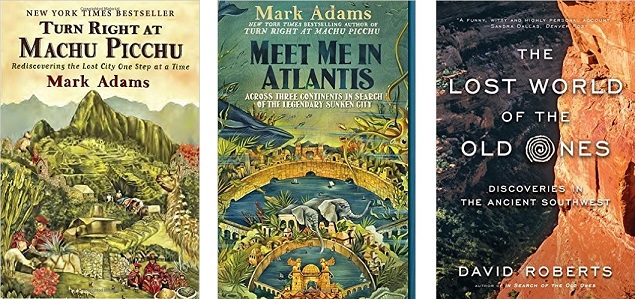
Most people love some sort of fiction whether it film, television or books. Yet, there are adventures to be had in the real world amidst all of its chaos and strife. We already took a look at some fantastic travels into Latin America where the ancient world still hides. Here are some more tales of authors who went on their own adventures to explore lost histories of our past:

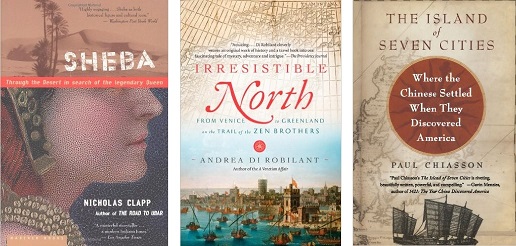
Few love stories can claim to have endured centuries, but that of Solomon and Sheba has done just that. Nicholas Clapp set out in Sheba: Through the Desert in Search of the Legendary Queen to uncover the truth to what is only briefly mentioned in biblical chronicles and some other sources. Traveling through unstable Yemen in Arabia, to ancient sites in Ethiopia and to the Jerusalem, the city of Solomon, he uncovers clues to the lost empire of Sheba that tantalize us with potentially much more hidden in the sands.

Legend has it that Venetian brother Antonio and Nicolo Zeno arrive in North America a hundred years before Columbus. Is it only a legend? Andrea di Robilant tracks them across Europe and to the fringes of the New World to uncover the truth in Irresistable North. Given a recent, new discovery of vikings, should we not take a little closer look at the Zenos?

The Zenos may not be the only ones to beat Columbus as Paul Chiasson writes in The Island of Seven Cities. Ruins on Cape Brenton in northeast Canada, not all that far from Viking sites, could be the remains of a Chinese outpost. If this wasn’t interesting enough, the Zeno brothers had mentioned encountering some sort of non-native settlement in the region. Vikings or Chinese or one of these intermixed with natives?

I’m thinking real life adventures like these beat television any day. So where do you want to go?

Categories: Ancient America, Ancient Documents, Ancient Sites, Bible, History | Tags: , , , , , , , , | 1 Comment

Last Man

When humans first entered the final frontier the very edge of technology was pushed to its limits. The race into space may have been driven by the Cold War, but ultimately there was something even greater behind it.

The human spirit.

That spirit has driven mankind to explore for millennia and space is no different. Every bit as dangerous as the New World, the Amazon and the Wild West, but this frontier has no bounds and is unforgiving. Unfortunately, the powers that be, quickly lost vision and returned to their myopia. In an age where technology is taken for granted, it is hard to believe this happened decades ago. It is also a reminder that we could do so much more than iPhones and smart cars.

There are some who still remain from that first wave; those who were there on the new frontier. This is the story of the last man to walk on another world:

shtv

Categories: History | Tags: , , , , , , | Leave a comment

Every Generation’s Legacy

Think not forever of yourselves, O chiefs, nor of your own generation. Think of continuing generations of our families, think of our grandchildren and of those yet unborn, whose faces are coming from beneath the ground. – Peacemaker, Founder of the Iroquois Confederacy

In all of your deliberations in the Confederate Council, in your efforts at law making, in all your official acts, self-interest shall be cast into oblivion…Look and listen for the welfare of the whole people and have always in view not only the present but also the coming generations, even those whose faces are yet beneath the surface of the ground – the unborn of the future Nation. – The Constitution of the Iroquois Nations: The Great Binding Law

There are a variety of quotes like these, often rewritten as some variation of, “In every deliberation, we must consider the impact on the seventh generation…” These quotes are often used in discussion of environmental issues, but they are a fundamental concept of foresight that should be applied to much of our thinking. This is something our politicians rarely do — they’re only concerned in what they can say or do (or appear to do) to get them through the next election cycle.

Continue reading

Categories: Critical Thinking, History, Nature, What You Can Do | Tags: , , , , , | Leave a comment

Challenger 7: 30 Years Ago

Two weeks from tomorrow, on January 28th, marks 30 years since the Challenger Disaster.

Seems so long ago, yet it is one of those days people never forget. School was out that day, probably because of bad weather, and I remember watching on television the news showing the explosion over and over.

I will never forget.

We didn’t give up on spaceflight that day, but I wish more would have seen the real promise of the Final Frontier. Instead, many in government still see it as another “get-elected-for-a-few-years” opportunity. The vision of government sees only through the next election cycle, not seven generations hence.

There are those who are far more forward in their thinking. Those who are tired of the others who have given up on the human spirit of adventure. The spirit that created pioneers, frontiersman and explorers. That spirit is in all of us, even if those in power have forgotten.

We can best remember and honor the Challenger 7, and all those astronauts who light up the sky on the National Astronaut Memorial, by looking and forging ahead.

By remembering pioneers are still needed, frontiers need explored and danger can never be eliminated.

Honor those who tried, those who failed, those who succeeded and those who gave the last full measure.

Let the future not say we gave up, forgot or ignored.

If we do, there will be no future to look back on us.

Categories: History | Tags: , , , , , , | Leave a comment

Did He or Didn’t He?

At the end of World War II the Allies splintered between East and West, and they began carving up Germany and the rest of Europe. Even as the Cold War began to develop, the Allies were rounding up and preparing to try various members of the Nazi regime. It is no secret that while they were doing this, they were also deciding which Nazis to keep for their own purposes (and others would be released early from prison in the following years). This, and the consequences and questions of ethics, have been documented in many books such as The Nazi Next Door and Operation Paperclip.

The Allies also sent investigators to verify the death of Adolf Hitler, since the remains had been burned. There have always been whispers of Hitler escaping, but I’m not one to jump quickly to join conspiracy theories. Then two things happened.

First, there has been the continuing revelations of deception regarding the protecting of many Nazis brought to the U.S., or used in Europe, to “assist” in prosecuting the Cold War. The government’s nonsensical policy of picking and choosing who to use, and who to prosecute, and to occasionally change their mind years later, is a troubling window into what certain people in power do.

Second, something stood out in these accounts of investigating Hitler’s suicide in his bunker. The investigators relied on the testimony on Nazis and evidence provide by them. Continue reading

Categories: History, Modern History | Tags: , , , , , , , | Leave a comment

Choose Your Adventure

The busyness of the Christmas season has become nearly a tradition itself. Many are bogged down in the Retail Apocalypse right to the last hours of Christmas Eve. Stores will do anything to get in you in the door and our leaders will smile at the minor economic bump and run and hide when it’s erased with post-holiday debt. Nevertheless, perhaps you’re like me and try to carve some time out of these weeks to tone it down a bit. Perhaps you’d like to go on an adventure? Disappear into the jungles searching for lost cities like Indiana Jones?

No, seriously, you can for only a few dollars.

In The Lost City of Z, you can follow the trail of legendary explorer Percy Fawcett. In 1925, he disappeared into the Amazon looking for the fabled city. When you’re done, head to Honduras in Jungleland and search for Ciudad Blanca — perhaps the fabled El Dorado. Then head back down south and follow the footsteps of Hiram Bingham and explore Machu Picchu in Cradle of Gold.

So take a breath, turn the lights down, and vanish into another world.

Categories: Ancient America, Ancient Sites, artifacts, Books, Forgotten Places, History, Mysteries, Native Americans | Tags: , , , , , , | Leave a comment

Discovering Columbus

Last year I asked, Should Columbus be Celebrated? It is a controversial question, since that day in 1492 meant the eventual end of many cultures in the Western Hemisphere. The other side of the sword is that new cultures arose from those escaping the Old World. In all likelihood, using Columbus as the poster child for all that did go wrong is not fair.

One has to dig deep into many studies of the man to even begin to unravel his mind. He was secretive, put himself in the middle of politics and was the target of his enemies. All of this, and the distance of time, have made any study of the explorer a difficult one.

As Carol Delaney argues in Columbus and the Quest for Jerusalem, acquiring wealth for the Spanish crown was not his primary goal. He sought allies and money for one more Crusade to the Holy Lands. Religious motivation has been suggested before, but by writers couching everything in esoteric conspiracies. It has also been suggested he knew the New World existed. As plausible as that is, most of what we know seems to point elsewhere. Beyond that:

…Delaney depicts her subject as a thoughtful interpreter of the native cultures that he and his men encountered, and tells the tragic story of how his initial attempts to establish good relations with the natives turned badly sour. Showing Columbus in the context of his times rather than through the prism of present-day perspectives on colonial conquests reveals a man who was neither a greedy imperialist nor a quixotic adventurer, but a man driven by an abiding religious passion.

Contrast this to the later Conquistadors who were made up of mercenaries and those looking to set up their own little kingdoms of wealth. In Kim MacQuarrie’s The Last Days of the Incas, we get the distinct impression that most of these men cared little about religion other than some unconvincing attempts to use it to justify their actions.

Columbus’ life didn’t begin and end on his first voyage to the new world. It was his fourth that would unfold like an epic film and perhaps best give insight into his motivations. Martin Dugard’s The Last Voyage chronicles mutiny, shipwreck, storms and war. A far different tale than the simple one told in schools. Only by going beyond the simple tales, do we actually begin to peel away the misconceptions and mystery. That curtain will probably never be completely pulled away and certainly Columbus is imperfect and flawed like us all. And maybe that’s the lesson this Columbus Day.

Anyone can change the world, for better, or for worse.

colum

Categories: Books, History, Native Americans | Tags: , , , | Leave a comment

On this Memorial Day…

From Historian Walter R. Borneman:

On this Memorial Day, we honor the sacrifices of prior generations. We honor the sacrifices of the men and women next door who have served or continue to serve our country. And we pledge never to forget the true meaning of Memorial Day. We would not have the privilege of celebrating this day and honoring so many memories without the sacrifices of those who gave their last full measure of devotion.

flag

Categories: History, Traditions | Tags: , , | Leave a comment

More to Patrick than Being Green

Leprechauns, green beer, parties, Irish heritage. Hard to tell that St. Patrick’s Day started as a religious remembrance of one of Christendom’s most famous missionaries. So here is a little history.

Partick’s early days aren’t well known. His father and grandfather were both members of the clergy. Possibly a wealthy family, but surprising to many, they were British. Yes, the patron saint of Ireland isn’t Irish (reminds me of famed British writer C.S. Lewis who was, well, Irish). Nonetheless, the teenage Patrick was kidnapped and became a slave in Ireland for six years. It is there his faith grew, and he would later write that God told him when to flee to the coast, where he escaped back to Britain. There, he would receive another call to return to the land of his captors to minister to them. After over a decade of training in the priesthood, he did just that.

He wasn’t the first to introduce Christianity to Ireland, but is often credited with influencing its explosive growth there. As with most missionaries, it wasn’t easy. His writings attest to being detained and subject of wrath from local rulers. Mostly likely not the “fire and brimstone” variety of preacher, he would sometimes incorporate — or subvert — some of the old Celtic symbols into his mission. He is said to have superimposed the Christian cross onto the Celtic one, making it a recognized Christian symbol to this day.

Many other legends have grown around Patrick, and quite probably, they are simply legends. Such as his use of the shamrock to explain the Holy Trinity or that he banished all snakes from Ireland. Others are quite fantastic, giving Patrick great powers like a wizard. He brought the Magic Fire the Druids of the great High King Lóegaire could not extinguish. It’s all much more fascinating than green beer.

Even though he’s often referred to as a “saint,” he was never officially canonized, but only declared a saint by popular opinion. Still, the day is observed officially by Catholics, Anglicans, Lutherans and some others. In the long centuries since the Reformation, many churches have abandoned such “feast” or observance days, but in this trend we have lost some of our history. 

Out of billions who have come and gone, when one has been remembered by history, one should be encouraged to find out why. Here’s a man who went back to the land of his enslavement, far from home and with little support, to teach and witness. He worked among the slaves and poor, one of the first to oppose the kind of slavery he himself had experienced. The monastic movement in Ireland would become an important part in coming resurgence of the West during the Middle Ages.

Yes, St. Patrick’s Day can be used to remember Irish heritage and its influence on the world. There’s nothing wrong with that, especially if you are Irish (if you aren’t, don’t you have your own day? Oh, laugh already). St. Patrick’s Day has always been a bit less about its namesake than it should. So take a minute and think about why this man is still known so many centuries later. History remembers only those terrible and those great. Patrick was the latter and we should ask this:

What does it take, whether history notes you or not, to leave a positive mark upon the world?

And perhaps, just perhaps, not all in myth is fiction…

irbks

Categories: History, Legend, Traditions | Tags: , , , | Leave a comment

Rescuing History

The truth is that the white men and savage Indians could never live in peace in the same land. The Indians wanted the land for hunting grounds; the white people wanted it for farms and ranches. The white men, being stronger, were able to win.

So it was written in the elementary school history text, The Growth of the American People and Nation, published in 1937. Boy, times have changed. A perfect example of history being revised, perhaps unintentional or based on the intentional agendas of others. Some more:

The government at last decided it was cheaper to feed the Indians than to keep on fighting them…moved [them] to…Indian reservation[s]…Government Indian schools were opened…The Indian problem was no longer one of our chief problems.

History has since, for the most part, corrected its recording of what transpired to the natives in the Americas. They didn’t just want the land for hunting, it was their home where they had lived for generations. Nor were they particularly more “savage” then any other humans. The text even notes that, “…the Indians had no food supply [buffaloes killed], [their] lands were taken from them…[they] were put on reservations.” Sobering to those who think such things cannot happen in a democracy. Historian Francis Jennings wrote in The Founders of America:

From 1812 until the end of the century, official policy, no matter what euphemistic terms expressed, was simple conquest. Its purpose was to reduce Indian persons to dependence and to seize tribal lands. It is common scandal that the United Sates has violated every single one of its treaties with Indians.

We cannot engage in revisionism of history, the good or bad, what we like or dislike, or else we cannot learn from it. One wonders, though, how many genocides and oppressions we must witness, or allow happen, before we get it. Unfortunately, historical revisionism is alive and well and is a favorite of those with political and other agendas.

There seems to have been a craze of trying to dig up dirt on the Founding Fathers in order to justify support for our less than stellar elected class. No one ever claimed the founders were perfect, unblemished humans. Comparative to many of our own, they did have a higher respect for their office. In the zealous attempts to dethrone them, facts have often been flushed away. For instance, take the cottage industry of attacking Thomas Jefferson.

One of those attacks is the claim that DNA proved he was fathering children with slave Sally Hemings. The problem with this is that the DNA didn’t have Jefferson’s name on it, only that someone in his family was implicated. Turns out that his brother could have been the father of the children. There is nothing that can be used to state that Thomas Jefferson absolutely was fathering these children, as so often has been implied or stated.

Often the old history books do get it right and can be used to ferret out agendas in our own. It is always a fun exercise to compare the two. The points to remember are these: Dig a little deeper, don’t think everything you are told or read is without error. Look for bias and agendas, especially when attached to politicians and those that fund them. Ask why some detail of history has changed and where’s the evidence. Yes, it can take time and may seem unnecessary to some people. Ultimately, however, we have a responsibility to pass on accurate and truthful history.

We must start thinking about those who will follow us instead of just tomorrow and the next day. We do this in the hope that our ancestors won’t repeat our tragedies and mistakes and will remember our triumphs.

hsbks

Categories: History | Tags: , , , , , , | Leave a comment

Blog at WordPress.com.