History

Losing History

President Obama has caused quite the controversy by making comparisons of ISIS’s campaign of terror to the Crusades. I will let others debate what, how and why he said everything that he did. Since this site does touch on history time to time, I will discuss his comparison. How do I put this nicely?

It’s absolutely ridiculous.

The Crusades are often brought up primarily by those looking to attack Christians or knock them down a bit. They have fed the perception that the Crusades were all about expanding empires and destroying Islam. The problem is that this perception isn’t history.

It’s revisionist history.

During the early history of Christianity, its population was centered in what we typically refer to as part of the Middle East (technically the Near East and Asia Minor). It’s hard for some to imagine that a country like Egypt was once predominately Christian. What is left out of drive-by comments about the Crusades is the part about the Muslim Conquests that swept through the region, conquering nearly all of it. Princeton scholar Bernard Lewis wrote:

At the present time, the Crusades are often depicted as an early expansionist imperialism — a prefigurement of the modern European countries. To people of the time, both Muslim and Christian, they were no such thing. The Crusade was a delayed response to the jihad, the holy war for Islam, and its purpose was to recover by war what had been lost by war — to free the holy places of Christendom and open them once again, without impediment, to Christian pilgrimage.

Were the Crusades full of tragedies, horrible events and misguided people on both sides? Yes, because all war is a horrible tragedy. That doesn’t mean we rewrite history for our agendas. We let history, the good and the bad, speak for itself. We learn from it, so we don’t repeat it. Or, as George Orwell said, “The most effective way to destroy people is to deny and obliterate their own understanding of their history.”

The revisionism of the Crusades is such an obvious one, it’s sad to see world leaders repeat it. We’ve lost respect for the importance of history. Instead, we have replaced it with superficial study, politics and the tendency of too easily believing everything we hear. We are in danger of losing the messages our ancestors have left for us.

The very messages that can preserve humanity’s future.

crbks

Categories: Critical Thinking, History | Tags: , , , , , , | 2 Comments

Allure of Islands

Islands.

Something about them has always drawn people to them, in real life and in fiction, for a variety of reasons. They are disconnected from the world and hideaways from life. Some are marooned on them. Pirates love them. They harbor lost worlds and indecipherable mysteries. Film and television has a constant stream of island adventure, but many of those tales, and our fascination with them, originated in books. Treasure Island, Robinson Crusoe, The Island of Doctor Moreau, The Land That Time Forgot and others set the precedent.

Perhaps it takes going to the island to learn more about ourselves. Or, at times, just to have fun.

bkspir

Categories: Books, Fiction, Forgotten Places, History | Tags: , , , , , | Leave a comment

Pandemics, Elementals and Nuclear Missiles

Receive a few gift cards to your favorite book store for Christmas? Well, here are a few suggestions on spending that money:

In one sense, I hesitated to pick up Steven Konkoly‘s The Jakarata Pandemic. Haven’t pandemics and apocalyptic collapse been overdone? Probably, but apocalyptic books have always been a favorite. That, along with the current Ebola threat, encouraged me to give this book a chance. It didn’t disappoint and ripped a story from headlines that had yet to be written. If you want a realistic look at what happens after a major crisis (no zombies, aliens or Godzilla) and what a pandemic could do, The Jakarta Pandemic will keep you on the edge of your seat. Definitely will be reading more from Konkoly. [Similar: One Second After]

While fantasy has been dominated by reluctant male heroes, that has been changing. In Mary Weber‘s Storm Siren, Nymeria is a slave haunted by her past and her ability. An elemental, her influence of the weather is uncontrollable and deadly. Or can her curse be a gift? Written in the first person, very quickly the reader is drawn in wanting to know what happens to Nym as she is drawn into a war of men and within herself. Listed as a “young adult” fantasy — and it is accessible to that group — but so sophisticated and immersive is the world Weber has created that all fantasy fans will be taken in. [Similar: Daughter of Light]

Want some non-fiction that reads like a Tom Clancy novel? Eric Schlosser’s Command and Control will give you and inside look at the Cold War and the tenuous relationship of man with nuclear weapons. If you grew up in the Cold War, and thought the Cuban Missile Crisis was as close as we got, think again. The rush into nuclear armament was peppered with many close calls. Those who did know are still surprised that no nukes have been used, or gone off, outside of test ranges since 1945. Scholosser recounts the history while threading in the account of an armed Titan II that exploded in its silo in 1980. It is also a tale of the many who served quietly in a supposedly “cold” war. A great book on history that we would be amiss to forget and a telling that honors those who died defending our nation. [Similar: 15 Minutes]

ssbk

Categories: Books, Fiction, History, Modern History | Tags: , , , , , , , , , , | Leave a comment

Warnings From the Third Reich

During the 1990s, as 50th year anniversaries of World War II began to come around, accounts of the war filled bookstores, television and film. Veterans who had said little for decades were now telling their stories. Some have wondered why in the years since so much attention has focused on studying Hitler. His motivations. His past. Attempt after attempt to figure out why and how he rose to power. Some think the attention is overdone.

The focus on Hitler isn’t entirely about him. It is also very much about the place. In 1945, as the Germans looked around them at their destroyed nation, more than one had to ask, “How did it come to this?”

Indeed, that is why Hitler and his Reich are studied so much. It all unfolded in nation made up of people very much like us.

Sure World War I, social chaos and the wild economies of the 1930s set the stage for Hitler’s rise. But Germany wasn’t a backwater, tribal nation ripe for a dictator. Germany was a sophisticated western nation with a deep history and a society of technology, intellect and culture.

Yet Hitler still led them down a path of ruin where tens of millions would die. He led a Reich that excelled in horror, destruction and death.

This is why the story of Hitler must be studied and remembered. Evil just doesn’t rise in nations of radicals and extremists. Do yourself a favor and check out the course, History of Hitler’s Empire or this classic volume.

And here look at the philosophies that gave rise to the Reich, which are growing again in our world:

More on those troubling times can be read here. Be vigilant, because wherever you live in this world, do not think evil cannot arise there and take hold. Make sure you don’t ever find yourself in the position to ask, “How did it come to this?”

Categories: History, Modern History | Tags: , , , | 2 Comments

The Fire of Exploration

Exploring the final frontier has never been easy. For decades, in fits an spurts, we have explored the Solar System and established manned outposts in orbit. We even reached the Moon, which has been so long ago now, that it seems a dream.  We can probably blame the tortoise pace of space exploration on it being largely controlled by the government and their ever changing, and short-sighted, whims. In recent years, private companies have taken up the torch. As witnessed by this week’s crash of the spacecraft Galactic, exploration on the edge of frontiers is still fraught with danger.

It always has been and always will be.

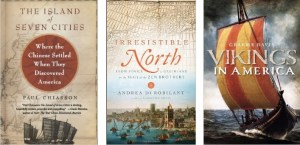
When the New World was being rediscovered by Europeans from 1492 on, it was much the same. Driven by politics, economics and the innate desire of humans to explore, not all went well. The early voyages were often about finding wealth and conquering lands. Later, though, it would be about building a better life, improving the human condition. The powerful desire to improve the existence of one’s family and future descendents has long been entwined with that frontier spirit. It’s often difficult to tell them apart. Interestingly enough, we would later learn that 1492 wasn’t the first rediscovery of what would later be named the Americas.

In 1000 A.D., the Vikings arrived in North America. It seemed almost inevitable that these quintessential seafarers and explorers would do just that. For centuries the sagas and rumors attesting to their arrival was largely discarded as myth. Then archaeological remains of a settlement were found in Canada in 1960.  Still, the idea of pre-Columbus explorers was seen as unlikely and supposed accounts quickly dismissed.

This was for two reasons: One, the level of required verified evidence is high. Is it too high? The Viking sagas told of exploring America, but were dismissed as legend. Even now, the extent of their exploration is unknown, but it is admitted that they voyaged to the coast for decades, if not longer. Only one settlement? These legendary warriors never ventured far from the beaches?

Two, early attempts to dismiss all natives as not much more than primitive cavemen saw many people ascribe anything of sophistication to foreign visitors. We now know the New World was replete with civilization and we know they arrived here longer ago than originally thought, through multiple paths. That paradigm shift has led many to wonder: Is it reasonable to think that people here for so long remained isolated from the rest world? A world that had many accomplished seafarers?  After all, didn’t the natives make it here at one point? Does any civilization live in isolation for over 10,000 years?

Of course, there are those who consider any suggestion of diffusion racist. They are driven by those who have, or still do, see natives as inferior. The other side of the coin are those who believe it did happen, repeatedly, and assert that it’s racist to say it couldn’t have happened.

So much for academic inquiry.

To be certain, the field has been full of fringe writers pushing many a bizarre theory or those motivated by ideology. Not all are so driven. Many are simply looking for the facts, some of which have always hidden in plain sight.

Sometimes it was intention, other times apparent chance, but in either case exploration burned in the souls of many men and women. What resulted wasn’t always good, but the overall condition of man usually improved. Does the fire of exploration still kindle? Are we too busy to see past tomorrow, buried in our televisions and self-created busyness?

Time will tell if humans will quit ignoring the calls to be something greater than what is pushed upon them. Modern steps into space are part of a long legacy that reaches back millennia. The crash of the Galactic won’t extinguish the flame.

It reminds us there are still those in which the fire still burns.
naex spcex

Categories: Ancient America, Ancient Sites, Books, History, Native Americans | Tags: , , , , , , | 2 Comments

Where’s Your Money Going?

Apparently convicted war criminals are.

Unfortunately, not really surprised. After all, the U.S. grabbed up quite a few Nazis after the war, scrubbed their past, and put them to work for the military. Even as some were being prosecuted at Nuremberg — in fact, before the war even ended — others were being vetted for the usefulness in the Cold War in what was called Operation Paperclip. And there began a decades-long policy with Nazis that still doesn’t make much sense.

Those not so valuable to the country were kept out or sent home. Some became exemplary rocket scientists, until someone decided certain ones should be prosecuted years after being effectively give a free pass. We still hunt down aged SS guards with a few years to live, yet many jailed after the war were released early in Cold War Europe to join the new cause.

Yet another lesson highlighting the government’s long downward spiral.

op

Categories: Books, History, Modern History | Tags: , , , | Leave a comment

13 Days to Halloween

Stores had Halloween decorations as early as August, and Christmas by October. Yes, we all know how nuts that is, but this isn’t about all that. This is about Halloween and its history (largely a re-post from last year).

What kids don’t like dressing up as superheroes or cartoon characters (or the old standby sheet as a ghost if you’re in a pinch) and collecting candy? The popularity of Halloween waxes and wanes with time and among people, but there’s much history behind it.

Halloween is technically part of Hallowmas, a three day Christian observance consisting of All Hallows’ Eve (Halloween), All Saints’ Day (All Hallows) and All Souls’ Day. Hallowmas is a time to remember all those who have departed this world. What does “hallow” mean? It’s derived from the Old English word halig, which means saint.

Some Christians object to Halloween because of the suspicion that it drew from the pagan holiday Samhain, but the connections are debated, other than using the same day. One has to ask, though, what does it matter? Christmas trees and Easter bunnies were reappropriated from nonchristian traditions. Crosses were popular in some pagan religions. In other words, we shouldn’t make the genetic fallacy and judge something on what it once was or how others celebrate it.

Because secular Halloween can be celebrated in a variety of ways by different people, some Christians have ceased recognizing it altogether. That’s fine, but asserting Halloween is simply a pagan or occultic festivity ignores a few centuries of Christian history (and have we all given up on Christmas as it has turned into an economic event for businesses?). I have also suspected that some groups perceive the Hallowmas days as Roman Catholic and have as such abandoned them. This too is in error, as many Protestant denominations still recognize these observances. In particular, All Saints Day has been fairly universal in large swaths of Christendom.

Fall festivals have replaced Halloween in other circles. These are actually another universal event among peoples of all beliefs, that reach into history. The last big hurrah before winter, a time to stock up on the summer’s harvest. So if Halloween is not celebrated because it’s “pagan,” why not apply that to fall fests? There’s nothing wrong with having such events (fall is the best time to have festivals, in my opinion), but don’t do it on false reasoning. I’ve seen some festivals that try to combine everything and come across as, “We want the kids to be able to do Halloween stuff, but we’ll call it something different.” Fall fests and Halloween are entirely two different things.

Perhaps there is a reason Christians should reclaim Hallowmas, instead of ignoring it. It’s a sad truth that we often avoid talking about those who have died. Out of a fear of sadness we fail to teach our children about those who came before them. Histories and people lost. It doesn’t have to be that way.

In fact, that’s what Halloween is all about.

Categories: History, Traditions | Tags: , , , , , | 2 Comments

History Uncensored, Remembered

We don’t have to always look towards fiction for powerful stories. Our own history is full of them. Many of the best, and the worst, you may have never heard.

When we are taught history in schools, it is condensed into names, dates and places. Rarely do we get to know the people involved. The result is a distant, impersonal past that seems like it never happened, nor is it relevant to the present.

Nothing could be further from the truth.

In Miracles and Massacres, Glenn Beck and others have pulled 12 stories from our past (though some not so long ago). Many are obscure, yet impact us to this day. Some show triumphs of our nation, and others its failures. Some of the failures have been hidden and remain unaddressed. All of these historical events provide valuable lessons for us in government, freedom and justice.

They also put faces to dry facts. When you tell a person’s story, it connects us to them. They are no longer a faded memory, an irrelevant soul. Not all of them are pretty with happy endings. Those are often the ones we shouldn’t forget. We all have a story. Some of those stories reach out from times forgotten begging to be heard.

And sometimes, we had best stop and listen.

Categories: Books, History, Modern History | Tags: , | 1 Comment

Raising Giza

The pyramids of Giza. The last of the Seven Wonders of the World. They have spawned endless speculation into the methods of their construction and purpose. Much of it bizarre: Aliens built it. It’s a power plant. A weapon. Vault of lost knowledge.

This all makes for a lot of absurd — I mean interesting — speculation. And occasional fun fiction. In this case, though, fact is far more interesting.

In The Secret of the Great Pyramid, Egyptologist Bob Brier chronicles the quest of architect Jean-Pierre Houdin to unlock the secret of the Great Pyramids assembly. Rather than resorting to stargates and levitation, Houdin looked at it with an eye honed by design and engineering: Moving and raising blocks is physics. No advanced math is needed. No spaceships either. That doesn’t mean it was easy.

Realize that Egyptians wrote about nearly everything, except how they built pyramids, which adds even more to their mystique. Brier recounts their history, which began with others before those at Giza. A bit of science, a bit of trial and error. Eventually it was perfected. I won’t reveal the details here, but it seems we may have long been looking for an answer too complicated. Sometimes simple is all that is needed.

Perhaps most fascinating is that pyramids came early in Egyptian history rather than later. We continue to learn that the ancients were quite intelligent. Too often we look back and down on those who have faded into history — “chronological snobbery” C.S. Lewis called it. They were smart, just had a different level of technology and knowledge base. Discoveries continue to show that mankind’s intelligence existed very early, if not from the beginning.

Our modern nations have existed for an eye-blink in time. Will we approach the longevity of ancient empires? Or will we be crushed under the weight of our misplaced stones?

So perhaps the pyramids carry a message after all.

pyr

Categories: Ancient Sites, History, Origins of Man, Prehistory | Tags: , , , , , , , | Leave a comment

Deal With the Devil: Operation Paperclip

Long a student of the history of space exploration, I knew of the Operation Paperclip (often called Project Paperclip) to bring rocket scientists to the U.S. after WWII from Germany. Never thought much about it until more studies on WWII and the Cold War started to reveal more about these scientists. Not all were innocents caught up in their nation’s war.

Some were part of the Nazi Machine.

Indeed, even when it was exposed in the ’40s that hundreds of these scientists, doctors and engineers were coming to America, protest was raised. It was largely too late. Records were scrubbed and classified. The people themselves remained quiet and evasive on the subject of their past until their death. While some Nazis to this day are hunted down in their old age, some were allowed to be free, in the open. Perhaps the most bizarre example of cognitive dissonance ever known, and widely at that. But most don’t know the whole story.

Annie Jacobsen remedies this in her new book, Operation Paperclip: The Secret Program that Brought Nazi Scientists to America. She isn’t the first to write on Paperclip, but perhaps the most thorough. She has brought new materials to light as more has become unclassified and through interviews with Paperclip family members and others with first hand knowledge.

I thought I knew a lot about the program, I didn’t. The twisted policy of chasing down prison guards in their 90s while other individuals were in effect acquitted. Some became American heroes. I have read of Von Braun and other rocket scientists who oversaw the V-2 production sites were thousands of prisoner-slaves died, but many know little of this. Jacobsen’s account will force you to look at our space heroes quite differently.

It wasn’t just the builders of rockets, however. Doctors involved in the Reich’s human experiments, experts in chemical and biological warfare and others were also spirited away by Paperclip. Most of these men lead productive lives contributing to our country. Others, though, were part of questionable state-sponsored activities here. In either case, Jacobsen writes this for us to ponder:

The question remains, despite a man’s contribution to a nation or people, how do we interpret fundamental wrong? Is the American government at fault equally for fostering myths about its Paperclip scientists — for encouraging them to whitewash their past…When, for a nation, should the end justify the means?

Categories: History, Modern History | Tags: , , , , , , , , , | Leave a comment

Blog at WordPress.com.