Prehistory

Destroyer of Worlds

“It is likely that hundreds of thousands of bodies, each capable of yielding a multimegaton explosion on Earth, are orbiting within the [Taurid meteor] stream.” – Victor Clube and Bill Napier, Cosmic Winter

Regular meteor showers are the periodic reminder we live in vast universe. For a few nights, they draw people away from their distractions to look at the heavens like their ancestors once did. What if these little fire balls have a darker history?

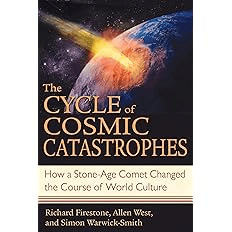
In Late October, the Taurid meteors often provide a little show — the Halloween Fireballs. These are the remnants of a fragmented comet that came apart 10,000 years ago. Lesser known are the June (or Beta) Taurids, when Earth passes through another part of this debris field. These are unseen since they occur during daylight hours.

They also may be the source of humanity’s near extinction.

As Earth emerged from the last Ice Age, something catastrophic interfered with climate cycles that persisted for hundreds of thousands of years. One result was the stable climate we now live in, which is a good thing, right? It is, unless the old cycles reassert themselves, or another disaster befalls us.

The bad part is the strong evidence comet fragments pummeled Earth during this apocalypse, the main impacts landing in North America, causing destruction around the globe. Humanity’s progress was set back centuries, if not more.

Could it happen again? Consider these other celestial events occurring during the June Taurids:

  • On June 25, 1178, an impact on the Moon created the massive Giordano Bruno crater.
  • On June 30, 1908, a fragment exploded over Tunguska in Russia, destroying 2000 square kilometers of forest. A few hours earlier, and Moscow would have been destroyed.
  • In late June 1975, a swarm of objects impacted the Moon.

Slightly different timing or trajectories, and these events could have had devastating effects on Earth. We aren’t out of the woods yet. Massive comet fragments are likely still floating in our orbit. Difficult to detect, but not impossible. Why isn’t planetary defense a higher priority, if not the highest? Why isn’t this a common cause among all humans?

Many stories come down to us telling of the time fire rained down from the heavens. Will we ever heed their warnings?

So next time you watch for meteors, or look to the sky every June, imagine what might be lurking in the darkness. Destroyer of worlds…
Categories: Prehistory | Tags: , , , , , , , , , , , , | 1 Comment

Europe’s Lost Civilization

For centuries, people have marveled and wondered at Stonehenge. Who built it and for what purpose? Yet, Stonehenge is only one of thousands of monolithic structures across Europe. Across many regions, over thousands of miles, do they share a common culture? Is there some ancient and lost people or tradition that began raising stones? And for what purpose?

Many reasons for the stone circles and similar creations have been put forth. Burials, religious and cultural ceremonies, or astronomical observatories. Perhaps the most intriguing possibility is some of these sites may have been used to send messages and preserve information.

Were they passing down history to their own people, or did they have a message for us?

The more these structures are studied, the more I am convinced a large slice of history is missing. A forgotten people, supposedly primitive, raised difficult monuments. Perhaps they weren’t as unadvanced as we thought. Recent decades have seen history rewritten as we learn not all stone age people were a step away from cavemen. There is still much we need to learn.

If you want to explore this lost world further, start with Standing with Stones, a documentary by the Prehistory Guys. Then try the two part Secrets of the Stone Age. For even more fascinating exploration, dive into The Memory Code and Stonehenge Complete.

Something amazing happened across Europe and the British Isles in a time lost to us. We could be only a turn of a shovel away from remembering what has been long forgotten.

Contact and connect with Darrick here. Watch for newsletter sign-up coming soon. Get your copy of Among the Shadows and find another purpose of Stonehenge. Will it lead you to Light? Or Darkness?

Categories: Ancient Sites, Forgotten Places, Prehistory | Tags: , , | Leave a comment

Is Humanity Doomed?

If you have ever read about our ancestors, you were probably taught that, at the end of the last Ice Age, the citizens of North America hunted the many species of megafauna (giant mammals) to extinction. After all, why not assume terrible humans are responsible for all that death?

As it turns out, evidence has been growing of a planet-altering catastrophe as the cause. Most likely an impact event centered over North America (which endured most of the extinctions), with indications of impact craters littered across the East Coast.

Why is this so fascinating? Because it reminded me of the tendency of some people to immediately blame humans for every terrible event to befall the planet. These are the same people, with their dour and glum outlook, whom have been predicting for decades, that we only have a decade or two before we destroy the planet, run out of energy, and starve to death.

Then the decades pass, and the apocalyptic scenarios do not. Continue reading

Categories: Ancient America, History, Native Americans, Prehistory | Tags: , , , , , , , , , | 1 Comment

Turn Right, and Meet Me in the Lost World

In my review of travel adventure books, we have searched for Sheba and explorers of the New World. We have also disappeared into the jungles of Latin America on the trail of lost cities. Now we will return to uncovering the ancient world.

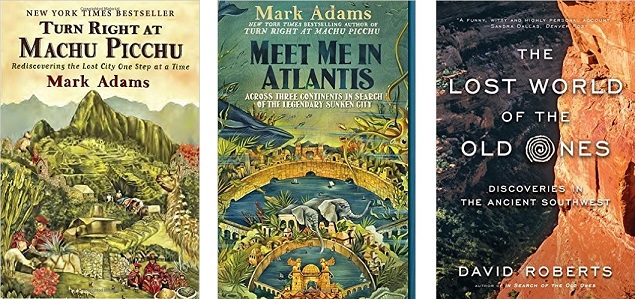
Mark Adams set a benchmark for travel adventure lit with his Turn Right at Machu Picchu. This fish-out-of-water follows the trail of legendary explorer Hiram Bingham who brought Machu Picchu, the hidden Inca mountain refuge, to the world’s attention. A perfect combination of Adams’ travails and history — every bit a page turner as a novel.

Adams followed this adventure up with Meet Me in Atlantis. Here he tries to hunt down the true experts of the legendary lost city, among a field known for, how should I put it, fringe thinkers. His hunt leads to many possibilities, and even though not as much adventuring as his first book, it is a refreshing change to the libraries full of bizarre Atlantis speculations.

Now we turn to David RobertsThe Lost World of the Old Ones where he continues his many years of hiking off-trail into the Southwest. Readers will be amazed at how much lies undiscovered and unknown about the civilizations that once populated these states. Roberts chronicles the politics, history and conflicting visions that have attempted to preserve the past — not always successfully. A fascinating and entertaining account that will remind people that United States has its own lost civilization still waiting for discovery

mcpic

Categories: Ancient America, Ancient Sites, artifacts, History, Native Americans, Prehistory | Tags: , , , , , , , , , , | Leave a comment

Raising Giza

The pyramids of Giza. The last of the Seven Wonders of the World. They have spawned endless speculation into the methods of their construction and purpose. Much of it bizarre: Aliens built it. It’s a power plant. A weapon. Vault of lost knowledge.

This all makes for a lot of absurd — I mean interesting — speculation. And occasional fun fiction. In this case, though, fact is far more interesting.

In The Secret of the Great Pyramid, Egyptologist Bob Brier chronicles the quest of architect Jean-Pierre Houdin to unlock the secret of the Great Pyramids assembly. Rather than resorting to stargates and levitation, Houdin looked at it with an eye honed by design and engineering: Moving and raising blocks is physics. No advanced math is needed. No spaceships either. That doesn’t mean it was easy.

Realize that Egyptians wrote about nearly everything, except how they built pyramids, which adds even more to their mystique. Brier recounts their history, which began with others before those at Giza. A bit of science, a bit of trial and error. Eventually it was perfected. I won’t reveal the details here, but it seems we may have long been looking for an answer too complicated. Sometimes simple is all that is needed.

Perhaps most fascinating is that pyramids came early in Egyptian history rather than later. We continue to learn that the ancients were quite intelligent. Too often we look back and down on those who have faded into history — “chronological snobbery” C.S. Lewis called it. They were smart, just had a different level of technology and knowledge base. Discoveries continue to show that mankind’s intelligence existed very early, if not from the beginning.

Our modern nations have existed for an eye-blink in time. Will we approach the longevity of ancient empires? Or will we be crushed under the weight of our misplaced stones?

So perhaps the pyramids carry a message after all.

pyr

Categories: Ancient Sites, History, Origins of Man, Prehistory | Tags: , , , , , , , | Leave a comment

Noah’s Ark Lands in Hollywood

Expensive biblical epics haven’t been a staple of Hollywood for decades, but this week saw the release of the first trailer of Noah which will hit theaters in early 2014.

Enter controversy.

Some like J.W. Wartick have written on concerns over possible “divergence from the Biblical story.” Fair enough, but I don’t have a problem with divergence, if it is in the sense Brian Godawa describes:

…there is nothing wrong with engaging in creative license, whether it is magical seeds or six-armed Watchers, or even Noah as a warrior. I don’t even think there is a problem in using non-biblical sources like the Book of Enoch or the Sumerian version of the Flood story, where unlike in the Bible, Noah receives dreams about the coming Deluge. The question is, does it support the spirit or meaning of the original story, or the original author’s intent. Bible believing Christians do not necessarily own this category of Biblical interpretation. The Bible doesn’t say what vocation Noah had before the Flood, only what he was afterward (a tiller of the soil). So if a Christian attacks the notion of Noah as a warrior shaman, he may really be illustrating his own cultural prejudice of the notion of a white bearded old farmer which is not in the Bible either…[bold mine]

However, Godawa does discuss quite a few concerns he had with an earlier draft of the script. Having only seen a brief clip of the movie, and not knowing how the script evolved or was edited, I’m not going to add or subtract from his analysis other than this: I do like how the film trailer does not depict Noah as a pastoral old man leading cute, Narnia-like animals into an ark. This Sunday School-fantasy version ignores the terror — and ultimately the point — of the account: Horrible evil is occurring in the world and mankind will be wiped out because of it. The actual story — an adult one — has been co-opted by preschoolers. Perhaps the film will spark debate on how shallow our take on Noah has become.

Hopefully, the filmmakers chose not to put modern agendas into an iconic account from the ancient world. There’s enough historical contextual sources to draw from, as Godawa does in his own novel on Noah. In a film of this budget, studios try not to be too offensive to anyone. It is a business after all. Then again, many big budget films failed in 2013.

Time will tell if Noah emerges under a rainbow or washes out.

Update [3/2/14, 3/17/14]: After continuing controversy over a film not released, Jerry A. Johnson, president of the National Religious Broadcasters (NRB), discusses Five Positive Facts and Five Negative Facts about the film. Johnson and the NRB were behind the recent press release from Paramount Pictures which states, “the feature film is a dramatization of the major scriptural themes and not a line-by-line retelling of the Bible story.”

Apparently the NRB thinks the Christian world is not intelligent enough to figure that out on their own. On the other hand, the “Sunday School-fantasy version” of Noah I discussed above that many envision in their minds is not “a line-by-line retelling of the Bible story” either.

And here, Dr. Hugh Ross looks at the biblical Noah account here and here. Or check out his new book that explores this and other issues of Genesis.

Update [4/3/14]: Here’s an interesting debate: Is Noah a Gnostic interpretation or not.

Categories: Ancient Documents, Bible, Prehistory | Tags: , , , , , , , , , , , , , , , , , , , | Leave a comment

Sunken Continent?

Scientists have found evidence of a lost land off South America. Sunken part of that continent? Or a completely unknown land from deep history?

It’s the kind of thing that fiction is made of.

Categories: Forgotten Places, Mysteries, Prehistory | Tags: , , , , , | Leave a comment

News From the Past & A Warning From Above

If you have completely lost interest in what the media chooses for news every night and in the daily papers, and the incompetence of the government makes you want to never turn the news on again, here’s some interesting recent stories:

The latest finds on Stonehenge indicate it started as a huge graveyard. Stonehenge’s importance for the dead has long been known, but these finds continue to roll back myths about aliens and druids building the ancient structure.

There’s a lot of empty space in Pacific Ocean and there has long been speculation of lost lands (and civilizations). Now the remains of a micro-continent scientists have named Mauritia have been found.

The Sahara continues to reveal North Africa was more than a desert in ancient times, giving up remains of stone age peoples.

And while the government can’t agree on what to waste our money on next, asteroids have been making a number of visits to Earth as of late. Impact events have changed Earth’s, and our, history in the past.

But, hey, Congress is busy buying each other’s votes and pretending they are looking out for you. You have nothing to worry about.

Categories: Ancient Sites, Forgotten Places, Prehistory | Tags: , , , , , | Leave a comment

Gilgamesh: The Warrior King

Brian Godawa has been writing a fascinating fantasy series that takes place in the ancient Near East. It began with Noah Primeval which was rooted in the question, “What was going on in the world that was so horrible that mankind needed destroyed?” The series continued with Enoch Primordial (actually a prequel), which centered around the enigmatic Enoch. A man barely mentioned in the biblical accounts, but because he never died, and the other books attributed to him recount many a strange event, he has long been a person of high speculation.

Godawa now steps out from filling in between the lines of the biblical accounts with Gilgamesh Immortal. Taking off from events in the Noah episode, the tale of Gilgamesh provides a link to storie Godawa has next that is centered around Babel. One can’t study Near Wast cultures in a vacuum, so bringing in the most famous character from that region’s legends that isn’t chronicled in the biblical accounts was a perfect idea. Gilgamesh, a king and warrior of Mesopotamia, rules his empire with an iron fist. He has everything. Then he encounters a Wild Man that is his equal in many ways, and better in others. He begins to realize there has to be something more.

He wants immortality.

There begins his quest to conquer the weak and silent gods of old. These fallen angels had largely been destroyed and contained during the Great Flood, but he seeks out their remnant. It’s a journey full of adventure and death, while one of the most sinister of these “gods” is about to re-emerge and try to take Gilgamesh’s kingdom.

This book, along with the others, have Godawa’s trademark fast-paced storytelling. Their combination of fantasy and history is a largely original take on the people and places they are centered around. He also draws on the elusive references to Nephilim, Watchers and “sons of god” in the bible and other writings. For centuries, people have debated exactly what these beings were. Essentially Godawa is saying, “Maybe these references aren’t so mysterious. Maybe all of the ancient legends of battling gods aren’t just myth. Perhaps there are kernels of truth in them. Maybe there is a reason that the ancient cultures believed in them so much.”

It’s an intriguing premise. Perhaps it sounds irrational in our supposedly advanced world. But it’s perfectly reasonable to ask why did the ancient world pay so much credence to such things? Was it all just because of active imaginations? Or have we left behind part of our history we chose to forget?

Godawa’s series not only entertains, it asks such questions. And it gives us one possible imagining of the answers. It could have happened like this.

Categories: Bible, Books, Fiction, Legend, Prehistory, Writing | Tags: , , , , , , , , , , | Leave a comment

Apocalypse Time

Here’s something to read while you are hunkered down in your bunker tonight waiting for the Mayan Apocalypse: 6 Real Threats Facing the US. Note the article doesn’t list the government’s poor responses to disasters or their driving us to a financial collapse…

It’s probably too late now, but The Mayan and Other Ancient Calendars is an informative little book on the ancient world’s time-keeping. Or for a more detailed examination of their skywatching, try Stairways to the Stars. This book is far more fascinating than those by people who pretend to know something about the Mayans.

There’s still time to go buy canned chicken. Hey, doesn’t hurt to be prepared. It’s not like the government is going to help you out whether it’s Mayans, snowstorms or whatever may come your way.

Categories: Native Americans, Prehistory | Tags: , , , | Leave a comment

Blog at WordPress.com.