Writing

Will Readers “Misunderstand” Your Book?

I wonder how much authors worry about how readers misunderstanding what their book is about. Its meanings, themes and intentions. Some authors might overcompensate by entering the story and explaining too much. This “author intrusion” often makes a character sound out of character or exposition sound like a lecture. Authors should realize not every reader is going to get, or like, everything you have written and that’s okay. A mature reader isn’t going throw down your book if he or she doesn’t agree with every sentence you write. They might do so if your book isn’t entertaining or is unreadable.

I mentioned in an earlier post on how modern readers like to reinterpret older books (in that case Dracula) through modern eyes. When an author is still living, or wrote about their books, it’s always best to default to their explanations. After all, they wrote the book. J.R.R. Tolkien’s The Lord of the Rings is brimming with themes and meaning, but it was no allegory. The author wrote:

There is no ‘symbolism’ or conscious allegory in my story…To ask if the Orcs ‘are’ communists is to me as sensible as asking if Communists are Orcs.

Devin Brown continues by asking, “Don’t they share a number of similarities? [along with Sauron/Hitler, etc.] Of course they do.” But he adds what Tolkien explained, “I think many confuse ‘applicability’ with ‘allegory.'”

Of course, “everyone knows” C.S. Lewis’ The Lion, the Witch and the Wardrobe was an allegory. Everyone forgot to tell C.S. Lewis. He said he never intended to write an allegory, the story unfolded as it did. He also wrote:

As we know, almost anything can be read into any book if you are determined enough…[the author] will find reviewers, both favorable and hostile, reading into his stories all manner of allegories which he never intended. (Some of the allegories thus imposed on my own books have been so ingenious and interesting that I often wish I has thought of them myself.)

So focus on writing your story. Understand not everyone will like it or get all the wonderful things you are trying to get across. Nor should you attempt to appease everyone or your story will most likely end up not being very interesting. Make your tale organic and entertaining. Use the tools you have to improve your craft.

Because ultimately the mythos you create is yours and someone out there wants to enter it.

Categories: Books, Writing | Tags: , , , , , , , | 2 Comments

Book Price Wars: 2015’s Publishing Battleground?

There’s concern that the price wars started by indie writers may come back to haunt them. Here’s the scoop: Indie authors are able to sell their books for at a much lower price than traditional publishing. You’re basically buying right from the source with minimal overhead. The issue is that if traditional publishers lower prices, more competition for indies. Maybe not.

For one, there is always competition, traditional or otherwise. Just walk into a bookstore or browse Amazon. Millions. It’s about — regardless of how you publish — connecting with audiences with a strong, quality product. Two, I’ve seen many of these “low” prices jump back up. Perhaps not as high as retail, but still up. Holiday pricing, perhaps? The idea of having a sale seems to be a new thing for some publishers. How low can traditional publishers really go? Sure, on a super runaway bestseller they can afford some sales or lower prices. Or they can say, “This is a bestseller, people are going to buy it regardless.” And, of course, the lower the traditional publishers go with pricing, the less their authors get.

That’s why indie authors still have an advantage when it comes to revenue (not that writing books is a get-rich scheme). There are other factors at work here, but ultimately I think indies, e-books and technology will continue to transform the industry. Where the equilibrium will occur, I’m not sure. There’s room for all publishing models, but we are seeing a settling of which is good for whom.

Categories: Books, Writing | Tags: , , , | 2 Comments

Humans Are Not The Mere Mortals They Believe Themselves to Be…

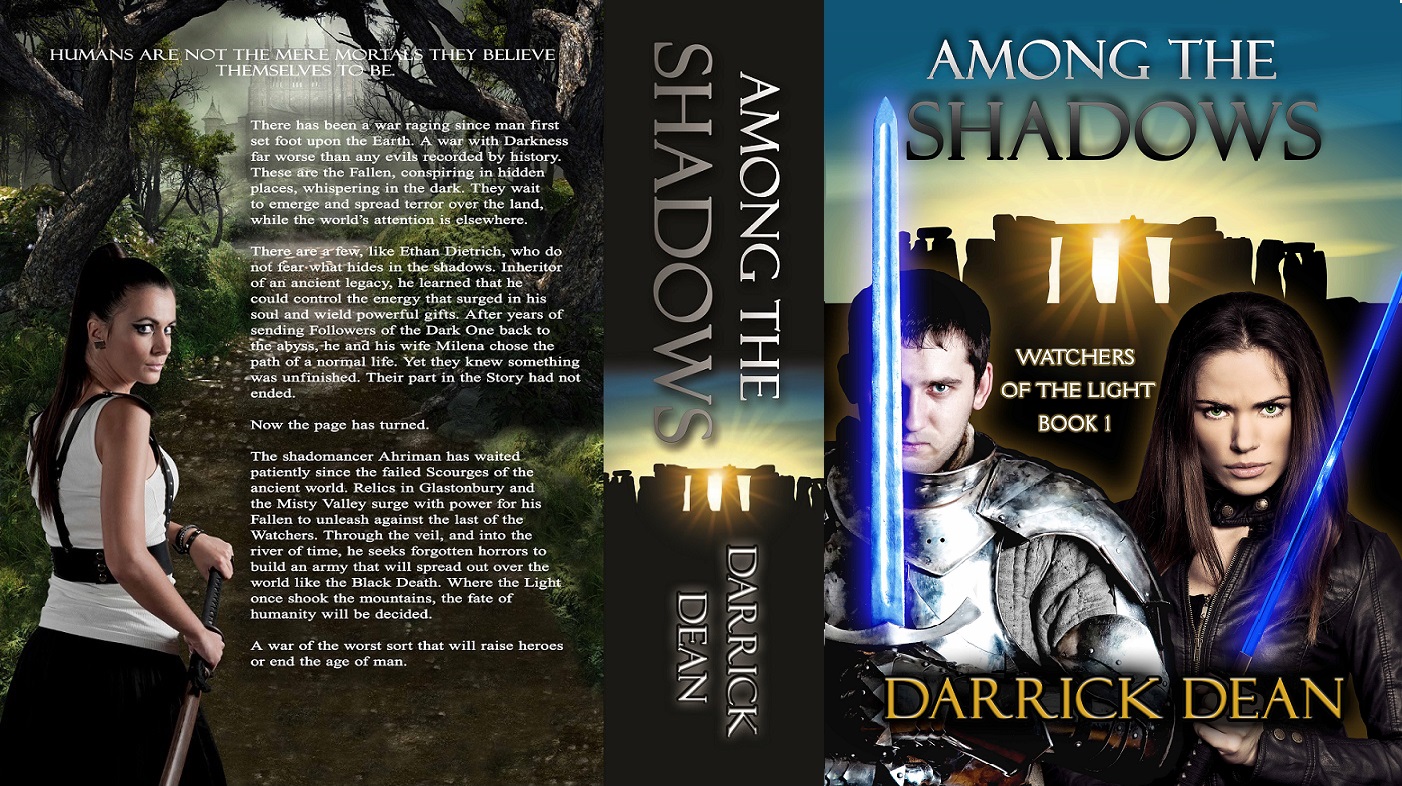
I released the first look at the cover of my book Among the Shadows earlier this month. I thought the copy on the back cover was a little long, so here I have trimmed it back (about 40 words) and made some other adjustments. For many authors, especially indie authors who control the cover design, the cover is an afterthought. This is a mistake. Yes, we are all told not to judge a book by its cover. That isn’t a bad bit of advice, but we live in a visual world. When readers are browsing hundreds of books on-line, a cover should at least make them stop and look. It should be relevant to the story, that is, not just something wild and unrelated to trick them. And just enough plot to let them know about the world they’re about to jump into (without giving away its secrets).

12-27-14-1background-official words3(1)

Categories: Books, Fiction, Writing | Tags: , , | 1 Comment

Making the Pitch

I’m always surprised what I find on a back cover. Sometimes no description, the giving away of plot points or it tells you how great the book is. That’s why I found Maria Murnane‘s post right on target. After spending so much time on your book, shouldn’t the cover copy be right?

Nor should you forget how important your Elevator Pitch is to explaining what your book is about to people, in an elevator or otherwise. This is also known as your Quick Pitch. Don’t neglect the little things that will sell your book. Very rarely is someone going to do it for you. Think Guerrilla Marketing. It can be work, but finding work you enjoy, rather than just having a “job,” is part of why you do this. As Rose Robbins writes:

But when you find work that actually makes you happy, work that makes you wake up in the morning excited at the prospect of getting back at it, HOLD ON TO THAT…focus on it, make the most of it, do your very best at it.

Categories: Writing | Tags: , , , | Leave a comment

Writing 101

Many of you just finished National Novel Writing Month, and if you finished, now it’s time to buckle down and start editing. So here’s a collection of my favorite writing posts: Outlining, Flashbacks, Storytelling vs. Writing, Being Entertaining & Thoughtful and Showing & Telling.

Share your own or from other sites and then get to work!

P.S. And if you haven’t seen it yet, click here, or just scroll down, for the cover reveal of Among the Shadows.

Categories: Writing | Tags: , , , | Leave a comment

Cover Reveal: Among the Shadows

Here it is:

fullcv5

“The Studio” has been making some adjustments over the past few days and I think we got it. When will it be released? Still in editing, so let’s just say 2015 for now. Updates and previews to be forthcoming. Some background on the cover: I took a look at a lot of the great artwork being used on fantasy books, but since this series is rooted in our time, some real people were in order.

So the question is where does myth end and history begin?

Cover Credit: Images and artwork from Shutterstock.com and digital work by K.D.

Categories: Books, Fiction, Writing | Tags: , , | 3 Comments

Should I Show or Should I Tell?

This is the dilemma that most all fiction writers face. Many readers, unless they are writers or editors, probably wonder what the big fuss is all about. “Why are writers always arguing over this?” they ask. What is the big deal, anyway? James Scott Bell defines the issue for us:

Showing is like watching a scene in a movie. All you have is what’s on the screen before you. What the characters do or say reveals who they are and what they’re feeling. Telling, on the other hand, is just like you are recounting the movie to a friend. Which renders a more memorable experience?

Easy enough. Sort of. Some telling is obvious, such as when you describe a character in a grocery list fashion:

Kelly was 5’2″, had long blond hair, blue eyes and always wore black boots.

Try this instead:

When Kelly sat to pull on her black boots, her blond hair fell around her. What a mess it is today. She loved her boots, they made it easy for her to pretend she wasn’t short. Hopefully, she would run into Kane again at work. Yeah, that comment about her blue eyes was a little corny, but hey, at least he noticed.

Both are grammatically correct (though not necessarily high literature), but which sounds more interesting? Which is more like something you would write in second grade? And maybe the second attempt isn’t perfect showing, but it gets you into the head of the character and tells the reader a thing or two about her.

That is one of the keys to show vs. tell: Is the author intruding into the story? Whereas brief telling can transition you quickly from one scene to the next, or can be used to describe a new world, does the latter sound like the author is launching into a documentary? Or does it sound like you are seeing, or possibly seeing, everything through the character’s eyes?

You may have a lot of cool things to tell your reader, but make sure it doesn’t sound like a PBS special. Your character (or the author), even if he is (or you are) a professor, shouldn’t suddenly launch into a chapter length discussion on whales. Wait, didn’t Melville do that in Moby Dick? Telling wasn’t always so taboo, but there is a reason why the whale chapter is the most skipped in that otherwise classic tome. And then there is they way Edgar Rice Burroughs ended his last Pellucidar novel. After all that adventure, we’re going to end it like that?

Here’s something that will help writers: Jeff Gerke has a handy tool for determining if your writing is telling too much. Ask yourself if a camera can see the scene. Could this appear on the screen? If the answers are no, then you have too much telling.

There are writers who argue telling is fine. Others say it’s all a matter of when, where, why and how. Certain genres tend to have more exposition than others. Some telling certainly can come off as poor or lazy writing, especially once you learn to spot it. You’ll be surprised how often you notice it.

One should always try to hone what ever their craft may be, but part of being is writer is deciding what you want to write and how to do it. Not every one will like your work — and you shouldn’t set out to make everyone happy — but immersive books are the ones that stay with people long after the cover is closed.

They’re also ones that readers don’t skip or skim chapters.

Categories: Writing | 1 Comment

Can Your Book Entertain and be Thoughtful?

Robert Bidinotto recently wrote:

…one cardinal rule, taught by many fiction instructors, is: Avoid expressing your personal views about politics, religion, and other controversial issues in your fiction. Your job as a novelist, they say, is solely to entertain—not to “preach.” If you get up on your soap box, you’ll only alienate many potential fans. To attract a broad readership, you should suppress the desire to push divisive “agendas.”

True art, which writing is, doesn’t shy away from controversy. How it is presented, however, is what sets apart good writers from the not so good. The not so good come off as preachy, overbearing or use drive-by attacks. You know the scenes, Robert does too:

In static scenes on porches, in drawing rooms, and around dinner tables, characters don’t converse; they deliver speeches and soliloquies. Too often, these wooden, one-dimensional “characters” are little more than premises with feet.

It doesn’t have to be way. The trick is to incorporate issues and ideas organically into the story:

I rejected the belief that there’s an inherent contradiction between entertaining fiction and thought-provoking fiction…I think many opinionated writers fail to entertain because they engage in extraneous pontificating, rather than make their ideas integral to the stories themselves. The trick is to weave a provocative theme or premise into the very fabric of your story, making it the thread that connects your characters to each other and to the events of the plot.

So when writing your stories, look for the characters who start speaking like a professor or some sort of activist. Sure, you have stuff rattling in your head you want to tell people. Everyone does. We all have strong beliefs. No one is going to listen if we lecture them. However, if you explore it thoughtfully, making it integral to your story, then even those who disagree with you will not be turned away. Most of them anyway.

You can’t make everyone happy, but you shouldn’t sacrifice your integrity either.

Categories: Books, Fiction, Writing | Tags: | 1 Comment

Indie Authors Continue to Change Publishing

This time it is publishers of Christian fiction taking notice. Indie authors are here forcing “the industry to adapt,” going beyond the “typical guidelines used to frame the culture’s concept of Christian fiction” and not limited by “genre restrictions.”  In other words, giving readers more choices.

Categories: Books, Fiction, Writing | Tags: , , | Leave a comment

Beware of Pirates

Since the World Wide Web made the Internet a button-click away from anyone, piracy (stealing) of others works has been a very easy occupation. Music downloads has been at the forefront of theft. Now, the proliferation of e-books has made books an easy target. If you don’t get what the big deal is, think of it this way: You spend weeks or months at your place of employment on a project. At completion, your company uses your work but doesn’t pay you. You’d be a bit upset and have some trouble paying the bills. Contrary to popular belief, most writers aren’t rolling in dough.

Robert Bidinotto wrote on this recently, ending with:

I hope readers tempted to download from a pirate site will pause to realize what will happen if your favorite writers finally give up, because piracy no longer makes it possible for them to write for a living. Ebooks aren’t expensive; in fact, they provide more value for their price tags than any other form of entertainment and information. Please remember that, and honor the authors who work so hard to provide you those values by purchasing their works only from authorized sites.


Categories: Books, Writing | Leave a comment

Create a free website or blog at WordPress.com.