What Would You do for a Review?

The on-line world has changed publishing: E-books, access to millions of books, independent publishing. It has also brought with it “fake reviews, purchased reviews, review-swapping schemes, attack reviews.”

Robert Bidinotto discusses this in his most recent post. He lays out his policies for reviewing books, posting reviews and asking for reviews. A very good set of points that all authors should adopt.

Categories: Uncategorized | Tags: , | Leave a comment

Are You Prepared?

It’s National Preparedness Month and I can’t help to wonder why something so simple is so overlooked by many. Just look how quickly shelves went bare a few weeks ago when water supplies went bad in northern Ohio. Or how people wipe out the bread, milk and toilet paper in the face of a two day snow storm.

Sometimes I wonder how civilization made it this far. What would happen in a far larger, sustained disaster? It doesn’t take much time or money to prepare. I don’t mean you have to be one of those hardcore prepper types, but could you and your family make it a few days without electricity and access to stores? Would your life break down and spiral out of control without a phone and the internet? What would you eat and drink? If it is winter, how would you heat?

sur

Fiction is littered with apocalyptic tales of survival. These imagine what would happen in a complete collapse. What attracts so many to these tales is that they are way to explore the best, and worst, in man.

end

They also serve as a warning: Pay attention. Don’t get lost in the useless and let others be responsible for the direction of yourself, your nation or humanity. Don’t take life for granted. Many a civilization has fallen, ones far older than our own. We think ourselves as unsurpassed in intelligence and greatness.

So did they.

Categories: Books, Fiction, What You Can Do, Writing | Tags: , , , , , , , | Leave a comment

Lost on Venus

While Mars gets all the attention in sci-fi, Edgar Rice Burroughs (of course) penned a five volume series back in the day (1930s) and has been the epic adventure on the clouded planet ever since.

He uses his classic formula: Earth man lost on another world, meets the girl of his dreams (native of the other world), must face peril after peril, often losing and rescuing his girl in the process. In spite of being a well-used plot in his books — and an archtype for much of pulp fiction that would come later — he creates fresh backdrops of alien cultures and beasts. One can detect allusions to nations or ideologies of our own world in his creations, yet he’s always subtle, never in your face with parallel meanings.

Is there anything wrong with an entertaining story that lets the reader disappear into another world? Must every book be on some sort of crusade? No, but all good books have some depth to them. Others try too hard and come off unintelligent to the thoughtful reader. Yes, there are those who like books that explicitly affirm their worldviews, no matter how poor the presentation.

Burroughs’ books, however, decades after they were written remain fresh, relevant and, above all, entertaining.

venus

Categories: Books, Fiction, Writing | Tags: , , , | 1 Comment

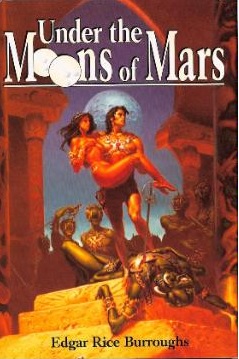
Under the Moons of Mars

Mars has always weighed heavy on man’s imagination. Since ancient times, the red planet has hung in the sky taunting us. Before space probes revealed it to be a dead world, it was where many authors set their adventures. Even afterwords, it has still lured writers there. First Burroughs and Bradbury explored the races among the red canyons and hills of the dying world. Even much later, Ben Bova’s manned mission to Mars found hints of a lost civilization.

John CarterBradburyBova

Perhaps the allure of Mars stays strong, in spite of being empty of cities and canals, because it still is seen as the most livable planet after Earth. That’s not saying much, considering how quickly one would die on its surface. But as planets go, it has resources that can be converted to fuels and supplies. And even better, perhaps it can be terraformed into a livable planet as outlined in Kim Stanley Robinson’s epic Mars Trilogy (starting with Red Mars). Robert Zubrin, in his The Case for Mars, describes how we can get there and why we should.

RobinsonZubrin

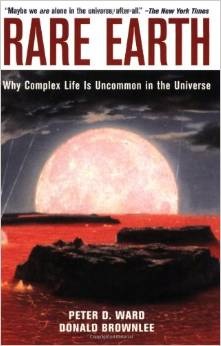
Recent years have seen a growing armada of robots to Mars. It is obvious that its ancient hold on us has not gone away. While many people can’t break away from their televisions, the distant red sands still call on that part remaining inside of many humans that wants to explore and push our race forward out of the mud. Yes, there are those alien enthusiasts who get excited every time a rock looks like a “bone” or something and then conspiracy theories come out of the woodwork. Sorry, as much as we would like otherwise, Mars has not been hospitable to complex life even in the best of times. In fact, the universe is likely very barren. Most people look out at all the stars and think, “There must be millions of worlds out there teeming with life!” Yet, even statistics must yield to physics. The requirements for life are so specific and narrow, there are few places out there that could harbor others like us (or unlike us).
Rare EarthTGHCosmos

Some think it depressing we may be all alone. Others still think advanced aliens are flying here in little ships that buzz cars in remote locations and crash a lot. Then perhaps, as many have suggested, maybe because we are here against impossible odds, we are special after all?

Even after all these centuries, Mars still calls on us to find our place and purpose in the universe. That is why writers will still explore the red sands until others finally set foot where water once flowed.

Categories: Uncategorized | Tags: , , , , , , , , , , , , , | Leave a comment

Burroughs’ Dystopian Earth

Edgar Rice Burroughs is best known for his pulp-sci-fi Barsoom series (John Carter of Mars) and Tarzan. His swashbuckling heroes and their over-the-top adventures influenced countless authors and movies ever since. He’s not known for dystopian tales like those so popular today. Yet, before Orwell and Huxley, he wrote one, a lesser known book, The Moon Men.

A sequel to The Moon Maid, it takes a decidedly different tone than that volume. Maid is the typical Burroughs adventure: Hero finds himself in perilous situations, always perseveres and rescues the girl in the end. In Men, Flash forward a few centuries after these events, and we find Earth invaded and conquered.

Earth, after its own wars, had created “peace” by disarming all. The world’s militaries also all abandoned. A world lulled into a false Eden, ripe for someone to take advantage of it. What follows is a subjugated population who worships in secret, books are rare and people are stolen by those aligned with the invaders. Fall out of line and face death and being fed to the alien race. But Julian has had enough.

Burroughs, writing in the 1920s, had seen the destructive Great War and writes of the follies of war in the first book, but also of the futility of pretending evil is conquered and peace can be forced. He then shows how tyranny can begin to falter because of one man. The master of pulp fiction showed that this genre could give us as much to think about as any “literary” work.

And any worthwhile book should entertain and make us think.

pyr

Categories: Books, Fiction, Writing | Tags: , , , , | 4 Comments

Amazon a “Market Disruption” for Publishers

The war between Amazon (who has led the wholesale changes seen in publishing in recent years) and traditional publishers (currently Hachette Book Group) has come to a head over e-book pricing. Hachette’s position is that they have the author’s best interests at heart, but indie writers argue otherwise. One of them, Robert Bidinotto, explains that there is more to the story:

…even though publishing contract terms (including advances, royalties, and rights) are simply awful for 99% of authors, a relative handful of Big Name Authors do in fact benefit disproportionately from their alliances with Big Publishing. These “one-percenters” (to borrow a term from current political parlance) get extravagant advances from the publishing houses — advances so large that they don’t care much about other contractual terms, such as royalties and subsidiary rights, which other authors must endure. They have a huge vested interest in keeping the publishing industry frozen in amber, exactly as it is. As marquee figures in the industry, these Big Name Authors also dominate prominent writers groups, such as the Authors Guild. So, when such individuals and groups issue statements, purporting to speak for authors generally, you can be sure that they are really only representing their own narrower interests.

You can read the complete post at his site and the petition that supports the Amazon side. Bidinotto also writes, “Look, I have no problem, in principle, with publishers. If they really did what they promise to do — take the burdens of editing and publication off writers, compensate them reasonably, and market them creatively and intelligently — I think many more authors would be happier than they are now. A number of small presses still do this.”

And that is truly what is at the heart of the debate. It isn’t that Big Publishing is evil or that no authors ever succeed with them or that no one but bad authors indie publish. Once writers had another path to publish their works, they were free to question the system that usually left them with the least return. If big deals come along, that’s great, but most writers would be happy to pay the bills and make a living. And most don’t.

The industry is changing. The death of many bookstores has shown us that. If traditional publishers don’t change, will they follow the same path?

P.S. For an example of how some in traditional publishing are adapting, see the October issue of Writer’s Digest in which “The Evolving Agent” details how agents are joining the digital era.

Categories: Books, Writing | Tags: , , , | 1 Comment

Bad Deeds

Tired of the System run by the corrupt that protects the corruption? You could call Batman. Or you could find Dylan Hunter.

In Robert Bidinotto‘s Hunter, we were introduced to investigative reporter Dylan Hunter who has, let’s just say, a bit of a past. Nor does he like when the criminal element gets away with murder.

In Bad Deeds, we find Hunter and his woman friend Annie on a much needed holiday in the towering forests of northern Pennsylvania. It’s not long before they find themselves in a middle of a war as ecoterrorists attempt to take down the evil corporate gas drillers. Soon, the trail leads to the cesspool of corruption known as Washington, DC, where the Hunter finds himself up against those who will do anything to cling on to power. They believe themselves untouchable. Hunter may have a thing or two to say about that.

Is this second installment, Bidinotto has built on the first and taken the story to a new level, as any sequel should. Readers find themselves in a “ripped from the headlines” tale that is all too plausible. Political games and money trails are all too the norm in our world. As are cover-ups and the near immunity of politicians from the rules the rest of us play by. This all unfolds in a page-turning fashion that exceeds Hunter’s last adventure. Of course, in the tradition of all memorable thrillers, Hunter finds himself in some over-the-top situations. At the same time, there is much to provoke thought in the thinking reader. When will more people become fed up with the status quo? Maybe not necessarily in the way Hunter goes about justice.

Then again, when are we going to stop letting the corrupt define justice?

pyr

Categories: Books, Fiction, Writing | Tags: , , , | 1 Comment

Raising Giza

The pyramids of Giza. The last of the Seven Wonders of the World. They have spawned endless speculation into the methods of their construction and purpose. Much of it bizarre: Aliens built it. It’s a power plant. A weapon. Vault of lost knowledge.

This all makes for a lot of absurd — I mean interesting — speculation. And occasional fun fiction. In this case, though, fact is far more interesting.

In The Secret of the Great Pyramid, Egyptologist Bob Brier chronicles the quest of architect Jean-Pierre Houdin to unlock the secret of the Great Pyramids assembly. Rather than resorting to stargates and levitation, Houdin looked at it with an eye honed by design and engineering: Moving and raising blocks is physics. No advanced math is needed. No spaceships either. That doesn’t mean it was easy.

Realize that Egyptians wrote about nearly everything, except how they built pyramids, which adds even more to their mystique. Brier recounts their history, which began with others before those at Giza. A bit of science, a bit of trial and error. Eventually it was perfected. I won’t reveal the details here, but it seems we may have long been looking for an answer too complicated. Sometimes simple is all that is needed.

Perhaps most fascinating is that pyramids came early in Egyptian history rather than later. We continue to learn that the ancients were quite intelligent. Too often we look back and down on those who have faded into history — “chronological snobbery” C.S. Lewis called it. They were smart, just had a different level of technology and knowledge base. Discoveries continue to show that mankind’s intelligence existed very early, if not from the beginning.

Our modern nations have existed for an eye-blink in time. Will we approach the longevity of ancient empires? Or will we be crushed under the weight of our misplaced stones?

So perhaps the pyramids carry a message after all.

pyr

Categories: Ancient Sites, History, Origins of Man, Prehistory | Tags: , , , , , , , | Leave a comment

Are you Tired?

The person ahead of you is just as tired. The one who gives up last will come first.Neila Rey

Categories: Uncategorized | Tags: , | Leave a comment

Of Martians and Details

Have you ever read a book where you feel like you are bogged down in a swamp? The author wants to tell you every little detail of his or her world. The color of every last button, the exact feel of every object, every inch of every person in vivid color. It’s as if they are afraid the reader will perceive something, anything, different from what was imagined in the author’s mind.

It’s true that too little detail is boring. Just as certain is that not allowing a story to breathe, to capture the reader and bring them in, is just as boring. It doesn’t take a lot of detail to paint a picture in the mind. A perception. A feeling. An immersive book doesn’t have to be 200,000 words long. Fewer and purposefully chosen words can ignite the reader’s imagination, draw them inside and propel them forward.

One of my favorite books is Ray Bradbury’s Martian Chronicles. Relatively short, it’s a collection of short stories, mostly connected only by the Martian setting. But Bradbury’s descriptions of the ancient, dead (or dying) Martian world leave an impression in one’s mind, one that stays with you long after. Maybe each reader’s image in their mind’s eye of the red planet is a little different in reading these stories. Yet long after they forget every exact word, character and event, the mere mention of the book brings up imagery and feeling like a memory of place actually walked.

And that is one of the traits that distinguishes remembered books from those forgotten.

Martian Chronicles

Categories: Books, Fiction, Writing | Tags: , | 2 Comments

Blog at WordPress.com.