Books

The Fire of Exploration

Exploring the final frontier has never been easy. For decades, in fits an spurts, we have explored the Solar System and established manned outposts in orbit. We even reached the Moon, which has been so long ago now, that it seems a dream.  We can probably blame the tortoise pace of space exploration on it being largely controlled by the government and their ever changing, and short-sighted, whims. In recent years, private companies have taken up the torch. As witnessed by this week’s crash of the spacecraft Galactic, exploration on the edge of frontiers is still fraught with danger.

It always has been and always will be.

When the New World was being rediscovered by Europeans from 1492 on, it was much the same. Driven by politics, economics and the innate desire of humans to explore, not all went well. The early voyages were often about finding wealth and conquering lands. Later, though, it would be about building a better life, improving the human condition. The powerful desire to improve the existence of one’s family and future descendents has long been entwined with that frontier spirit. It’s often difficult to tell them apart. Interestingly enough, we would later learn that 1492 wasn’t the first rediscovery of what would later be named the Americas.

In 1000 A.D., the Vikings arrived in North America. It seemed almost inevitable that these quintessential seafarers and explorers would do just that. For centuries the sagas and rumors attesting to their arrival was largely discarded as myth. Then archaeological remains of a settlement were found in Canada in 1960.  Still, the idea of pre-Columbus explorers was seen as unlikely and supposed accounts quickly dismissed.

This was for two reasons: One, the level of required verified evidence is high. Is it too high? The Viking sagas told of exploring America, but were dismissed as legend. Even now, the extent of their exploration is unknown, but it is admitted that they voyaged to the coast for decades, if not longer. Only one settlement? These legendary warriors never ventured far from the beaches?

Two, early attempts to dismiss all natives as not much more than primitive cavemen saw many people ascribe anything of sophistication to foreign visitors. We now know the New World was replete with civilization and we know they arrived here longer ago than originally thought, through multiple paths. That paradigm shift has led many to wonder: Is it reasonable to think that people here for so long remained isolated from the rest world? A world that had many accomplished seafarers?  After all, didn’t the natives make it here at one point? Does any civilization live in isolation for over 10,000 years?

Of course, there are those who consider any suggestion of diffusion racist. They are driven by those who have, or still do, see natives as inferior. The other side of the coin are those who believe it did happen, repeatedly, and assert that it’s racist to say it couldn’t have happened.

So much for academic inquiry.

To be certain, the field has been full of fringe writers pushing many a bizarre theory or those motivated by ideology. Not all are so driven. Many are simply looking for the facts, some of which have always hidden in plain sight.

Sometimes it was intention, other times apparent chance, but in either case exploration burned in the souls of many men and women. What resulted wasn’t always good, but the overall condition of man usually improved. Does the fire of exploration still kindle? Are we too busy to see past tomorrow, buried in our televisions and self-created busyness?

Time will tell if humans will quit ignoring the calls to be something greater than what is pushed upon them. Modern steps into space are part of a long legacy that reaches back millennia. The crash of the Galactic won’t extinguish the flame.

It reminds us there are still those in which the fire still burns.

naex spcex

Categories: Ancient America, Ancient Sites, Books, History, Native Americans | Tags: , , , , , , | 2 Comments

Can Your Book Entertain and be Thoughtful?

Robert Bidinotto recently wrote:

…one cardinal rule, taught by many fiction instructors, is: Avoid expressing your personal views about politics, religion, and other controversial issues in your fiction. Your job as a novelist, they say, is solely to entertain—not to “preach.” If you get up on your soap box, you’ll only alienate many potential fans. To attract a broad readership, you should suppress the desire to push divisive “agendas.”

True art, which writing is, doesn’t shy away from controversy. How it is presented, however, is what sets apart good writers from the not so good. The not so good come off as preachy, overbearing or use drive-by attacks. You know the scenes, Robert does too:

In static scenes on porches, in drawing rooms, and around dinner tables, characters don’t converse; they deliver speeches and soliloquies. Too often, these wooden, one-dimensional “characters” are little more than premises with feet.

It doesn’t have to be way. The trick is to incorporate issues and ideas organically into the story:

I rejected the belief that there’s an inherent contradiction between entertaining fiction and thought-provoking fiction…I think many opinionated writers fail to entertain because they engage in extraneous pontificating, rather than make their ideas integral to the stories themselves. The trick is to weave a provocative theme or premise into the very fabric of your story, making it the thread that connects your characters to each other and to the events of the plot.

So when writing your stories, look for the characters who start speaking like a professor or some sort of activist. Sure, you have stuff rattling in your head you want to tell people. Everyone does. We all have strong beliefs. No one is going to listen if we lecture them. However, if you explore it thoughtfully, making it integral to your story, then even those who disagree with you will not be turned away. Most of them anyway.

You can’t make everyone happy, but you shouldn’t sacrifice your integrity either.

Categories: Books, Fiction, Writing | Tags: | 1 Comment

Where’s Your Money Going?

Apparently convicted war criminals are.

Unfortunately, not really surprised. After all, the U.S. grabbed up quite a few Nazis after the war, scrubbed their past, and put them to work for the military. Even as some were being prosecuted at Nuremberg — in fact, before the war even ended — others were being vetted for the usefulness in the Cold War in what was called Operation Paperclip. And there began a decades-long policy with Nazis that still doesn’t make much sense.

Those not so valuable to the country were kept out or sent home. Some became exemplary rocket scientists, until someone decided certain ones should be prosecuted years after being effectively give a free pass. We still hunt down aged SS guards with a few years to live, yet many jailed after the war were released early in Cold War Europe to join the new cause.

Yet another lesson highlighting the government’s long downward spiral.

op

Categories: Books, History, Modern History | Tags: , , , | Leave a comment

Orwell and Huxley, Who Was Right?

George Orwell and Aldous Huxley wrote two of the most prophetic warnings in fiction, 1984 and A Brave New World, respectively. Orwell foresaw a world where classic government oppression would erode democracy. In Huxley’s vision, he depicted humanity controlled by pleasure and distraction. It would seem that, to our dismay, they both got it right. Orwell’s Big Brother government is increasingly a reality at the same time Huxley’s populace’s lives are controlled by the trivial and consumerism.

They wrote their books as warnings. Most people weren’t paying attention.

If you are someone who wanders through life day-to-day, driven by wherever the winds blow you, these books are for you. If you are someone who thinks the elite few who run the governments are out there upholding your rights and looking out for you, first, where have you been? Second, these books are for you.

And if you are someone who thinks about the legacy we leave to generations yet to come, unlike our rulers who think election to election, these books are for you as well.

There are always those who look truth straight in the eye and ignore or dismiss it. They don’t want to ask questions or be questioned. Otherwise reasonable people who don’t want to upset their life and the cognitive dissonance they have created. It’s just hysteria or a conspiracy. It can’t happen here.

Until it does happen to them or someone they know. Then it’s a shock. A surprise.

Orwell and Huxley asked us to pay attention to signs. Think like adults. They knew what the corruption of men could lead to, right here, not in some far away place.

Their fiction has become fact. That is an inheritance we don’t want to leave the future.

Categories: Books, Fiction | Tags: , , | Leave a comment

Indie Authors Continue to Change Publishing

This time it is publishers of Christian fiction taking notice. Indie authors are here forcing “the industry to adapt,” going beyond the “typical guidelines used to frame the culture’s concept of Christian fiction” and not limited by “genre restrictions.”  In other words, giving readers more choices.

Categories: Books, Fiction, Writing | Tags: , , | Leave a comment

Beware of Pirates

Since the World Wide Web made the Internet a button-click away from anyone, piracy (stealing) of others works has been a very easy occupation. Music downloads has been at the forefront of theft. Now, the proliferation of e-books has made books an easy target. If you don’t get what the big deal is, think of it this way: You spend weeks or months at your place of employment on a project. At completion, your company uses your work but doesn’t pay you. You’d be a bit upset and have some trouble paying the bills. Contrary to popular belief, most writers aren’t rolling in dough.

Robert Bidinotto wrote on this recently, ending with:

I hope readers tempted to download from a pirate site will pause to realize what will happen if your favorite writers finally give up, because piracy no longer makes it possible for them to write for a living. Ebooks aren’t expensive; in fact, they provide more value for their price tags than any other form of entertainment and information. Please remember that, and honor the authors who work so hard to provide you those values by purchasing their works only from authorized sites.


Categories: Books, Writing | Leave a comment

Take a Trip: Africa, Lost Islands, Pirate Ships

Sometimes modern readers roll their eyes at the suggestion of reading the “classics.” Can they really be better than the 1800th vampire novel? How can they compare to yet another teen-dystopian-sorta-adventure/romance novel?

Yes, there are some classics that leave one wondering who exactly voted them to those “must read before college lists.” Then there are those that have earned their title with generations of readers.

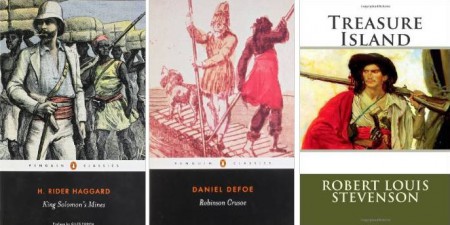
Long before Michael Crichton did so in Congo, H. Rider Haggard brought readers into the heart of Africa looking for the long lost King Solomon’s Mines in 1885. The original Indiana Jones, Allan Quartermain feared little.

Stranded on lost islands have been a of Hollywood for decades, but it was Daniel Defoe’s Robinson Crusoe that started it in 1719!

And if Robert Louis Stevenson hadn’t written Treasure Island in 1883, would countless pirate films held our fascination for so long?

These books have endured  — even after their many imitators have faded from memory — because the writers created atmospheric, detailed worlds that anyone could disappear into. Seriously, want to go on a treasure hunt across Africa and make it back? Live on an island by yourself for years and not worry about being saved? Or go on a high seas adventure and make it home for dinner?

Many books come and go. A few, though, we never forget.

adv

Categories: Books, Fiction | Tags: , , , , , , | Leave a comment

History Uncensored, Remembered

We don’t have to always look towards fiction for powerful stories. Our own history is full of them. Many of the best, and the worst, you may have never heard.

When we are taught history in schools, it is condensed into names, dates and places. Rarely do we get to know the people involved. The result is a distant, impersonal past that seems like it never happened, nor is it relevant to the present.

Nothing could be further from the truth.

In Miracles and Massacres, Glenn Beck and others have pulled 12 stories from our past (though some not so long ago). Many are obscure, yet impact us to this day. Some show triumphs of our nation, and others its failures. Some of the failures have been hidden and remain unaddressed. All of these historical events provide valuable lessons for us in government, freedom and justice.

They also put faces to dry facts. When you tell a person’s story, it connects us to them. They are no longer a faded memory, an irrelevant soul. Not all of them are pretty with happy endings. Those are often the ones we shouldn’t forget. We all have a story. Some of those stories reach out from times forgotten begging to be heard.

And sometimes, we had best stop and listen.

Categories: Books, History, Modern History | Tags: , | 1 Comment

Messing with Nature

Long before genetic engineering, or people even knew of DNA, fiction has been warning us of taking our tinkering with nature too far. Books like The Island of Doctor Moreau, Frankenstein and The Monster Men are all at least a century or more old. Yet these authors all saw the age-old hubris in man to try to “improve” on nature, for good or evil.

Some may think the hideous creations in these books will never happen. In the decades after these books were written, we saw how naive this thinking is with experimentation by the Nazis and Imperial Japanese. Since then, genetic science has made it easier…

Is some government or group making fiction fact? Unfortunately, the answer is probably.

Science is an amazing gift, created in the minds of men. Too bad some of those men turned science into a god — a religion of scientism. Others abandoned good for evil.

No wonder such books have endured for so long. We all — whether we admit to it or not — instinctively know danger lurks in the shadows.

And there must always be someone to stop it.

nat

Categories: Books, Fiction | Tags: , , | Leave a comment

Breathing in Autumn

Fall is hard to appreciate when you are younger because it always meant going back to school. Now it is the time of harvests, festivals, and the changing of the leaves if your region is so lucky. Dreadfully short, autumn is that transitional season that must be experienced before winter sets in. A few months ago I wrote how Dandelion Wine was a quintessential book of summer. Do any books do the same for autumn?

Sleepy Hollow comes to mind. Maybe partly because stories like this also preface the coming of Halloween, which is nearly smack in the middle of the season (and retailers have been reminding us of its coming since August). Hollow and those of Edgar Allan Poe are very different than what often passes as “horror” these days. Where the modern genre often tries to shock and scare, back in the day it was more psychological and creepy. Rather than being something you soon forgot, they were something to long ponder.

Perhaps the uniqueness of fall is meant to do the same: Remind us to slow down and stop and take look around us. Ponder and prepare.

See what is all around us for the very first time.

P.S. Perhaps you aren’t ready to say goodbye to summer yet. Check out Bradbury’s Farewell Summer.

f2

Categories: Books, Fiction | Tags: , , , , , , | Leave a comment

Create a free website or blog at WordPress.com.