History

1492

In 1492, Columbus sailed the ocean blue…

That little rhyme was once taught to all kids. Now, the name Columbus isn’t uttered much, and people just know the mail isn’t delivered today, the banks are closed, and they might have they day off.

However, for a historical perspective on the man who rediscovered America, check out my post from last year.

And, perhaps, we can look forward to the day that mankind rediscovers its spirit of exploration.

Categories: History, Native Americans, Uncategorized | Tags: , , , , | Leave a comment

America: Miracle or the Titanic?

So I ran across The 5000 Year Leap, subtitled A Miracle That Changed the World: Principles of Freedom 101, at a book sale. Here, in one volume, is an accessible volume on the principles that went into writing the U.S. Constitution. The chapter I opened today reads:

3rd Principle: The Most Promising Method of Securing a Virtuous and Morally Stable People is to Elect Virtuous Leaders

Isn’t that a novel idea?

Continue reading

Categories: Critical Thinking, History | Tags: , , , , , | Leave a comment

Turn Right, and Meet Me in the Lost World

In my review of travel adventure books, we have searched for Sheba and explorers of the New World. We have also disappeared into the jungles of Latin America on the trail of lost cities. Now we will return to uncovering the ancient world.

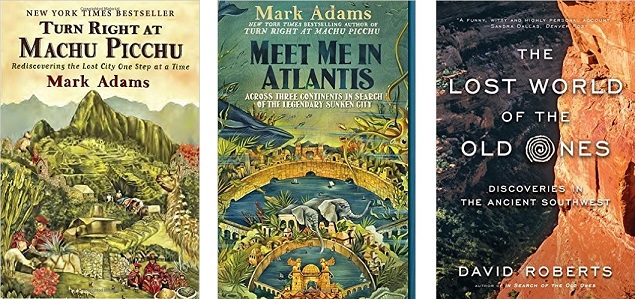
Mark Adams set a benchmark for travel adventure lit with his Turn Right at Machu Picchu. This fish-out-of-water follows the trail of legendary explorer Hiram Bingham who brought Machu Picchu, the hidden Inca mountain refuge, to the world’s attention. A perfect combination of Adams’ travails and history — every bit a page turner as a novel.

Adams followed this adventure up with Meet Me in Atlantis. Here he tries to hunt down the true experts of the legendary lost city, among a field known for, how should I put it, fringe thinkers. His hunt leads to many possibilities, and even though not as much adventuring as his first book, it is a refreshing change to the libraries full of bizarre Atlantis speculations.

Now we turn to David RobertsThe Lost World of the Old Ones where he continues his many years of hiking off-trail into the Southwest. Readers will be amazed at how much lies undiscovered and unknown about the civilizations that once populated these states. Roberts chronicles the politics, history and conflicting visions that have attempted to preserve the past — not always successfully. A fascinating and entertaining account that will remind people that United States has its own lost civilization still waiting for discovery

mcpic

Categories: Ancient America, Ancient Sites, artifacts, History, Native Americans, Prehistory | Tags: , , , , , , , , , , | Leave a comment

Turn: America’s First Spies

Less and less on television holds my attention. Repetition, little creativity and stories that don’t go anywhere. And I’m always asking myself, “Isn’t there something else I could be doing?” So, halfway through last year’s television season, I gave up on what few shows I was watching. There was one big exception, Amazon’s excellent A Man in The High Castle. Now, another gem of a find, AMC’s Turn:

Spies. Revolutionaries. War.

Where can you get this on network tv?

Categories: History | Tags: , , , , , , | Leave a comment

401 A.D.: The Year Literature Changed

Thomas Cahill, the author of How the Irish Saved Civilization, called Augustine of Hippo “almost the last great classical man — and very nearly the first medieval man.” Augustine wrote in Confessions:

I carried inside me a cut and bleeding soul, and how to get rid of it I just didn’t know. I sought every pleasure — the countryside, sports, fooling around, the peace of a garden, friends and good company, sex, reading. My soul floundered in the void — and came back upon me. For where could my heart flee from heart? Where could I escape from myself?

Cahill responds to this:

No one had every talked this way before…we realize that with Augustine human consciousness takes a quantum leap forward — and becomes self-consciousness…From this point on, true autobiography becomes possible, and so does its near relative, subjective and autobiographical fiction. Fiction had always been there…But now for the first time there glimmers the possibility of psychological fiction: the subjective story, the story of the soul…[Augustine] is the father of not only of autobiography but of the modern novel.

In Augustine’s words we find someone searching for his true purpose and — shortly before the fall of the classical age — published his 13 part classical work Confessions in 401 A.D. Yet it often sounds like it was written yesterday.

We are no better or worse than those who walked before us centuries ago. Our troubles are rarely unique to us. Those ancient voices left us plenty to ponder, to learn from and to be warned by.

Perhaps we should take the time to listen?

Categories: Books, History, Writing | Tags: , , | Leave a comment

From Arabia to the New World

Most people love some sort of fiction whether it film, television or books. Yet, there are adventures to be had in the real world amidst all of its chaos and strife. We already took a look at some fantastic travels into Latin America where the ancient world still hides. Here are some more tales of authors who went on their own adventures to explore lost histories of our past:

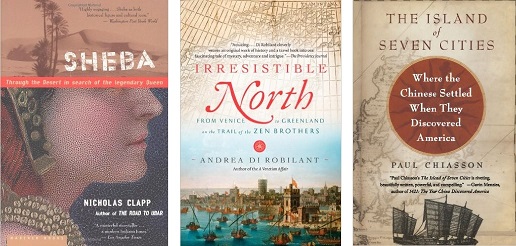
Few love stories can claim to have endured centuries, but that of Solomon and Sheba has done just that. Nicholas Clapp set out in Sheba: Through the Desert in Search of the Legendary Queen to uncover the truth to what is only briefly mentioned in biblical chronicles and some other sources. Traveling through unstable Yemen in Arabia, to ancient sites in Ethiopia and to the Jerusalem, the city of Solomon, he uncovers clues to the lost empire of Sheba that tantalize us with potentially much more hidden in the sands.

Legend has it that Venetian brother Antonio and Nicolo Zeno arrive in North America a hundred years before Columbus. Is it only a legend? Andrea di Robilant tracks them across Europe and to the fringes of the New World to uncover the truth in Irresistable North. Given a recent, new discovery of vikings, should we not take a little closer look at the Zenos?

The Zenos may not be the only ones to beat Columbus as Paul Chiasson writes in The Island of Seven Cities. Ruins on Cape Brenton in northeast Canada, not all that far from Viking sites, could be the remains of a Chinese outpost. If this wasn’t interesting enough, the Zeno brothers had mentioned encountering some sort of non-native settlement in the region. Vikings or Chinese or one of these intermixed with natives?

I’m thinking real life adventures like these beat television any day. So where do you want to go?

Categories: Ancient America, Ancient Documents, Ancient Sites, Bible, History | Tags: , , , , , , , , | 1 Comment

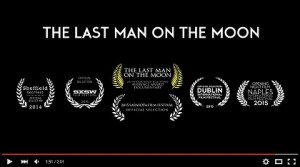
Last Man

When humans first entered the final frontier the very edge of technology was pushed to its limits. The race into space may have been driven by the Cold War, but ultimately there was something even greater behind it.

The human spirit.

That spirit has driven mankind to explore for millennia and space is no different. Every bit as dangerous as the New World, the Amazon and the Wild West, but this frontier has no bounds and is unforgiving. Unfortunately, the powers that be, quickly lost vision and returned to their myopia. In an age where technology is taken for granted, it is hard to believe this happened decades ago. It is also a reminder that we could do so much more than iPhones and smart cars.

There are some who still remain from that first wave; those who were there on the new frontier. This is the story of the last man to walk on another world:

shtv

Categories: History | Tags: , , , , , , | Leave a comment

Every Generation’s Legacy

Think not forever of yourselves, O chiefs, nor of your own generation. Think of continuing generations of our families, think of our grandchildren and of those yet unborn, whose faces are coming from beneath the ground. – Peacemaker, Founder of the Iroquois Confederacy

In all of your deliberations in the Confederate Council, in your efforts at law making, in all your official acts, self-interest shall be cast into oblivion…Look and listen for the welfare of the whole people and have always in view not only the present but also the coming generations, even those whose faces are yet beneath the surface of the ground – the unborn of the future Nation. – The Constitution of the Iroquois Nations: The Great Binding Law

There are a variety of quotes like these, often rewritten as some variation of, “In every deliberation, we must consider the impact on the seventh generation…” These quotes are often used in discussion of environmental issues, but they are a fundamental concept of foresight that should be applied to much of our thinking. This is something our politicians rarely do — they’re only concerned in what they can say or do (or appear to do) to get them through the next election cycle.

Continue reading

Categories: Critical Thinking, History, Nature, What You Can Do | Tags: , , , , , | Leave a comment

Challenger 7: 30 Years Ago

Two weeks from tomorrow, on January 28th, marks 30 years since the Challenger Disaster.

Seems so long ago, yet it is one of those days people never forget. School was out that day, probably because of bad weather, and I remember watching on television the news showing the explosion over and over.

I will never forget.

We didn’t give up on spaceflight that day, but I wish more would have seen the real promise of the Final Frontier. Instead, many in government still see it as another “get-elected-for-a-few-years” opportunity. The vision of government sees only through the next election cycle, not seven generations hence.

There are those who are far more forward in their thinking. Those who are tired of the others who have given up on the human spirit of adventure. The spirit that created pioneers, frontiersman and explorers. That spirit is in all of us, even if those in power have forgotten.

We can best remember and honor the Challenger 7, and all those astronauts who light up the sky on the National Astronaut Memorial, by looking and forging ahead.

By remembering pioneers are still needed, frontiers need explored and danger can never be eliminated.

Honor those who tried, those who failed, those who succeeded and those who gave the last full measure.

Let the future not say we gave up, forgot or ignored.

If we do, there will be no future to look back on us.

Categories: History | Tags: , , , , , , | Leave a comment

Did He or Didn’t He?

At the end of World War II the Allies splintered between East and West, and they began carving up Germany and the rest of Europe. Even as the Cold War began to develop, the Allies were rounding up and preparing to try various members of the Nazi regime. It is no secret that while they were doing this, they were also deciding which Nazis to keep for their own purposes (and others would be released early from prison in the following years). This, and the consequences and questions of ethics, have been documented in many books such as The Nazi Next Door and Operation Paperclip.

The Allies also sent investigators to verify the death of Adolf Hitler, since the remains had been burned. There have always been whispers of Hitler escaping, but I’m not one to jump quickly to join conspiracy theories. Then two things happened.

First, there has been the continuing revelations of deception regarding the protecting of many Nazis brought to the U.S., or used in Europe, to “assist” in prosecuting the Cold War. The government’s nonsensical policy of picking and choosing who to use, and who to prosecute, and to occasionally change their mind years later, is a troubling window into what certain people in power do.

Second, something stood out in these accounts of investigating Hitler’s suicide in his bunker. The investigators relied on the testimony on Nazis and evidence provide by them. Continue reading

Categories: History, Modern History | Tags: , , , , , , , | Leave a comment

Blog at WordPress.com.