
Joe Konrath makes his predictions for the publishing business in 2014. He makes many viable points about the growing indie market, though I disagree that Barnes and Noble is finished, and I detailed in a post earlier this year on how they can succeed. Have they taken up my suggestions? Not yet, but it will be interesting to see how they fared over the past few weeks with amped up advertising and as the prime bookstore chain going into the end-of-year Retail Armageddon.
Author Archives: Darrick Dean
Finding our Past, and Future, in the Jungle
Many of you have grown up with fictional characters like Indiana Jones. Swashbuckling tales of danger in search of lost cities. There was a time when such adventures weren’t the realm fiction.
In the last decades of the heyday of exploring the last wilds of the Earth, Colonel Percy Fawcett led an expedition into the Amazon to search for the fabled Lost City of Z.
He was never seen again.
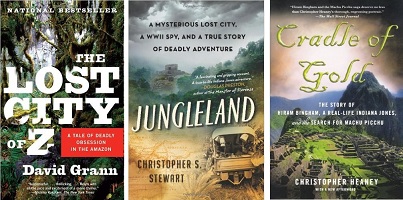
Decades of rumors of his fate ensued. Had he found the lost city? Was he living among the natives? Had he succumbed to the jungle many years before? David Grann takes us on a tour of Fawcett’s obsession in The Lost City of Z, in part by heading into the jungle himself following the footsteps of the lost explorer.
But Fawcett wasn’t the only one. Theodore Morde had claimed he had found the lost White City in Honduras. He never returned to explore his find and may have tried to obscure its location to dissuade others. Christopher S. Stewart dives into this man’s life in Jungleland. He too goes to the jungle and tries to locate Morde’s discovery and, perhaps, what haunted him to the end.
Then there was Hiram Bingham who discovered the legendary mountaintop city of Machu Picchu. This site was not lost and has become an iconic wonder of the Mesoamerican past. Christopher Heaney chronicles Bingham’s quest in Cradle of Gold. The classic journey of that era that has impacted history decades later to our time. Its forgotten history of a sprawling empire is still being revealed. And Machu Picchu has become the prime example of the need to return artifacts to their rightful nations that were acquired (not always honestly) during the age of relic hunting.
These books are windows into the bygone era of journeys into the unknown. Sometimes driven by fame or fortune, discovery or quest of knowledge, the explorers were nearly the last of their kind. Perhaps those who have left Earth into space are our only successors to them.
In any case, there are still discoveries to be made on our world; jungles that still cling to their secrets and can make men vanish in an eye blink. We are desperately in need of a generation that takes mankind’s history seriously while looking forward and are willing to explore new frontiers and push us beyond new thresholds.
Ignoring history, not seeing past tomorrow and thinking a new phone is “innovation” just doesn’t cut it.
Categories: Ancient America, Ancient Sites, Forgotten Places, Native Americans
Tags: Amazon, Christopher Heaney, Christopher S. Stewart, Cradle of Gold, David Grann, exploration, Hiram Bingham, Honduras, Incas, Jungleland, lost cities, Lost City of Z, Machu Picchu, Mesoamerica, Percy Fawcett, Peru, Theodore Morde, White City
2 Comments
Ghosts of Christmas Past
Today, being Christmas Eve and all, here are some past posts on Christmas history:
Categories: Traditions
Tags: Christmas, Christmas trees, Nativity, star of bethlehem
Leave a comment
Immerse Yourself into Middle-Earth
A few months ago in my post More Than Just a Fantasy we looked at how the fantasy genre — in particular J.R.R. Tolkien’s vision — is relevant to us in its stories and themes. In particular, Matthew Dickerson’s book A Hobbit Journey: Discovering the Enchantment of J.R.R. Tolkien’s Middle-Earth, showed us how Tolkien’s worldview was populated with many deep ideas to ponder and learn from.
With the release of the second Hobbit film, it’s a good time for Tolkien fans to once again dig deep into his mythos and what formed what has become a classic part of 20th Century literature. There is no shortage of books to peruse, but a couple stand out.
There is the before-mentioned by Dickerson, which focuses on how Tolkien’s Christian beliefs were the foundation to his writings. Tom Shippey’s The Road to Middle Earth: How J.R.R. Tolkien Created a New Mythology is the go to biography of Tolkien and exploration of his many inspirations. John Garth expands on one aspect of Tolkien’s past, his serving in World War I, in Tolkien and the Great War. The War of the Ring had some very real life parallels.
For those just looking for guides through the incredibly realized Middle-Earth, The Atlas of Middle Earth and Tolkien’s World from A to Z are indispensable guides.
If you wish Tolkien himself had written more of his creation, he did in The Children of Hurin and The Silmarillion (both completed by his son after Tolkien’s death).
To top all this off, Christopher Snyder’s new The Making of Middle-Earth covers a little bit of everything of Tolkien’s world and legacy. It’s a great place to start for all Tolkien students and fans.
Do you need these books to enjoy Tolkien’s fiction? No. Do they make you want to go back and re-read and become immersed — deeply so — into Middle-Earth like it was the first time? Yes, they certainly do.
Categories: Books, Fiction
Tags: Christopher Synder, fantasy, Hurin, J.R.R. Tolkien, John Garth, Lord of the Rings, Matthew Dickerson, Middle-Earth, The Hobbit, The Silmarillion, Tom Shippey, War of the Ring
3 Comments
The Egg Nog is In the Stores, So Christmas Must be Here!
I realize many people think Black Friday was the beginning of the Christmas season (or when stores first rolled out decorations before Halloween was over). I have been known to declare Christmas here once the egg nog starts appearing in stores. Well, it really began last Sunday — the first day of Advent. At least in large sectors of the Christian world this is when it starts and continues to January 6th (remember the 12 days of Christmas?). This is all in the background as the Retail Apocalypse gets bigger and earlier each go-around and has become Last Ditch Attempt to bail out the economy before the new year (though how much is the economy really helped with all that new personal debt?). Christmas has become so overwhelmed by all this that many people wonder — if they stop and breathe while running on the way to buy that cheap, no-name flatscreen — what happened to Christmas?
It’s a bit of dark irony that this religious holiday has become the icon of materialism and the yearly personal bailout program of retailers. No, I’m not against gift giving. I find myself trying to bail out Barnes & Noble (with my Amazon card?). Gifting has become part of the celebration of sharing love and friendship. Even the weeks of crazed frenziness add to the atmosphere. But when you wake up the day after and ask, “What happened?” and everything is over, did you ever stop to ask “Why?” or “Have I really celebrated Christmas or just become a pawn of marketers and retailers?”
I realize some people get worked up at slightest hint at questioning their Christmas motivations or methods. You’re free to do whatever you want, but I’m just asking you to think about why you do what you do. We are told that spending drives the economy. It does, but so does saving (banks invest your money, usually in items with more long-term value than toys and obsolete electronics). Writer Charles W. Sasser hit the nail on the head when he wrote:
I looked around and observed how many of my friends held eight-to-five jobs they could barely tolerate. The average American owned two cars, a house with a 30-year mortgage, a color TV set and a stack of bills on luxuries and ‘necessities’ long worn out and discarded. It seemed to me that he did not work to enrich his life. Instead, he worked to support his possessions, all the while feeling compelled to continue to buy and buy in hopes of ever new and more wonderful possessions making him happy.
Most of us, to one extent or another, have let ourselves to be dragged into this wonderful world of stuff that we let people (usually strangers) convince us we absolutely need. The rough economy has done little to remind people that this is one of the reasons that they (and the government) are in such a mess. Many churches and charities are trying to scrape together money, yet billions seem to manifest themselves during Christmas for shopping. This is all a far cry from Christmas’ origins. What other religious holiday has become so commercialized? Corrupted?
I would have thought sacred days other than Christmas would have been exploited to their fullest by now. Then again, Black Friday has been starting on Thanksgiving as of late. And I wonder why non-Christians celebrate Christmas. It would be like me celebrating Hanukkah just to get more gifts or not to feel left out. I guess we all like the “Hanukkah song” and its hard for people not to get caught up in the Christmas traditions. One can completely scrub all religious content from Christmas if they wish, and that’s fine. Still, what do people tell themselves, after all “Christ” is even in the name? Can’t get by that one.
Christians aren’t without fault here either. Really, who let one of their primary holidays spiral out of control? What other holiday is comparable in what this one has become? Yes, many Christians still try their best in all of the secularization to worship and remember what Christmas is all about. I tend to think we can all do a bit better. The issues of Christmas are only an extension of our other problems.
It brings me amusement that some groups will protest or boycott stores not saying “Merry Christmas” or for using generics like “Happy Holidays.” These things used to bother me too until I thought about these protests a bit: Basically they’re saying that we will gladly participate in the retailers’ secularization of Christmas if they would only use the right codewords.
Retailers aren’t celebrating the holidays, they are using them as tool to make money. Nothing wrong about making money, but I don’t much care about what they do so long as they aren’t purposefully attacking Christmas. Though some could argue, and with some truth, that their abuse of Christmas has gone too far. Perhaps we don’t want them to use “Christmas” in their advertising. Let them come up with something like Winter Fest or Empty Your Bank Account Month.
So maybe we should step back, take a moment and think about how we approach and celebrate Christmas and the Advent season. I like how the folks over at Advent Conspiracy approach this. They’re not saying stop buying your gifts, only remember what motivates you to buy them in the first place.
Once you do that, you will experience Christmas as intended. And some of those intentions apply whether or not you retain the day’s (or season’s) religious origins. It can be a time to reevaluate your life, put other people first and figure out where you are going.
You got over four weeks. Don’t blow it.
[This is an updated post from 2011]
Categories: Traditions
Tags: Advent, Black Friday, Christmas, debt, Happy Holidays, Merry Christmas, money, shopping, spending
Leave a comment
More than Flesh
Since the dawn of man, there have been pervasive whispers of the beyond. Much more than vague imagination, it has been innate to our existence and nearly all of our belief systems. In our enlightened age it is common to hear that this has all been in our heads. No next life. No heaven. No souls. Such things are unscientific and have been explained away. But have they?
Not quite.
No matter how skeptics have tried to disprove what they see as remnants of superstition, science has bit back. Neuroscientist Mario Beauregard marshals and impressive array of this evidence in Brain Wars and The Spiritual Brain that the mind and the physical brain and entirely two different things.
In other words, a nonphysical essence of us exists. A soul.
While Beauregard doesn’t delve into analyzing what religions say on the matter, he does show how weak the critics’ attempts to demote us to nothing but flesh. The point? Too often people take as gospel whatever the day’s headlines or the current special on the Discovery Channel proclaim as truth. Sometimes we are a bit too trusting in what “authorities” (or those who have proclaimed themselves such) tell us. Not that the majority of the world has given up their “superstition” at any rate.
Science has declared they don’t have to.
Origins
In recent years, Hollywood has tapped into the audience’s desire to see how their favorite characters came to be. In Star Trek we witnessed the coming together of the legendary starship crew. X-Men First Class unveiled the emergence of professor X, Magneto and their teams of mutants. And in Casino Royale we finally saw how Bond became 007. Film isn’t the only place that has been exploring origins. Brian Godawa has been exploring the beginnings of iconic figures from biblical accounts in his Chronicles of the Nephilim series.
First it was Noah, then Enoch. The great patriarch of religion Abraham. Now Joshua comes alive in Joshua Valiant. As in the previous books, Godawa reads between the lines and makes three-dimensional these people that we all know, whether or not one is a reader of the biblical accounts. Those accounts are known for giving us the main points, the purpose of our place in the Great Story. We can argue that this all that is needed and we’d be right, but many of us our curious and inquisitive people. What has been relayed to us are sometimes short on the details on the lives of these people. How they became who they were. Their paths that led them to where we meet up with them in the Bible.
So in this novel on the entrance of Joshua, Godawa continues to draw on what subtle details that the Bible provides, history from the era and other contemporary writings, and extrapolates into the fantasy genre with a cast of warring giants, demons and angels. But one is left wondering where does the fiction end and the history begin?
As I have said in previous reviews, it’s always best to start at the beginning with volume one of the series. You can jump in with this latest entry without much trouble, however. If you’re worried about this being “biblical fiction” that is going to sound like a sermon, put your concerns aside. This written more in the style of high fantasy and definitely not the calm, pastoral stories of children’s books (which have so colored our minds of the source material).
Before the walls of Jericho fell, there was a story to tell. Many stories, in fact. And when you compare the events of those times to the present day, you will begin to see some important parallels and one thing may come to your mind.
Has the War of the Seed begun again?
Categories: Bible, Books, Fiction, Writing
Tags: Brian Godawa, Enoch, Joshua, Nephilim, Noah
Leave a comment
Noah’s Ark Lands in Hollywood
Expensive biblical epics haven’t been a staple of Hollywood for decades, but this week saw the release of the first trailer of Noah which will hit theaters in early 2014.
Enter controversy.
Some like J.W. Wartick have written on concerns over possible “divergence from the Biblical story.” Fair enough, but I don’t have a problem with divergence, if it is in the sense Brian Godawa describes:
…there is nothing wrong with engaging in creative license, whether it is magical seeds or six-armed Watchers, or even Noah as a warrior. I don’t even think there is a problem in using non-biblical sources like the Book of Enoch or the Sumerian version of the Flood story, where unlike in the Bible, Noah receives dreams about the coming Deluge. The question is, does it support the spirit or meaning of the original story, or the original author’s intent. Bible believing Christians do not necessarily own this category of Biblical interpretation. The Bible doesn’t say what vocation Noah had before the Flood, only what he was afterward (a tiller of the soil). So if a Christian attacks the notion of Noah as a warrior shaman, he may really be illustrating his own cultural prejudice of the notion of a white bearded old farmer which is not in the Bible either…[bold mine]
However, Godawa does discuss quite a few concerns he had with an earlier draft of the script. Having only seen a brief clip of the movie, and not knowing how the script evolved or was edited, I’m not going to add or subtract from his analysis other than this: I do like how the film trailer does not depict Noah as a pastoral old man leading cute, Narnia-like animals into an ark. This Sunday School-fantasy version ignores the terror — and ultimately the point — of the account: Horrible evil is occurring in the world and mankind will be wiped out because of it. The actual story — an adult one — has been co-opted by preschoolers. Perhaps the film will spark debate on how shallow our take on Noah has become.
Hopefully, the filmmakers chose not to put modern agendas into an iconic account from the ancient world. There’s enough historical contextual sources to draw from, as Godawa does in his own novel on Noah. In a film of this budget, studios try not to be too offensive to anyone. It is a business after all. Then again, many big budget films failed in 2013.
Time will tell if Noah emerges under a rainbow or washes out.
Update [3/2/14, 3/17/14]: After continuing controversy over a film not released, Jerry A. Johnson, president of the National Religious Broadcasters (NRB), discusses Five Positive Facts and Five Negative Facts about the film. Johnson and the NRB were behind the recent press release from Paramount Pictures which states, “the feature film is a dramatization of the major scriptural themes and not a line-by-line retelling of the Bible story.”
Apparently the NRB thinks the Christian world is not intelligent enough to figure that out on their own. On the other hand, the “Sunday School-fantasy version” of Noah I discussed above that many envision in their minds is not “a line-by-line retelling of the Bible story” either.
And here, Dr. Hugh Ross looks at the biblical Noah account here and here. Or check out his new book that explores this and other issues of Genesis.
Update [4/3/14]: Here’s an interesting debate: Is Noah a Gnostic interpretation or not.
Categories: Ancient Documents, Bible, Prehistory
Tags: Anthony Hopkins, Book of Enoch, Brian Godawa, Darren Aronofsky, Deluge, Emma Watson, films, Genesis, Hollywood, Hugh Ross, Jennifer Connelly, Jerry Johnson, National Religious Broadcasters, Noah, Noah's Ark, Noah's Flood, NRB, Paramount Pictures, Russell Crowe, Watchers
Leave a comment
Darkness Rises
The following post is a rerun. Why would I repost it? Because I made subtle changes that makes this a perfect example on how a little revision can make all the difference in the world. When you write, really write, you shape and reshape every word like clay.
There has been a war raging since before man first appeared on the Earth.
A war with Evil.
But it’s not what you see on the nightly news. This is far worse.
These shadows conspire in hidden places, whispering in the dark. They wait for times to emerge and spread terror over the land. While the world’s attention is elsewhere, they plan for chaos that few could imagine. They work to unleash horrors long banished to myth.
The Dark One is very pleased most believe such things fantasy. Others know better. Those who have stood among the shadows and crushed their campaigns. Pushing back incursions of the Followers of Darkness as the world was unaware, they asked for no reward. When humanity was propelled to the abyss time and time again, a few brought them back.
Now the Darkness has grown once more. Are there still those who are as the heroes of old? Will they rise?
The time is upon us.
It will be the beginning. Or the end.
Among the Shadows, Watchers of the Light Book 1, the first in a new fantasy series, coming soon.
Categories: Books, Fiction, Writing
Tags: Among the Shadows, Darkness, fantasy, novel, Shadows, Watchers of the Light
1 Comment
Happy Hallowmas?
Autumn is often not appreciated when one is a child, because it signaled going back to school. There were a few good things like playing in the falling leaves (if you live in those regions). And, of course, Halloween. What kids don’t like dressing up as superheroes or cartoon characters (or the old standby sheet as a ghost if you’re in a pinch) and collecting candy? The popularity of Halloween waxes and wanes with time and among people, but there’s much history behind it.
Halloween is technically part of Hallowmas, a three day Christian observance consisting of All Hallows’ Eve (Halloween), All Saints’ Day (All Hallows) and All Souls’ Day. Hallowmas is a time to remember all those who have departed this world. What does “hallow” mean? It’s derived from the Old English word halig, which means saint.
Some object to Halloween because some suspect that it drew from the pagan Samhain, but the connections are debated, other than using the same day. One has to ask, though, what does it matter? Christmas trees and Easter bunnies were reappropriated from nonchristian traditions. Crosses were popular in some pagan religions. In other words, we shouldn’t make the genetic fallacy and judge something on what it once was or what others appropriate to it.
Because secular Halloween can be celebrated in a variety of ways by different people, some Christians have ceased recognizing it altogether. That’s fine, but asserting Halloween is simply a pagan or occultic festivity ignores a few centuries of Christian history (and have we all abandoned Christmas as it has turned into an economic event for businesses?). I have also suspected that some groups perceive the Hallowmas days as Roman Catholic and have as such abandoned them. This too is in error, as many Protestant denominations still recognize these observances. In particular, All Saints Day has been fairly universal in large swaths of Christendom.
Fall festivals have replaced Halloween in other circles. These are actually another universal event among peoples of all beliefs, that reach into history. The last big hurrah before winter, a time to stock up on the summer’s harvest. So if Halloween is not celebrated because pagans do, why not apply that to fall fests? There’s nothing wrong with having such events (fall is the best time to have festivals, in my opinion), but don’t do it on false reasoning. I’ve seen some festivals that try to combine everything and come across as, “We want the kids to be able to do Halloween stuff, but we’ll call it something different.” Fall fests and Halloween are entirely two different things.
Perhaps Christians should reclaim Hallowmas. It’s a sad truth that we often avoid talking about those who have died. Out of a fear of sadness we fail to teach our children about those who came before them. Histories and people lost. It doesn’t have to be that way.
In fact, that’s what Halloween is all about.
Categories: History
Tags: All Hallows' Eve, All Saints' Day, All Souls' Day, autumn, Christians, Fall Fests, Halloween, Hallowmas, holiday, Samhain, Trick or Treat
Leave a comment


 Darrick Dean