This time it is publishers of Christian fiction taking notice. Indie authors are here forcing “the industry to adapt,” going beyond the “typical guidelines used to frame the culture’s concept of Christian fiction” and not limited by “genre restrictions.” In other words, giving readers more choices.
Indie Authors Continue to Change Publishing
13 Days to Halloween
Stores had Halloween decorations as early as August, and Christmas by October. Yes, we all know how nuts that is, but this isn’t about all that. This is about Halloween and its history (largely a re-post from last year).
What kids don’t like dressing up as superheroes or cartoon characters (or the old standby sheet as a ghost if you’re in a pinch) and collecting candy? The popularity of Halloween waxes and wanes with time and among people, but there’s much history behind it.
Halloween is technically part of Hallowmas, a three day Christian observance consisting of All Hallows’ Eve (Halloween), All Saints’ Day (All Hallows) and All Souls’ Day. Hallowmas is a time to remember all those who have departed this world. What does “hallow” mean? It’s derived from the Old English word halig, which means saint.
Some Christians object to Halloween because of the suspicion that it drew from the pagan holiday Samhain, but the connections are debated, other than using the same day. One has to ask, though, what does it matter? Christmas trees and Easter bunnies were reappropriated from nonchristian traditions. Crosses were popular in some pagan religions. In other words, we shouldn’t make the genetic fallacy and judge something on what it once was or how others celebrate it.
Because secular Halloween can be celebrated in a variety of ways by different people, some Christians have ceased recognizing it altogether. That’s fine, but asserting Halloween is simply a pagan or occultic festivity ignores a few centuries of Christian history (and have we all given up on Christmas as it has turned into an economic event for businesses?). I have also suspected that some groups perceive the Hallowmas days as Roman Catholic and have as such abandoned them. This too is in error, as many Protestant denominations still recognize these observances. In particular, All Saints Day has been fairly universal in large swaths of Christendom.
Fall festivals have replaced Halloween in other circles. These are actually another universal event among peoples of all beliefs, that reach into history. The last big hurrah before winter, a time to stock up on the summer’s harvest. So if Halloween is not celebrated because it’s “pagan,” why not apply that to fall fests? There’s nothing wrong with having such events (fall is the best time to have festivals, in my opinion), but don’t do it on false reasoning. I’ve seen some festivals that try to combine everything and come across as, “We want the kids to be able to do Halloween stuff, but we’ll call it something different.” Fall fests and Halloween are entirely two different things.
Perhaps there is a reason Christians should reclaim Hallowmas, instead of ignoring it. It’s a sad truth that we often avoid talking about those who have died. Out of a fear of sadness we fail to teach our children about those who came before them. Histories and people lost. It doesn’t have to be that way.
In fact, that’s what Halloween is all about.
Not Worried About Ebola?
I am a bit baffled and disturbed, that months after the Ebola epidemic started raging across Africa, we are still letting people from those areas into the U.S. If you are not baffled or disturbed, I’m thinking you don’t understand what Ebola is.
What it is not is the flu or measles. You have the flu and cough in a room full of people, most won’t even get sick, let alone die. You have Ebola and cough in a room, many may get it (no immunities) and, well, the fatality rate puts this disease somewhere above anthrax (which doesn’t spread very easily without sophisticated help).
While I’m sure there are plenty of dedicated people working around the clock to fight this disease, the laze-fair doctrine of non-existent control of our borders and who enters the country is ripe for a deadly scourge. The open borders, by some studies, is at fault for the recent re-emergence of other disease outbreaks — though none of the killing caliber of Ebola.
Many will say, “It’s only two or three, we can handle it.” Perhaps. But two or three can infect hundreds. This isn’t the chicken pox. You don’t give your kids some lotion, wash your hands a little more often, and go about your life. No, you and everyone you have been in contact goes into isolation lock-down and those who contact the disease fight for their lives.
The only way to stop a disease like this is to take it seriously.
Books like Germs and The Dead Hand detail the insidious nature of diseases like Ebola and, while many were worried about nukes, governments tinkered with weapons some argue are worse. Lab 257 reveals that even the knowledge of what bio agents can do, we didn’t always take them seriously. These books, while focused on biowarfare, hinge on what many viruses and bacteria are capable of doing in nature and among populations (the history of biowarfare research will be eye-opening to many in a troubling sort of way). Then take a look at the movie Contagion for a realistic depiction of what a widespread outbreak could look like.
We can discount, dismiss or explain away what the politicians do or don’t do because of our political preferences. Or we can hold them all accountable to their fundamental purpose: Defending borders, whether from disease or man. Or both.
So technically, if you prepare and take precautions, you no longer have to worry (if you had been to begin with). This is a winnable battle, but decisions now will decide how costly it will be.
P.S. Many people have taken the either-or approach: Either “The media is just hyping Ebola” or “They’re under-reporting it and you need to be in a bubble.” People like to gravitate to extremes, often in emotional response to another extreme. What I am promoting here is simple: Don’t pretend Ebola is just the bad flu or some African disease, and taking simple precautions is common sense. Also, don’t be one of these people who say, “Oh, thousands die from the flu every year, so why worry about Ebola?” Other than that the “thousands” claim is a spurious stat, look at the mortality rates. Mortality rate of flu viruses: Less than 1% (effectively zero), Ebola: 70%.
Beware of Pirates
Since the World Wide Web made the Internet a button-click away from anyone, piracy (stealing) of others works has been a very easy occupation. Music downloads has been at the forefront of theft. Now, the proliferation of e-books has made books an easy target. If you don’t get what the big deal is, think of it this way: You spend weeks or months at your place of employment on a project. At completion, your company uses your work but doesn’t pay you. You’d be a bit upset and have some trouble paying the bills. Contrary to popular belief, most writers aren’t rolling in dough.
Robert Bidinotto wrote on this recently, ending with:
I hope readers tempted to download from a pirate site will pause to realize what will happen if your favorite writers finally give up, because piracy no longer makes it possible for them to write for a living. Ebooks aren’t expensive; in fact, they provide more value for their price tags than any other form of entertainment and information. Please remember that, and honor the authors who work so hard to provide you those values by purchasing their works only from authorized sites.
Take a Trip: Africa, Lost Islands, Pirate Ships
Sometimes modern readers roll their eyes at the suggestion of reading the “classics.” Can they really be better than the 1800th vampire novel? How can they compare to yet another teen-dystopian-sorta-adventure/romance novel?
Yes, there are some classics that leave one wondering who exactly voted them to those “must read before college lists.” Then there are those that have earned their title with generations of readers.
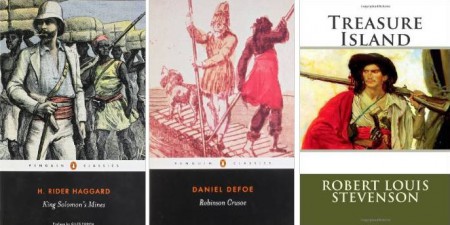
Long before Michael Crichton did so in Congo, H. Rider Haggard brought readers into the heart of Africa looking for the long lost King Solomon’s Mines in 1885. The original Indiana Jones, Allan Quartermain feared little.
Stranded on lost islands have been a of Hollywood for decades, but it was Daniel Defoe’s Robinson Crusoe that started it in 1719!
And if Robert Louis Stevenson hadn’t written Treasure Island in 1883, would countless pirate films held our fascination for so long?
These books have endured — even after their many imitators have faded from memory — because the writers created atmospheric, detailed worlds that anyone could disappear into. Seriously, want to go on a treasure hunt across Africa and make it back? Live on an island by yourself for years and not worry about being saved? Or go on a high seas adventure and make it home for dinner?
Many books come and go. A few, though, we never forget.
History Uncensored, Remembered
We don’t have to always look towards fiction for powerful stories. Our own history is full of them. Many of the best, and the worst, you may have never heard.
When we are taught history in schools, it is condensed into names, dates and places. Rarely do we get to know the people involved. The result is a distant, impersonal past that seems like it never happened, nor is it relevant to the present.
Nothing could be further from the truth.
In Miracles and Massacres, Glenn Beck and others have pulled 12 stories from our past (though some not so long ago). Many are obscure, yet impact us to this day. Some show triumphs of our nation, and others its failures. Some of the failures have been hidden and remain unaddressed. All of these historical events provide valuable lessons for us in government, freedom and justice.
They also put faces to dry facts. When you tell a person’s story, it connects us to them. They are no longer a faded memory, an irrelevant soul. Not all of them are pretty with happy endings. Those are often the ones we shouldn’t forget. We all have a story. Some of those stories reach out from times forgotten begging to be heard.
And sometimes, we had best stop and listen.
Messing with Nature
Long before genetic engineering, or people even knew of DNA, fiction has been warning us of taking our tinkering with nature too far. Books like The Island of Doctor Moreau, Frankenstein and The Monster Men are all at least a century or more old. Yet these authors all saw the age-old hubris in man to try to “improve” on nature, for good or evil.
Some may think the hideous creations in these books will never happen. In the decades after these books were written, we saw how naive this thinking is with experimentation by the Nazis and Imperial Japanese. Since then, genetic science has made it easier…
Is some government or group making fiction fact? Unfortunately, the answer is probably.
Science is an amazing gift, created in the minds of men. Too bad some of those men turned science into a god — a religion of scientism. Others abandoned good for evil.
No wonder such books have endured for so long. We all — whether we admit to it or not — instinctively know danger lurks in the shadows.
And there must always be someone to stop it.
Breathing in Autumn
Fall is hard to appreciate when you are younger because it always meant going back to school. Now it is the time of harvests, festivals, and the changing of the leaves if your region is so lucky. Dreadfully short, autumn is that transitional season that must be experienced before winter sets in. A few months ago I wrote how Dandelion Wine was a quintessential book of summer. Do any books do the same for autumn?
Sleepy Hollow comes to mind. Maybe partly because stories like this also preface the coming of Halloween, which is nearly smack in the middle of the season (and retailers have been reminding us of its coming since August). Hollow and those of Edgar Allan Poe are very different than what often passes as “horror” these days. Where the modern genre often tries to shock and scare, back in the day it was more psychological and creepy. Rather than being something you soon forgot, they were something to long ponder.
Perhaps the uniqueness of fall is meant to do the same: Remind us to slow down and stop and take look around us. Ponder and prepare.
See what is all around us for the very first time.
P.S. Perhaps you aren’t ready to say goodbye to summer yet. Check out Bradbury’s Farewell Summer.
Shannara: The Heir to Middle-Earth?
Nearly forty years ago, during a dark age where epic fantasy was hard to come by, Terry Brooks released The Sword of Shannara. In many ways, similar to The Lord of the Rings: An unaware, peaceful guy (Shea Ohmsford), happy in his own world, is tasked by a wise, mysterious stranger (Allanon) to obtain the Sword of Shannara before the Warlock Lord uses it to conquer Shannara. While some thought the plot too similar to Frodo/Gandalf/The Ring/Sauron, Tolkien’s books would ultimately establish the archtype for all fantasy that followed. And, in the following decades, Brooks would unveil his Shannara mythos in over 25 books (and it’s still going).
For those that wished Tolkien had written much more, Brooks is the perfect author. His books quickly would show their originality. Long-time readers were in for a welcome surprise when he connected them to his Word & Void series and linking high fantasy with the modern world. Since the series is made up of self-contained sequences (trilogies, duologies…), which makes it easier to pick a place to start (though Sword is still the best place). It also makes those who slogged through years of Robert Jordan’s epic one-story series, or those afraid to start, a little more at ease of taking on another never-ending fantasy. However, many Brooks fans probably wish he would go back and revisit some of his classic characters.
In the final analysis, fantasy fans will long remember Middle-Earth, Narnia and Shannara.