
Remembering American Explorers, American Heroes and the importance of the Space Frontier: 28 Years Ago Today and Fallen Heroes.
Challenger: 28 Years Later and its Legacy in Space
Categories: Modern History
Tags: Apollo 1, astronuats, Challenger, Columbia, NASA, space program, space shuttle, spaceflight
Leave a comment
Your Health in Your Hands
Yes, I normally review novels and history nonfiction here, but hey, I can deviate once and awhile on my own blog and this particular deviation concerns health (and I do mention six books below). I haven’t done any official studies or surveys, but is there a trend in recent years of people living healthier and taking control of their own health? I think there is based on growth I have seen in healthier food demands and fitness movements that focus on common sense nutrition and exercise. At the very least I hope this is what I’m seeing.
While debates rage on government intervention in healthcare, what has largely been ignored is the way we, in large measure, control our own health. Genetics plays a part, in some people more than others, but some of us tend to blame our ancestors more than we should. Our lifestyles can also exacerbate or initiate problems lurking in our genes. Truth is, many of the chronic diseases we suffer through are preventable. This has led many to turn to common sense efforts to turn the tide.
To be sure, there are many too-good-to-be-true weight loss and get healthy plans out there. Way too many. Yes, you cut out one entire food group or another or all fat or all carbs, you’ll lose weight. Will you stay that way and be healthier overall? Not always. Common sense plans focus on both nutrition and exercise and the right kinds of each. Eating healthy isn’t rice cakes and iceberg lettuce. It is eating a well-balanced intake from the food groups, learning what is a real portion, what foods we do eat too much of and what ingredients do and don’t do to our bodies.
I have found that knowledge is half the battle. If you know why something is bad for you and what it will do to you, you are much less likely to eat it. And yes, if you care about your health, you’ll have to commit some time to overcoming the learning curve. A great place to start is Eat This and Live for an accessible and simple guide to eating healthy. Top that off with You: The Owner’s Manual and You: Staying Young and your healthcare library is off to a good start.
Then there is all those workout plans. One that actually makes sense is The ABS Diet (which was designed for men and women, but they released a more women-specific version), which isn’t so much a diet as a health plan. Combining good nutrition with a fitness plan that covers all your core muscles. When many people exercise, they focus on one part of their body or one type of routine. In scientific reality, you want to work all your muscle groups. No, you don’t have to be a body builder, but strong muscles are your fat burners, even when you are asleep or sitting on the couch. You won’t see your abs by just doing sit-ups.
You must keep challenging your body or it will quickly adapt and you’ll hit a brick wall. Constantly one must keep evaluating their workouts and adjust. Once you own a pattern, it must be tweaked so it challenges again. The one weakness of the ABS Diet is it doesn’t show you how to adjust all those core exercises, many of which are perfect for doing just that. So stack with it one of the more reasonable interval programs such as the Spartacus Workout and cycle through its seven routines. The ABS Diet will fill in the nutrition and health knowledge that the Spartacus Workout doesn’t mention. Combining the two is a perfect match and you don’t need a gym or much equipment. And so you never get bored, check out Neila Rey‘s 100 Workouts all creative and free to download. Yes, I said 100 and free (though instead of printing all the workouts out, it may be cheaper to buy the bound version). Here’s someone committed to promoting good health.
If not already apparent, you should consult with healthcare professionals before you undertake a radical lifestyle change, especially if you have existing conditions. Nor do you have to implement every change overnight. Ultimately, however, we all must decide if our health is important to us. If we determine that it is, then there is a question you must ask.
What are you going to do about it and when will you start?
Categories: Books
Tags: abs diet, exercise, fitness, food, health, healthcare, Neila Rey, nutrition, Spartacus Workout, workouts
Leave a comment
C.S. Lewis, Accidental Genius
My collection of books by and about J.R.R. Tolkien and C.S. Lewis has been missing a good bio on Lewis. I have remedied that with expansive new Lewis study by Alister McGrath entitled C.S. Lewis: A Life: Eccentric Genius, Reluctant Prophet.
Released last year in time for the 50th anniversary of Lewis’ death, it is a very readable and insightful look at this influential writer-scholar who never set out to be famous. McGrath has scoured all of Lewis’ writings and letters and pieced together the Narnian’s life story from beginning to end. We see Lewis as the intelligent child trying to fit in, the soldier in WWI, the ardent atheist, the scholar who reasons to belief in God, the everyman champion of Christianity and the writer of subtle, yet complex novels. Many love his simple intellectual approach to belief (as in Mere Christianity), others can’t stand that the theology of this non-theologian wasn’t perfect (as if theirs is) or that he loved to smoke and drink. Ultimately, as this detailed biography shows, Lewis was, like us all, a very complex individual who didn’t claim perfection (or that Christianity made one so).
McGrath’s book is a study of Lewis, not his books, but through those writings McGrath looks into the mind of one of the few writers remembered decades after they have passed. His influences were many and together they left quite the legacies. For some, it was his creation of Narnia that has inspired many others (even those who didn’t like his mythos). There was his lesser known Space Trilogy (or the Ransom Trilogy, as McGrath suggests it should be known as) that showed us the dangers of scientisim and other irrational thought. His books that explored issues we all face, regardless of our beliefs, such as A Grief Observed or The Problem of Pain. Through Lewis’ many books and letters, and those who knew him, his life can be reconstructed in a way that can be accomplished for very few writers.
Indeed, it was his life that made him a writer that will be long remembered.
Categories: Books, Writing
Tags: Alister McGrath, C.S. Lewis, Chronicles of Narnia, Mere Christianity, Narnia, The Problem of Pain
1 Comment
No E.T. Here
A little aside for today: For those who still think “crop circles,” especially intricate ones, can only be explained by aliens, see this.
Of Checking Sources & Not Jumping the Gun
Awhile back, an author wrote a book on guns in the United States. He argued that history showed that the “gun culture” was a relative new phenomenon and not present in early America. The book went on to great acclaim. Many endorsements. Awards were won.
Problem was, when people actually began to check the references, little of it was true. The book was withdrawn, so were the awards. Positions lost.
This particular incident was chronicled in Armed America. Regardless on your thoughts on the relevant issue (guns), that is besides the point for our purposes. What should be clear is as a writer doing research, or just as a citizen, don’t assume everything you read or hear is true, no matter how well it’s footnoted or couched in sophisticated words.
Too often we gravitate to only what confirms what we think is true. Rarely do we actually confirm or seek out other views. We let emotion drive our thinking and, in all reality, end up doing no thinking at all.
“There are two ways to be fooled. One is to believe what isn’t true; the other is to refuse to believe what is true,” said Søren Kierkegaard. We can avoid this trap if we just train ourselves to stop, take a deep breath and dig a little deeper.
Ultimately, it’s about deciding to think like an adult.
Categories: Books, Critical Thinking, Writing
Tags: Armed America, clear thinking, reason, references, Soren Kierkegaard, sources
Leave a comment
Should you Flashback?
Writers are often told to do this, don’t do that. Then someone comes along and tells them the opposite. One thing they are often told not to use are flashbacks. Author and publisher Jeff Gerke writes in The First 50 Pages:
But if your whole purpose for doing a flashback is to reveal backstory, it’s de facto telling. You’re still stopping the story (the main, present-day story) to explain something, and it’s probably something the reader doesn’t care about…Avoid flashbacks if you can.
I would normally agree. Flashbacks are often poorly used. In recent years, however, film and television have showed us how to seamlessly use flashbacks in storytelling. We owe much of that to Lost.
Flashbacks revealing the pasts of characters were integral to Lost‘s writing. The premise behind the technique was that we rarely ever start with a character at birth and see their whole life. We nearly always start in situ somewhere in their timeline.
Ever read a scene that is obviously trying to show something about a character that comes across forced? There’s often enough going on in the current story that the backstory will get the shaft or feel out of place. Flashbacks can solve this if — and pay attention to this if — they are fluid and seamless. The reader clearly knows, or soon will know, the time has changed. It must feel like the story hasn’t stopped or slowed. Your reader shouldn’t be jarred. Visually, on television, this is all a bit easier. Do you need to preface a flashback with a notation such as “6 years ago…” If you have to do that, the scene is probably not seamless enough or you’re not showing enough in your story. If you do that well, then trust your readers. Don’t be like films that subtitle “Washington, D.C.” over a shot of the Mall and its monuments.
So like many techniques, flashbacks can be done right or wrong. See how television has done it right so you won’t do it wrong.
Categories: Books, Writing
Tags: editing, flashbacks, Jeff Gerke, Lost, publishing, Revolution, writing techniques
1 Comment
A Mercifully Short 2013 ‘Best of’ List
I’m tired of all the Best of 2013 lists, but here is one more. Maybe it was just me, but there seemed to be yet another overload of films released this year. I was thoroughly underwhelmed by most of them. Sure, a lot of okay films for a few hours of amusement, but nothing I’ll watch again. So my list of favorites is rather short:
The Hobbit: The Desolation of Smaug
Star Trek Into Darkness
Man of Steel
Oblivion
I’m not going to go into drawn out reviews of these. Maybe I’ll do a Hobbit review, which I had intended to write. It would be positive look at the film, so given its success, it probably doesn’t need my comments anyway.
Why no “artsy” films? Because most of them try too hard and are not really that good. If people have to spend countless hours and words convincing you it’s great, chances are it isn’t. Reminds me how Star Wars (not artsy in the traditional artsy sense, but it is art) fans have spent three decades telling everyone how The Empire Strikes Back is the best of those films. Well, maybe it isn’t the best if you have to try that hard. Doesn’t mean it’s bad either.
In any case, how many films (or the books they come from) will you remember a couple months later? People have been reading The Hobbit since 1937. So maybe there is something a little deeper in all that orc-killing? If you really want something a little different than big budget spectacle, don’t miss my Indie Film Fest.
Categories: Uncategorized
Tags: 2013, box office, DVDs, films, Hobbit, motino pictures, movies, Oblivion, Star Trek
Leave a comment
Outlining Your Stories to Life
One tool writers like to debate the value of is outlining. The argument against outlining states it’s too restrictive and doesn’t allow the story to breathe. The pro-outliners write that the anti-outliners are still stuck in that rigid outlining method learned in the 5th grade. I think the latter is correct.
Yes, there are a (very) few people who can just start writing and end up somewhere great and not worry about dead ends, corners or poor endings. What outlining is not is a rigid, blow-by-blow plan of every detail of a book. In a shorter work like a short story or article, okay, an outline can be more detailed. For a novel, think of it as a roadmap with the best places to visit.
I take the storyboard approach, which, I suspect, is not original to me (Morgan Busse talks about storyboarding in a recent post). I even taped a long roll of paper on the wall initially, though this proved a bit problematic referring back to. I soon transferred it all to a notebook. In this storyboard, I put the main events I see occurring (or “set pieces”) in their approximate locations (and this must always include the beginning and end). Then this is followed with a sprinkling of other events, people and details throughout. Then the writing begins, sort of like connecting the dots.
In front of you there is a path, but you are uncertain of what is going to occur along the way. You do know where you want to end up. Just like using a roadmap, you don’t always know what will happen between point A and B and that’s where the fun begins.
Most writers are quickly surprised that their story will take on a life all its own when carving out these paths. New characters show up that weren’t planned. Locations that weren’t on the original map. C.S. Lewis wrote how Narnia “all began with a picture of a Faun carrying an umbrella and parcels in a snowy wood.” Then “Aslan came bounding into it” pulling the rest of the story behind him. I think that is what he was talking about, the moment a story writes itself. The instant in time the author knows they are onto something big.
It all starts with a handful of ideas and characters in the mind’s eye of an author waiting to given life. Outlining may help you do just that, but in either case, nothing will happen if you don’t start writing.
Categories: Books, Fiction, Writing
Tags: Aslan, C.S. Lewis, Narnia, novels, outlining, plotting, set pieces, storyboard
1 Comment
Finding our Past, and Future, in the Jungle
Many of you have grown up with fictional characters like Indiana Jones. Swashbuckling tales of danger in search of lost cities. There was a time when such adventures weren’t the realm fiction.
In the last decades of the heyday of exploring the last wilds of the Earth, Colonel Percy Fawcett led an expedition into the Amazon to search for the fabled Lost City of Z.
He was never seen again.
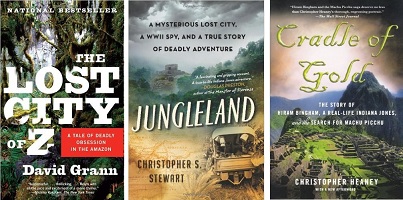
Decades of rumors of his fate ensued. Had he found the lost city? Was he living among the natives? Had he succumbed to the jungle many years before? David Grann takes us on a tour of Fawcett’s obsession in The Lost City of Z, in part by heading into the jungle himself following the footsteps of the lost explorer.
But Fawcett wasn’t the only one. Theodore Morde had claimed he had found the lost White City in Honduras. He never returned to explore his find and may have tried to obscure its location to dissuade others. Christopher S. Stewart dives into this man’s life in Jungleland. He too goes to the jungle and tries to locate Morde’s discovery and, perhaps, what haunted him to the end.
Then there was Hiram Bingham who discovered the legendary mountaintop city of Machu Picchu. This site was not lost and has become an iconic wonder of the Mesoamerican past. Christopher Heaney chronicles Bingham’s quest in Cradle of Gold. The classic journey of that era that has impacted history decades later to our time. Its forgotten history of a sprawling empire is still being revealed. And Machu Picchu has become the prime example of the need to return artifacts to their rightful nations that were acquired (not always honestly) during the age of relic hunting.
These books are windows into the bygone era of journeys into the unknown. Sometimes driven by fame or fortune, discovery or quest of knowledge, the explorers were nearly the last of their kind. Perhaps those who have left Earth into space are our only successors to them.
In any case, there are still discoveries to be made on our world; jungles that still cling to their secrets and can make men vanish in an eye blink. We are desperately in need of a generation that takes mankind’s history seriously while looking forward and are willing to explore new frontiers and push us beyond new thresholds.
Ignoring history, not seeing past tomorrow and thinking a new phone is “innovation” just doesn’t cut it.
Categories: Ancient America, Ancient Sites, Forgotten Places, Native Americans
Tags: Amazon, Christopher Heaney, Christopher S. Stewart, Cradle of Gold, David Grann, exploration, Hiram Bingham, Honduras, Incas, Jungleland, lost cities, Lost City of Z, Machu Picchu, Mesoamerica, Percy Fawcett, Peru, Theodore Morde, White City
2 Comments


