Brian Godawa continues his instructional series with How to Market Your Self-Published Novel. Don’t let the title mislead you, however. Regardless of how you publish your novel, much of the marketing is up to the author. Until you earn the auto-selling reputation of a Tom Clancy or J.R.R. Tolkien, an author’s effort at marketing their book is critical. Many new authors are surprised at this, expecting book ads and radio spots, but such things have become the exception rather than the rule. The quantity of books being published also makes it impossible for every new book to receive the red carpet treatment. So once that book is done, your work isn’t.
Detecting Nonsense
In 1988, Stephen Hawking’s runaway bestseller A Brief History of Time made history in making astrophysics accessible to everyone. Relativity, black holes and multi-dimensional physics were no longer some ivory tower subject. He would follow the book up with others, but none had the same effect. Then came the The Grand Design in 2010 which claimed science had banished God. In the process, the eminent scientist apparently left the world of science and entered scientism. Oxford mathematician John C. Lennox details this fall in God and Stephen Hawking.
Hawking begins his argument by claiming philosophy is dead and suggesting science is the root of all knowledge – itself a philosophical statement. Other scientists before him – like Carl Sagan and Richard Dawkins – have also fallen into this trap. So enamored by the promise and power and science, they have made it a religion. Ironic for professing atheists. Nevertheless, Hawking also seems now very willing to abandon science.
Lennox goes into much more detail, but Hawking contradicts himself in “asserting that the universe is created from nothing and from something – not a very promising start.” Then he says the universe creates itself. Then gravity somehow explains the universe’s existence as if it was a Creator. Lennox concludes, “…the main conclusion of the book turns out not simply to be a self-contradiction…but to be a triple self-contradiction.”
It appears that Hawking, so bent to justify his belief in no God, has abandoned his previously astute scientific understanding no matter how ridiculous. His “science” and reasoning in this latest book has been criticized by many. To be fair, this scientism of his and other scientist “celebrities” like him, has been challenged by even those who share his beliefs on God. All belief systems have those who tumble into irrationality. And as Lennox writes, “What this all goes to show is that nonsense remains nonsense, even when talked by world-famous scientists.”
So what’s the point? We shouldn’t be taking claims from “authorities” blindly. In today’s 24/7 news cycle especially, where sound bites take the place of true discussion, we need not be quick to nod our heads in agreement. Whether scientists, politicians or “experts,” we need to think, reason and test. Even authorities err, experts disagree and much ado can be made about nothing. Hawking’s earlier books are still some of the best. But this one? It’s a shame that Hawking has abandoned the science he once championed, but it serves as a lesson for all of us.
Nonsense is constantly trying to overwhelm us, but we don’t have to let it win.
Self-Publishing vs. Legacy Publishing
Be an Explorer. Yes You.
A few posts ago, I mentioned some of the activities you should be engaging in before summer vanishes and you start complaining about the cold. They revolved around activities outside. That’s right, outside, as in not in a buiilding.
Even in the great outdoors, we can’t seem to leave our electronics home. It wasn’t that long ago where if you said you were going camping for the week, that’s the last anyone heard from you for a couple days. Now you’re expected to blog, text, tweet, call and face time every step of the way. There is hope for us.
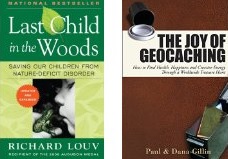
Richard Louv expertly argued in his books Last Child in the Woods and The Nature Principle the importance of nature in our lives. While technology has often improved our lives, it can be an impediment, especially through the “entertainment” it brings with it. So it’s with certain irony that geocaching has brought tech to the woods and let millions become explorers again.
In the old days, you would use a compass and map to engage in the sport of orienteering. Find hidden caches or capture the opponent’s flag, it could be quite the weekend adventure. Then came GPS and someone said, “Let’s hide stuff in the woods and others can try to find it with their GPS.” Years – and millions of hides and finds later – geocaching continues to grow. In spite of that, it lives a strange existence of many still not knowing about it, to being almost a secret society to others.
Paul and Dana Gillin chronicle the sport in their book The Joy of Geocaching. They write how it dovetails with many other outdoor hobbies, is an inexpensive way to spend time with friends and family, brings enthusiasts together from all walks of life, among other points. Perhaps most importantly, geocaching appeals to the “restless and inquisitive” and as one geocacher wrote that he found, “most caches were placed in these out-of-the-way places. It’s not what the tourism office thinks you should see; it’s what people in the community think you should see.”
Indeed, many parks and communities have embraced geocaching, while some government entities (no surprise here) have seen it has something to ban or regulate. I once had a cache in a very scenic, but oft forgotten, corner of a state park. Over the years, many of the cache finders commented on how they didn’t know about the place so close to home or had forgotten it. But apparently increased business on tax-payer funded lands didn’t sit well with the parks and they made it harder for caches to be put in place. Most were pulled out.
Regardless of such irrationality, geocaching still a perfect way to ignite the explorer in all of us. You can armchair it all you want in front of the tube, but that will never be the same as putting on your Indy hat, lacing up your boots and heading out the door. Even if it’s just discovering what you have been missing in your own community, it’s like discovering a lost world.
The Space Age has put the power to explore in your hands. What are you waiting for?
Final Fight Against Evil in the Lands
I first started reviewing Morgan L. Busse‘s Follower of the Word trilogy back in 2012. Now, it concludes with Heir of Hope in what is a final encounter between good and evil.
The story thus far has followed Rowen Mar, a young woman whose power to see into the darkness of others made her an outcast. Former assassin Caleb Tala has forsaken his past, but must come to terms with who he is as well. The Lands have been plagued by the Shadonae, those like Rowen and Caleb who chose darkness and the shadows that they conjure. In this volume, we see the reluctant heroes continuing to learn who they are, question what they can do and come to the edge of a final confrontation.
It is focus on a small group of characters that drives these stories forward. Sure, there is action as in all fantasy tales, but here that is not front and center. Readers will never be bored and at this point they can’t wait to learn what happens to those that they have followed from one danger to another. Sadly, this is the conclusion of the tale, but maybe Busse will return to it someday. The ending surely hints to that possibility.
The fantasy genre is full of stories on the timeless struggle between good and evil. It is the staple of much fiction and is revealed in our own world on a daily basis. The Follower of the Word is no exception. And yet so many seem to be blind to the battle.
Perhaps books like these will remind people to recognize evil, see its true nature, stand up to it and show how they can defeat it.
Pluto Reminds Us to Awaken
A U.S. spacecraft named New Horizons arrived at Pluto today after a 9 year, 3 billion mile journey. Some may ask why bother? What’s the point?
It’s sad that many have taken such a small view of humanity. Instead, small incremental changes are seen as breakthroughs. We allow government, societies and anyone with a lot of money to define us, tell us what to do and how far we can go.
The truth is, if New Horizons and other achievements like it were the norm, we’d live in a much different world. The wonders of the future wouldn’t always be 50 years distant. Imagine fusion reactors fed by Helium-3 from the Moon. Asteroids with uncountable mineral resources. Regular space travel not limited to a few or science fiction. These aren’t dreams, but are realities long within our grasp. Instead, we let those with no vision, who only see tomorrow and do what it takes to hang onto power until then, decide what is best.
Pluto may be a small world, with little impact on our own, but it is in our Solar System. Exploring this region of space – our region of space – is in us as much as the drive that explored every corner of our planet, above it and on our Moon. William E. Burrows explained this in his book Exploring Space that chronicled the first wave of robot explorers, envoys that preceded the people that have or will follow:
…the core motivation for human beings to venture where the can, and to send robotic proxies where they cannot, is as sublimated but as real and ultimately unerring as the one that guides snow geese, salmon and other migrators on their own immense journeys. It is a reason that transcends reason. We go because of a profound urge to leave our imprint on the universe…That is why we explore. The treasure invested in long voyages of high adventure could be arguably spent [elsewhere]…but ultimately the imperative to merely survive…is not the most admirable of goals. Greatness is achieved not by putting out fires but by creating monuments to humanity’s full capacity for enterprise, imagination and courage. Certainly these include, as they always have, setting courses that lead straight into the heart of the unknown.
In other words, setting our sights so low, following those with no vision, will lead us nowhere we want to be. We need to dare ourselves again. Awake the fires that we are born with. Science can’t do it all, it is not a religion or God. Our free will to do great things has a dark side as well. So we could just give up and let others decide our fate, or we can believe, as Dr. Franklin Storm states in the new Fantastic Four film:
It is our duty as human beings to push forward into the unknown…
Your Soul-Library
Why read books? Here’s one reason, from John Eldredge:
Certain stories come into your life, and because of the way they come, or the timing of the moment, or because of what they speak to you when they do arrive, they become a part of your soul-library—books that both shape and reflect who you are as a man.
Does the newspaper do that? Your favorite films? Binge-watching your favorite show? There’s a reason books endure over generations and why so many are written.
They are someone’s Story, ready to become part of yours.
Start a Revolution
Been reading through The Great Influenza, an account of the deadliest disease outbreak in human history. You may be thinking, “Well, that’s not very exciting,” but you would also be wrong. A well-written history book reads like a novel and tells its story against the backdrop of the times and through the eyes of the people.
One of the threads therein is the state of medicine at the turn of the 20th Century. It was terrible. Technology had advanced in industry and society. In a few short years, mankind would go from riding horses to cars and airplanes (and, unfortunately, WWI, would soon introduce things like tanks, chemical warfare, strategic bombing…). Medicine, though, was largely primitive and anyone could be a doctor. Not everyone was willing to let that status quo continue. They had foresight and vision. It wouldn’t be easy, but they would push for the change. It would take more than slogans and hope. They joined together and decided they would “precipitate a revolution.”
When is the last time we have had a threshold-crossing advance? We think a new Kindle or iPhone is a big deal, yet it is still doing what a computer 30 years ago did. Sure, ours are faster, smaller and have some cool features. At the end of the day, they are still just computers. Incremental change versus revolutionary.
Fusion energy always 50 years away. Space travel mired for decades with occasional bursts of greatness. Governments that stand in the way of true advancement. Have we lost our vision? Our nerve? In spite of our love of sci-fi, who really can see into the future and its potential? Or do too many people think we have it all figured out?
Robert Zubrin, in Entering Space, wrote on societies who thought they had reached the pinnacle, only to become static in their self-satisfaction. They knew everything, had done everything. Dead cultures they would become.
There is a line in Star Trek where Christopher Pike challenges Jim Kirk to not just be another cog in the machine:
You can settle for a less than ordinary life, or do you feel like you were meant for something better? …I dare you to do better.
Dare yourself.
What’s on Your List?
What’s on tap for your summer reading? Not that summer has any more time for relaxation, but you’ll need something for the beach. Here’s the first three on my list:
Shift is volume 2 of Hugh Howey‘s Silo Saga. The first book was a record-breaking bestseller in sci-fi’s dystopian/apocalyptic subgenre (yes, there is a difference between the two, but there is overlap as well). Part 2 promises to fill in the history prior to Wool.
…robots smaller than human cells [created] to make medical diagnoses, conduct repairs, and even self-propagate…A simple pill, it had been discovered, could wipe out the memory of any traumatic event. At almost the same moment in humanity’s broad history, mankind had discovered the means for bringing about its utter downfall. And the ability to forget it ever happened.
Heir of Hope concludes Morgan Busse‘s Follower of the Word fantasy trilogy. This series gave me hope that there is still a lot of great fantasy stories to be told and I look forward to seeing how the series concludes (and probably will wish Ms. Busse will continue it someday).
The great city of Thyra has fallen and shadows spread across the land. Rowen Mar, the last Truthsayer, is taken before the Shadonae. But the Shadonae are not who she thought they were, and now they want to claim her as their own.
The Name of the Wind the first in a trilogy by Patrick Rothfuss, has been much-talked about in the fantasy world. Only a few pages in and the book has my attention (always a good sign).
…a young man who grows to be the most notorious magician his world has ever seen. From his childhood in a troupe of traveling players, to years spent as a near-feral orphan in a crime-ridden city, to his daringly brazen yet successful bid to enter a legendary school of magic…
Everyone Lost Yesterday
Many upset, others happy. Some don’t care.
The truth is that everyone lost.
We’ve allowed the Supreme Court to (once again) step outside its power. The Constitution instructs it to determine the constitutionality of laws, not write them. The Constitution does not speak on marriage — does not list it as a “right” — so the court shouldn’t have even heard the case — if they were following the law. They could have argued that since marriage for many is a religious ceremony, defined by religious beliefs, that the government has no business meddling with it (as the First Amendment forbids).
The Constitution was written to define and limit the federal government’s power, not engage in social engineering. “Marriage equality” is a nice-sounding catchphrase (and an obfuscating one), but it’s not the government’s job, or right, to define what that means. Giving them the power to do so was a mistake. Letting a small group of unelected judges to do it is even worse.
Why? Because any time the views of the politicians and their judges change — and they change like the wind — they can redefine marriage or anything else at will. The people, over 300 million, have ceded their democratic control to a tiny minority of people in Washington.
This should trouble everyone, regardless of what you think of the Supreme Court’s decision. It doesn’t matter if you are Democrat or Republican, liberal or conservative, or of any other politics, philosophy or religion.
You all lost. We all did.
We let emotion supersede reason and the law be ignored. We have given power to the few — the very reason we created this nation was to not have that dangerous situation. Notice that the dissenting judges didn’t base their decision on opposition to “marriage equality,” but on what the Constitution does or does not state. Wrote Justice Samuel Alito:
…not what States should do about same-sex marriage but whether the Constitution answers that question for them. It does not. The Constitution leaves that question to be decided by the people of each State. The opinion in these cases is the furthest extension in fact – and the furthest extension one can even imagine – of the Court’s claimed power to create “liberties” that the Constitution and its Amendments neglect to mention. This practice of constitutional revision by an unelected committee of nine, always accompanied (as it is today) by extravagant praise of liberty, robs the People of the most important liberty they asserted in the Declaration of Independence and won in the Revolution of 1776: the freedom to govern themselves.
So I guess if you think a couple of politician-appointed judges are needed to sanction or bless your beliefs, and unconstitutionally redefine the law in the process, then yesterday was a good day.
Most people, when they stop to think about it, probably want to decide for themselves and for the government to follow the rule of law.
When the law becomes an option, we are all in danger.